

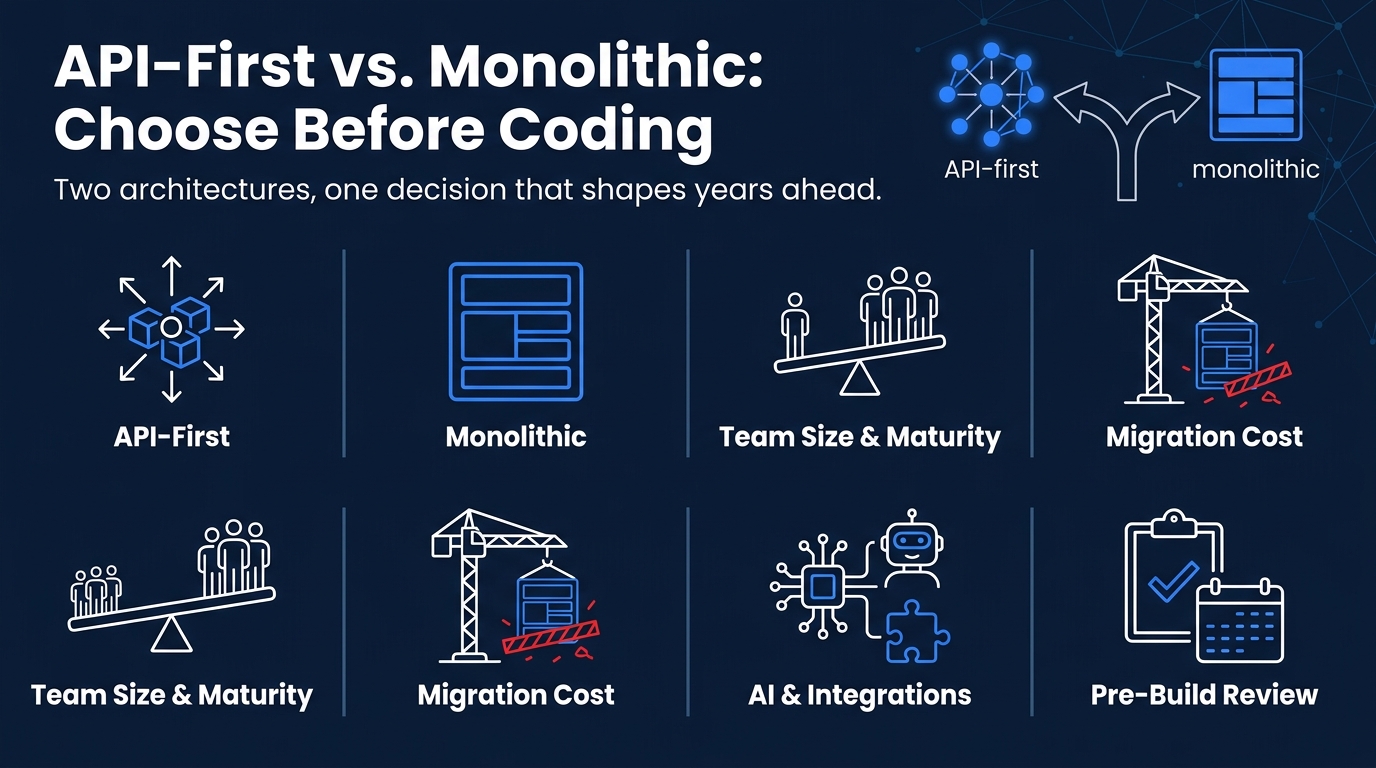
For mid-market SaaS companies, the architecture decision made before a single line of code is written shapes every delivery timeline, hiring plan, and scaling cost for years. API-first development treats APIs as the primary building blocks of an application, designed and agreed upon before implementation begins. Monolithic architecture bundles all application logic into a single, unified codebase that is deployed as one unit. Neither is universally correct. The right answer depends on team size, product maturity, integration requirements, and the speed at which the business expects to scale. What experienced Vietnam software teams bring to this conversation is not a formula, but a structured method for reaching the right answer before the first sprint begins.
TL;DR
API-first architecture positions APIs as the foundation of the software system, enabling parallel development and easier third-party integration.
Monolithic architecture has lower initial complexity and allows early-stage products to move faster without distributed systems overhead.
The decision has downstream consequences for team structure, DevOps maturity, and scaling costs, making pre-build architecture consulting critical.
Vietnam software development companies like 724SOFTWARE provide software architecture consulting services that combine senior engineering depth with cost efficiency: Vietnam-based delivery at 40-60% lower fully-loaded cost than Singapore, US, or UK onshore hiring without quality tradeoff.
AI tooling (Claude, Cursor, Gemini) integrated into the SDLC accelerates architecture documentation, API contract drafting, and code generation by approximately 30%.
About the Author: 724SOFTWARE is a Vietnam-based software engineering company with 200+ professionals, 58% of whom are senior-level experts. The company has delivered across Fintech, SaaS, Edtech, and ERP verticals for clients in Singapore, Australia, Hong Kong, the US, and the UK, including API-first trading platforms, AI-powered education products, and large-scale ERP implementations.
What Does "API-First" Actually Mean in a Production SaaS Context?
API-first development means the API contract is written, reviewed, and agreed upon before backend or frontend code is produced. The application is designed around the API rather than the API being added later as an afterthought to connect existing components. This distinction is more consequential than it sounds.
In practice, API-first means:
Frontend, backend, and mobile teams can develop in parallel against a shared contract
Third-party integrations and partner ecosystems are built in from day one
The product is naturally positioned to support AI agents, which interact with software by calling API endpoints rather than navigating user interfaces
For SaaS companies in 2026, this last point is growing in importance. Products that expose clean, well-documented APIs are easier to embed into automated workflows and AI-orchestrated pipelines than products built around tightly coupled UI logic.
When Does a Monolithic Architecture Still Make Sense?
Building on the API-first case above, the harder question is when NOT to use it. Monolithic architecture remains the right choice under specific, identifiable conditions. A monolith bundles all application layers into a single deployable unit, which reduces operational overhead at early stages and allows a small team to move fast without distributed systems complexity.
Monoliths are defensible when:
Condition | Why Monolith Works
|
|---|---|
Team is under 10 engineers | Coordination costs of microservices exceed the benefits |
Product is pre-product/market fit | Rapid iteration beats architectural purity |
Integrations are minimal and internal | API contracts add design overhead without matching return |
Budget constrains DevOps investment | Microservices require container orchestration, CI/CD pipelines, and observability tooling |
Domain boundaries are not yet understood | Premature service decomposition creates the wrong boundaries |
Netflix, Amazon, and Shopify all began as monoliths and migrated outward as load and team scale demanded it. For mid-market SaaS companies with 20-100 employees, a well-structured monolith with clean internal module boundaries is often the more practical starting architecture.
What Are the Real Costs of Getting This Decision Wrong?
A monolithic to microservices migration is one of the most expensive and disruptive technical programs a SaaS company can undertake mid-flight. The engineering cost is not simply rewriting services; it includes redefining data ownership, rebuilding deployment pipelines, retraining teams, and managing the dual-run period where both architectures are live simultaneously.
The risks of a premature microservices decision include:
Distributed systems complexity without the team depth to manage it
Latency and data consistency issues that did not exist in the monolith
Debugging difficulty multiplied across service boundaries
Hiring gaps: microservices require DevOps, SRE, and platform engineering skills that are expensive to source onshore
Conversely, starting monolithic when API-first was correct has its own costs: retrofitting external API contracts onto internal business logic is technically possible but produces inconsistent, difficult-to-maintain interfaces. The point is that both errors are recoverable but expensive. The right software architecture consulting services front-load this analysis before any scaffolding is committed.
How Do Vietnam Software Teams Approach Architecture Consulting Before Build?
Stepping back from the technical detail, a separate concern is what the engagement model for architecture consulting actually looks like in practice. Vietnam software development companies with senior engineering depth run architecture consulting as a structured pre-build phase, not as a sales activity attached to a development contract.
At 724SOFTWARE, this typically involves:
Domain mapping: identifying bounded contexts and integration surface area
Team topology review: matching architecture to the actual team size and DevOps maturity at hand
API contract drafting: producing OpenAPI specifications with stakeholder sign-off before development starts
Build vs. buy analysis: evaluating whether an existing market API or custom-built API better serves the core service requirement
Migration path planning: for companies already running a monolith, sequencing which services to extract first based on business risk and team capacity
Using Claude and Cursor inside the architecture and early development workflow delivers measurable returns. API documentation, contract generation, and code scaffolding accelerate by approximately 30%. As an official partner with both Anthropic (Claude) and Cursor, 724SOFTWARE integrates these tools into the SDLC systematically, not experimentally.
Why Does the Location of Your Engineering Team Matter for This Decision?
A related but distinct question is whether offshore Vietnam software teams are actually equipped to lead architecture decisions, or whether they are better used for implementation after onshore architects have decided.
The honest answer is that it depends on seniority density. With 58% of its engineers at senior level, 724SOFTWARE is structured to lead architecture conversations, not just receive specifications. The team has delivered API-first, microservices-based platforms in capital markets (Algo724, SHS Derivatives), AI education (Novalearn), and consumer scale (Higher, with 500,000+ downloads), where architecture choices had direct consequences on latency, compliance, and throughput.
The cost structure is also relevant without framing it as a price-only advantage. Engaging a Vietnam software team for software architecture consulting services delivers the same senior engineering perspective as Singapore or US onshore hiring while reducing fully-loaded cost by 40-60%. For mid-market SaaS companies managing engineering budgets carefully, this makes a pre-build architecture investment financially accessible rather than a luxury reserved for well-funded series B companies.
Frequently Asked Questions
What is the core difference between API-first and monolithic architecture?
API-first designs the API contract before implementation and treats it as the primary interface between system components. Monolithic architecture packages all logic into one deployable unit without enforced interface boundaries.
When should a SaaS startup choose monolithic architecture?
When the team is small (under 10 engineers), the domain is not yet fully understood, and speed of iteration matters more than scalability. A well-structured monolith is easier to refactor later than a prematurely decomposed microservices system.
What triggers a monolithic to microservices migration?
Typical triggers include performance bottlenecks isolated to one domain, team growth requiring independent deployment autonomy, or specific compliance requirements that demand service isolation.
How long does a pre-build architecture review take?
Duration depends on product complexity and integration surface area. Focused engagements for mid-market SaaS products typically run two to four weeks.
Does API-first support AI agent integration?
Yes. AI agents interact with software by calling API endpoints, not navigating user interfaces. Products built API-first are structurally ready for AI-orchestrated workflows from day one.
What certifications should a software architecture consulting partner carry?
For SaaS companies handling user data, look for ISO 27001:2022 and SOC 2 Type II. These certifications confirm that the partner's own development and delivery processes meet auditable security standards. 724SOFTWARE holds ISO 9001, ISO 27001:2022, SOC 2 Type II, and GDPR compliance.
Can a Vietnam software team scale up after the architecture phase is complete?
Yes. 724SOFTWARE can scale from a consulting-phase team to a full dedicated build team of 1 to 50+ pre-vetted engineers within 2 to 4 weeks, which means there is no handoff gap between the architecture decision and execution.
About 724SOFTWARE
724SOFTWARE is a Vietnam-based technology company and long-term engineering partner for mid-market SaaS companies, Fintech businesses, and enterprises across Singapore, Australia, the US, the UK, and the broader APAC region. With 200+ professionals (58% senior-level), ISO 9001, ISO 27001:2022, SOC 2 Type II certifications, a 95% client retention rate, and official partnerships with Claude (Anthropic) and Cursor, the company delivers software architecture consulting, dedicated engineering teams, and full-cycle product development. Delivery teams scale from 1 to 50+ engineers in 2 to 4 weeks, with 24/7 support and a guaranteed incident response time under 10 minutes.
Ready to get the architecture decision right before writing line one? Talk to the engineering team at 724SOFTWARE about a structured pre-build architecture review.