

When evaluating an offshore software partner, most procurement checklists focus on certifications, tech stacks, and hourly rates. They skip the number that predicts everything else: engineer attrition rate. A vendor's annual turnover figure tells you whether the team assigned to your product will remain stable over a multi-year engagement. High attrition means repeated team disruption, slower delivery, and compounding replacement costs that rarely appear in a contract. Low attrition signals a stable engineering culture and is one of the strongest predictors of long-term delivery quality.
TL;DR
Engineer turnover at an offshore vendor directly affects your product's continuity, velocity, and security posture.
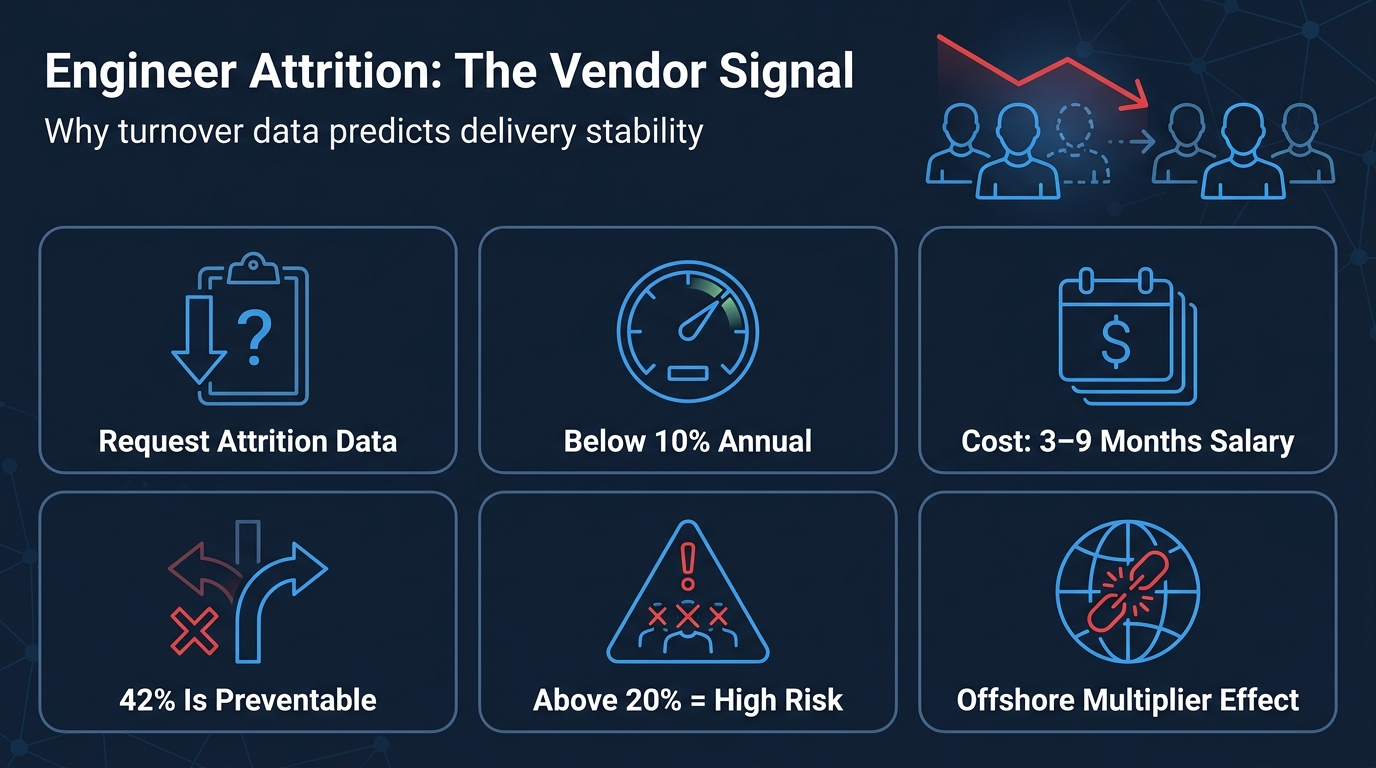
Replacing one engineer costs an estimated three to nine months of that engineer's salary in productivity loss and ramp-up time.
A healthy attrition rate for knowledge-work industries sits below 10% annually ; the average across software engineering in 2025 was approximately 12% .
42% of employee turnover is preventable, meaning a vendor's attrition rate reflects deliberate cultural and compensation choices, not just market forces .
Always ask for attrition data broken down by seniority level, not just company-wide averages.
About the Author: This article is written by the team at 724SOFTWARE, a Vietnam-based engineering partner with a 95% client retention rate and a documented track record of maintaining stable, low-attrition teams across fintech, healthcare, and enterprise ERP engagements spanning 10+ countries.
Why Does Engineer Attrition Hurt Offshore Engagements More Than In-House Teams?
Attrition is costly in any context, but the damage multiplies in an offshore model because the knowledge gap is harder to close across time zones and organizational boundaries.
When an in-house engineer leaves, institutional knowledge departs but remains accessible within the same city, culture, and professional network. When an offshore engineer leaves mid-engagement, your team loses context about your codebase, your business domain, your stakeholder preferences, and your undocumented architectural decisions simultaneously. The replacement engineer is typically in a different country, onboarding remotely, and starting from documentation that is never fully complete.
The financial math is sobering. Research estimates that replacing one employee costs between three and nine months of their salary in lost productivity, recruiting, and ramp-up time. For technical roles specifically, that replacement cost can reach 80% of annual salary. In a dedicated offshore team of eight engineers, even two departures per year at that rate represents a material hidden cost that never appears on your vendor invoice.
The compounding effect matters too. Each departure resets team continuity, slows the remaining team during knowledge transfer, and introduces defect risk during the handover period.
What Attrition Rate Is "Acceptable" for a Software Engineering Vendor
Definition: Attrition rate is the percentage of employees who leave an organization over a given period (typically 12 months), calculated as departures divided by average headcount, multiplied by 100.
Benchmarks vary by industry and role type. For knowledge-work industries, rates below 10% are generally considered healthy. A healthy attrition rate for software engineering specifically sits between 5% and 10% annually. The average engineering attrition rate in 2025 sat at approximately 12%, meaning a vendor at or below that figure is performing at or above the market median. Rates exceeding 20% signal structural problems: compensation misalignment, poor management, or a culture that treats engineers as interchangeable resources.
Attrition Rate | Signal
|
|---|---|
Below 10% | Healthy; reflects stable culture and competitive retention |
10-15% | Acceptable; monitor trends and ask for root-cause data |
15-20% | Elevated; request seniority-level breakdown and retention initiatives |
Above 20% | High risk; frequent team disruption and delivery instability likely |
One important nuance: ask for attrition broken down by seniority. A vendor might report a company-wide rate of 9% while quietly losing senior engineers at 18% and replacing them with junior hires. That pattern erodes delivery quality even as the headline number looks clean.
What Does Attrition Tell You That Other Vendor Metrics Don't?
Building on the cost analysis above, attrition is distinct from most vendor metrics because it is a lagging indicator of culture and a leading indicator of delivery risk simultaneously.
Certifications like ISO 27001:2022 or SOC 2 Type II confirm that a vendor has documented processes and controls. They say nothing about whether the engineers who know your system will still be there in Q3. Portfolio case studies show capability at a point in time. They don't reveal whether those teams stayed together or dispersed after project close.
Attrition rate answers a different question: does this organization retain the people who carry institutional knowledge?
Consider what 42% of all turnover being preventable actually means. It means that a vendor with high attrition has, at least partially, chosen it through compensation decisions, promotion structures, management quality, or work culture. High attrition is not simply a market condition that happens to vendors; it reflects deliberate or neglected choices. That matters when you are assessing a partner for a multi-year engagement.
A related but distinct question is whether attrition affects your team specifically or the vendor's bench. In a dedicated team model, your engineers are named individuals. Their retention rate is your delivery continuity. Ask explicitly: "What is the attrition rate for engineers placed on dedicated client accounts?" That figure is more predictive of your experience than the company-wide average.
How Should You Request and Evaluate Attrition Data from a Vendor?
Stepping back from the benchmarks, the practical challenge is that most vendors will not proactively surface unflattering turnover data. Here is a structured approach to getting usable information:
Questions to ask directly:
- What is your annual attrition rate for the last two years, broken down by seniority level?
- What is the average tenure of engineers on your dedicated client teams?
- What percentage of engineers on active client accounts were replaced in the last 12 months?
- What are your three most common reasons for voluntary departure?
What strong answers look like:
- Specific numbers, not ranges or deflections
- Breakdown by seniority (not just company-wide)
- Honest acknowledgment of departure reasons with corresponding retention initiatives
- Reference to compensation benchmarks, career progression frameworks, and long-term team stability
Red flags to watch for:
- "Our attrition is very low" without a number attached
- Company-wide figures only, no seniority or role breakdown
- Resistance to sharing the data or reframing toward other metrics
- High rates justified entirely by "market conditions" with no retention response
Frequently Asked Questions
What is a good attrition rate for an offshore software vendor?
Below 10% annually is considered healthy for knowledge-work and software engineering roles. Rates above 20% suggest structural retention problems that will affect your delivery.
How much does engineer turnover actually cost?
Replacing a single engineer typically costs between three and nine months of their salary in productivity loss and ramp-up. For senior technical roles, replacement costs can reach 80% of annual salary.
Is some attrition normal and acceptable?
Yes. Natural attrition through retirement or role transitions is expected. The concern is voluntary turnover driven by dissatisfaction, which research suggests accounts for 42% of all turnover and is largely preventable.
Should I ask for attrition data before or after reviewing portfolios?
Ask for it before. Portfolio reviews confirm past capability. Attrition data predicts whether you can rely on the same capability being available to your engagement going forward.
Does attrition matter less in a project-based engagement than a dedicated team?
It matters differently, not less. In a project model, high attrition mid-delivery causes team disruption at the most critical stages. In a dedicated team model, it directly disrupts your ongoing operations.
Can a vendor hide attrition problems behind subcontracting?
Yes. Ask specifically whether your dedicated team will consist of the vendor's direct employees or subcontractors, and request attrition data for each group separately.
How does 724SOFTWARE perform on attrition?
724SOFTWARE maintains a 95% client retention rate and operates under a dedicated team model designed to keep engineers on long-term client accounts. With career progression frameworks and compensation aligned to regional competitiveness, the company prioritizes engineer tenure on client deliverables.
About 724SOFTWARE
724SOFTWARE is a Vietnam-based technology partner serving mid-sized B2B product companies, SaaS platforms, and enterprises across Singapore, Australia, the US, and the UK. With 200+ professionals (58% senior-level), ISO 9001 and ISO 27001:2022 certifications, SOC 2 Type II and GDPR compliance, and a dedicated team model that scales from 1 to 50+ pre-vetted engineers within 2 to 4 weeks, the company is built for long-term delivery rather than one-off engagements. A 95% client retention rate and an incident response commitment under 10 minutes reflect the same operational discipline that keeps attrition low and delivery consistent. As an official partner with Claude (Anthropic) and Cursor, 724SOFTWARE also integrates practical AI tooling directly into the software delivery lifecycle, accelerating delivery by approximately 30%.
If you want to evaluate an offshore partner with full transparency into team stability, seniority composition, and retention practices, start the conversation at https://724software.com.vn.