

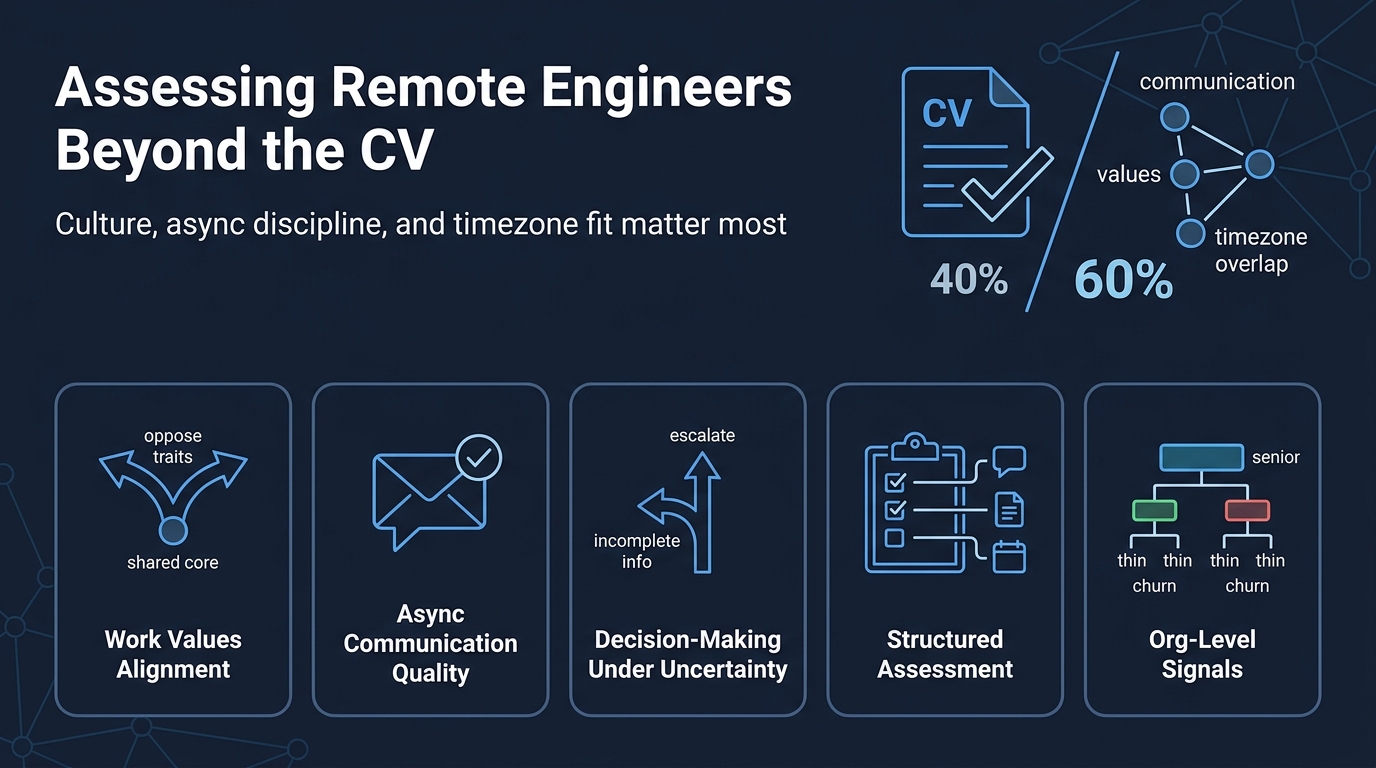
When building a remote engineering team across timezones, the CV tells you roughly 40% of what you need to know. The rest depends on how an engineer handles ambiguity, communicates without real-time feedback, and aligns with your team's working rhythm. For companies evaluating an offshore development team or a Vietnam IT company as a long-term delivery partner, getting this assessment right separates productive multi-year collaborations from frustrating, high-turnover engagements.
TL;DR
Technical skills are table stakes. Cultural fit, async communication habits, and timezone discipline are the harder variables that determine whether a remote team actually delivers.
"Cultural fit" assessment must be structured to avoid similarity bias, which can quietly exclude strong candidates.
Practical evaluation tools include async work samples, values-based structured interviews, and trial sprints - not gut-feel conversations.
When assessing an offshore development team, evaluate the partner organisation's culture and processes, not just individual engineers.
Long-term retention is the real ROI metric: teams that fit well stay longer, reduce onboarding costs, and compound in delivery quality.
About the Author: 724SOFTWARE is a Vietnam-based technology company that has built and operated dedicated engineering teams for clients across Singapore, Australia, the US, and the UK for over a decade. With a 95% client retention rate and delivery experience spanning 10+ countries, the company's perspective on remote team assessment comes from direct, repeated practice.
Why Do Technical CVs Fail to Predict Remote Team Success?
Technical CVs are optimised for past roles, not future working conditions. A candidate's GitHub profile, tech stack, and years of experience say nothing about how they respond to a Slack message at 9 PM their time, how they document a decision made without a manager in the room, or how they push back constructively on a product brief they disagree with.
Research consistently shows that cultural alignment, more than skill level alone, predicts long-term retention. Candidates who feel aligned with an organisation's values stay longer, reducing the compounding cost of turnover: recruitment, onboarding, lost context, and team disruption.
The challenge for cross-timezone hiring is that "culture" is harder to decode remotely. You cannot observe informal behaviour in a shared office. Everything must be surfaced deliberately, through structured assessment.
What Does "Cultural Fit" Actually Mean in a Remote Engineering Context?
Cultural fit is not about finding engineers who share your hobbies or educational background. That version of cultural fit is actually a bias risk. In a remote engineering context, cultural fit means alignment on three practical dimensions:
Work values: Does the candidate value autonomy over direction, or structured process over fluid experimentation? Neither is wrong, but a mismatch with your team's operating style creates friction.
Communication norms: Does the engineer write clearly, proactively, and with appropriate detail when no one is watching? Async communication quality is a direct proxy for remote culture fit.
Decision-making style: Can they operate with partial information and escalate intelligently, rather than blocking progress while waiting for a synchronous meeting?
Before you can assess these dimensions in a candidate, your organisation needs to articulate its own answers to these questions. Teams that cannot define their own culture cannot screen for alignment to it.
How Should You Structure Interviews to Reveal Culture Fit Without Bias?
Unstructured interviews reliably surface similarity bias: interviewers score candidates higher when they perceive shared backgrounds, communication styles, or social references. This is a particular risk when a Singapore or US-based hiring manager interviews a Vietnam-based engineer across both a language and cultural gap.
Structured interviews with pre-defined, values-based questions close this gap. Practical approaches include:
Behavioural questions anchored to work values: "Describe a time you disagreed with a technical decision made by a senior colleague. What did you do?" This surfaces both communication style and psychological safety norms.
Scenario-based questions for async discipline: "You are blocked on a task at 4 PM your time, and your client's team won't be online for eight hours. Walk me through what you do." There is a right answer structure here: document the blocker, attempt resolution independently, flag proactively. Candidates who default to "I wait" are a yellow flag for distributed teams.
Values alignment questions: Present your company's actual working principles and ask the candidate to reflect on where they align and where they would find it challenging. Candidates who engage honestly with the tension are often stronger fits than those who claim perfect alignment.
A separate but related concern is panel composition. Including team members from the actual delivery team, not just HR or senior management, surfaces cultural signals that a formal interview cannot.
What Practical Tools Assess Async Discipline Before a Hire Is Made?
Beyond interviews, the most reliable signal of async discipline is a structured work sample under async conditions. This means:
Async task completion: Send the candidate a technical brief by email. Set a 48-hour window. Assess not just the output quality but the communication during the window: did they ask a clarifying question in writing? Did they flag a blocker or just deliver something incomplete?
Written communication sample: Ask for a short written explanation of a technical concept relevant to your stack. Evaluate clarity, structure, and whether the writing is self-contained (a reader should not need to ask follow-up questions to understand it).
Trial sprint: For senior hires, a paid short-term project is one of the most reliable culture and discipline assessments available. It removes the interview performance variable entirely.
AI tools are increasingly used to analyse patterns in candidate communication, including writing clarity, response structure, and consistency of tone across interactions. These can supplement human review, but the human judgment on values alignment remains essential.
How Does Assessing an Offshore Partner Differ From Assessing Individual Candidates?
When you engage a Vietnam IT company or an offshore development team, you are not just hiring individuals. You are inheriting a delivery organisation with its own culture, processes, communication standards, and retention policies. The individual engineers on your team reflect the environment that produced them.
This shifts the assessment criteria. Key questions to ask a potential offshore partner include:
Assessment Area | What to Look For
|
|---|---|
Attrition and retention | Low attrition signals cultural stability; high churn means context loss |
Onboarding process | Structured onboarding indicates process maturity, not ad hoc placement |
Communication standards | Does the partner organisation have documented async protocols? |
Senior-to-junior ratio | Higher senior ratios mean stronger internal mentoring and code quality |
Client transparency | Billing based on actual hours? Direct access to team health metrics? |
724SOFTWARE's dedicated team model is built around these organisational-level signals: 58% of its engineering team is senior-level, attrition is structurally low due to stable working policies, and clients have direct visibility into delivery performance. When a client in Singapore or Sydney is evaluating a remote team in Vietnam, they are evaluating the organisation as much as the individuals.
Frequently Asked Questions
Is cultural fit assessment legally risky?
Yes, if it is unstructured. Assessing "vibe" or "personality" without defined criteria creates discrimination risk. Structured, values-based assessment tied to documented work behaviours is the defensible approach.
How many interview rounds are appropriate for a remote engineering hire?
Three to four touchpoints is typical: a values screen, a technical assessment, a structured behavioural interview, and ideally an async work sample. More than five rounds signals process dysfunction and loses strong candidates.
Can AI tools replace human judgment in cultural fit assessment?
No. AI tools can surface patterns in communication and flag inconsistencies, but values alignment requires human interpretation. Use AI to augment the process, not automate the decision.
What is the biggest mistake companies make when assessing offshore teams?
Focusing exclusively on individual technical skills during the interview phase, and ignoring the organisational factors (attrition, onboarding quality, senior density) that determine whether those individuals will still be on the team in 18 months.
How do you assess timezone discipline specifically?
Run a structured async scenario during the interview process. Evaluate how the candidate communicates across a simulated time gap. Self-reported discipline is a weak signal; demonstrated behaviour is a strong one.
About 724SOFTWARE
724SOFTWARE is a Vietnam-based technology company delivering dedicated engineering teams, custom software development, and managed IT services to clients across Singapore, Australia, the United States, and the United Kingdom. With 200+ professionals (58% senior-level), a 95% client retention rate, and delivery experience across 10+ countries, 724SOFTWARE operates as a long-term technology partner rather than a transactional project vendor. The company holds ISO 9001, ISO 27001:2022, and SOC 2 Type II certifications, and is an official partner with Claude (Anthropic) and Cursor, applying generative AI tools directly inside the software delivery lifecycle to accelerate delivery by approximately 30%.
If you are evaluating how to build or scale a remote engineering team in 2026 and want a partner with documented processes for cultural alignment, async delivery, and transparent team management, visit 724SOFTWARE at https://724software.com.vn to start the conversation.