

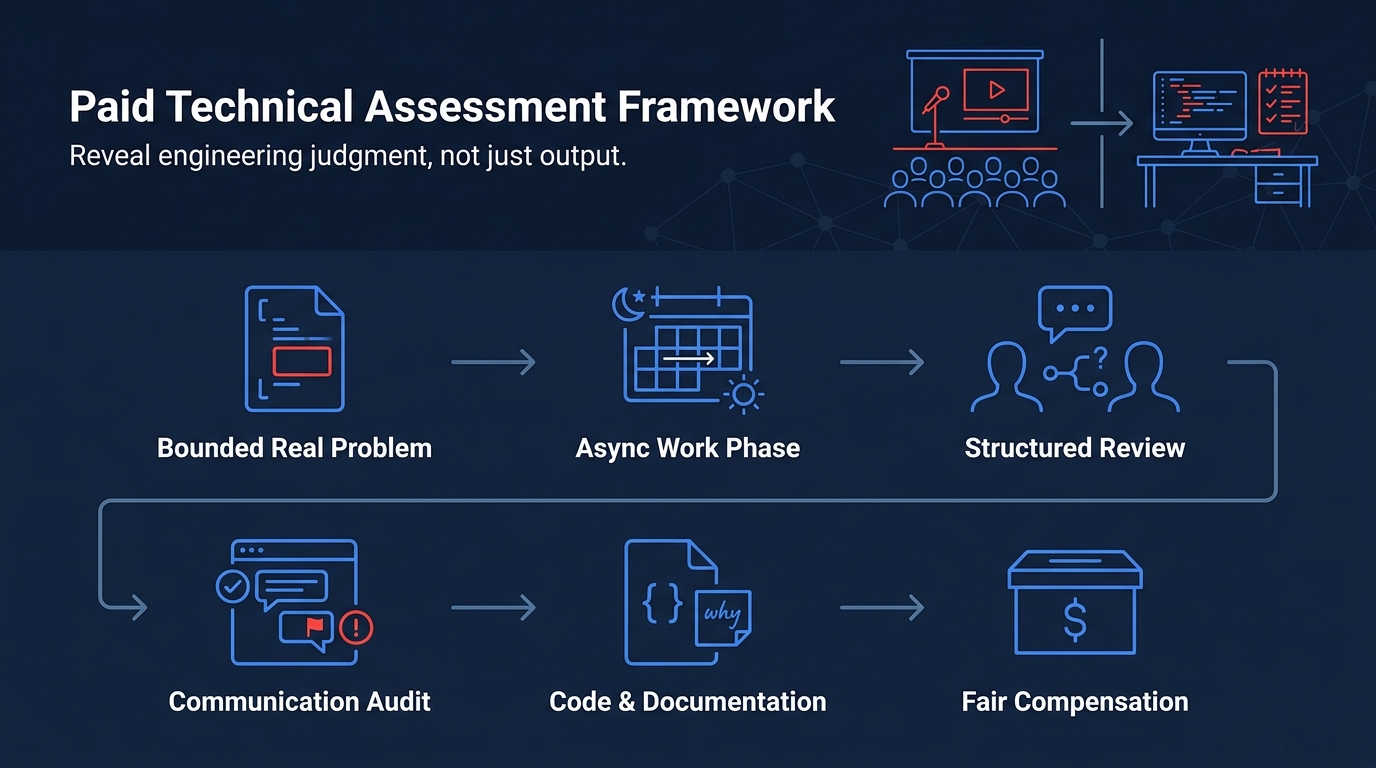
A paid technical assessment with an offshore Vietnam team should do one thing well: show you how engineers think under real constraints, not how they perform in a rehearsed demo. The most useful assessments are scoped to a bounded problem from your actual codebase, paid fairly, time-boxed to 3-5 days, and evaluated against explicit criteria that go beyond "does it compile." Done correctly, this process gives you signal on architecture judgment, communication habits, and code quality before you commit to a long-term engagement.
TL;DR
Free demos reveal polish; paid assessments reveal judgment. Pay for the work.
Scope the task to a real, bounded problem from your stack, not a generic LeetCode challenge.
Evaluate the review conversation as carefully as the code submission itself.
Pair the technical output with process signals: async communication quality, deadline transparency, question-asking behavior.
A Vietnam software development company with senior engineers (58%+ at senior level, in 724SOFTWARE's case) will engage substantively with design-level feedback during review.
About the Author: 724SOFTWARE is a Vietnam-based technology partner with 200+ professionals and delivery experience across 10+ countries, including long-term engagements in Fintech, Edtech, and Enterprise ERP. The company has been assessed and hired under the conditions described in this article, and has run its own structured pre-placement evaluations for clients scaling dedicated engineering teams.
Why Do Free Demos Fail to Predict Engineering Quality?
Free demos are optimized for optics. An offshore team presenting a polished prototype has every incentive to hide complexity, hardcode edge cases, and rehearse the happy path. You see what they want you to see.
Paid assessments change the incentive structure entirely. When you pay for the work, the team treats it as a real delivery obligation. They document decisions, ask clarifying questions, and handle ambiguity the way they would on an actual sprint. That behavior is the data you need.
The second problem with demos is that they test output, not process. A trading platform or healthcare integration fails at the seams: unclear requirements, missed edge cases, timezone handoffs that break context. A paid assessment exposes exactly those seams.
What Kind of Problem Should You Give Them?
This is where most assessments fail. Generic algorithmic puzzles (reverse a linked list, implement a binary search tree) test computer science fundamentals, not the engineering judgment you actually need.
Instead, extract a bounded, real problem from your codebase:
A data-model decision: "We have this existing schema. We need to add multi-currency support. Design the migration path."
A refactoring task: "This service has cyclomatic complexity that is breaking our test coverage. Refactor it with a plan we can execute incrementally."
An integration spike: "We need to connect this third-party API. Write the adapter and document the failure modes you'd handle in production."
The key attributes of a good assessment problem:
- Solvable in 3-5 days at part-time effort (10-15 hours)
- Ambiguous enough to require judgment calls
- Close enough to your actual stack to reveal real fit
- Specific enough that a weak submission is obviously weak
If you are evaluating a Vietnam software development company for a long-term dedicated team, the problem should reflect the domain complexity you expect them to own. A Fintech team should touch event consistency or transaction safety. A Healthcare team should encounter a compliance-adjacent design choice.
How Do You Structure the Review to Reveal Engineering Judgment?
Submitting code is the beginning of the evaluation, not the end. The review session is where engineering judgment emerges through substantive discussion of tradeoffs and design decisions.
Run a structured review session with these components:
Decision walkthrough (20 min): Ask the engineer to walk through 2-3 specific decisions they made. Not "explain your code" but "why did you choose this pattern over X?"
Deliberate challenge (15 min): Push back on one decision with a reasonable counter-argument. Watch whether they defend reflexively or engage with the tradeoff.
Scope extension (10 min): Add one requirement they could not have anticipated. This tests adaptability under pressure.
Async communication audit: Before the review, re-read every message they sent during the assessment. Did they ask useful clarifying questions? Did they flag a blocker proactively? Did they communicate a delay before it became a problem?
That last point is underrated. Async communication quality in a paid assessment is a direct predictor of what daily collaboration will look like across timezones.
What Does a Strong Submission Actually Look Like?
Strong submissions from experienced offshore engineers share a consistent pattern:
Dimension | Weak Signal | Strong Signal
|
|---|---|---|
Code structure | Monolithic, no separation of concerns | Modular with clear boundaries and rationale documented |
Error handling | Happy path only | Explicit handling of failure modes with reasoning |
Documentation | Inline comments on obvious lines | ADR-style notes explaining why, not what |
Test coverage | None or superficial | Tests that cover the edge cases they identified |
Scope management | Scope creep or gold plating | Explicit note on what was descoped and why |
Communication | Silent until submission | Proactive questions and progress checkpoints |
The documentation pattern is particularly revealing. An engineer who writes a short note explaining "I chose eventual consistency here because strict consistency would require distributed transactions that are out of scope for this assessment, but I flagged this as a production risk" is showing you exactly the kind of judgment that prevents expensive architectural mistakes later.
How Should You Handle Compensation and IP?
Pay a flat fee for the assessment. The amount matters less than the signal it sends: this is real work and you respect the engineer's time. A typical range is a few hundred US dollars for a 3-5 day scoped problem, though the exact figure depends on seniority and scope.
On IP: use a problem that is either synthetic (inspired by your stack but not drawn directly from proprietary code) or explicitly licensed to the team for evaluation purposes. Do not use a paid assessment as free labor to solve a real production problem. Beyond the ethical issue, it produces bad signal because the team will optimize for solving your problem rather than demonstrating their process.
At 724SOFTWARE, pre-placement evaluations for dedicated team candidates follow this structure before engineers are presented to clients. This means clients engaging a Vietnam software team through our ODC model are not running the assessment cold; they are validating engineers who have already passed internal process screening.
Frequently Asked Questions
Should the assessment be synchronous or async?
Primarily async, with one synchronous review session at the end. Async work tests how they operate under the actual conditions of offshore collaboration.
How many engineers should complete the assessment?
Evaluate 2-3 finalists, not the entire pool. Running more than 3 assessments simultaneously dilutes your review bandwidth and produces noisy comparisons.
What if the submission is technically correct but poorly documented?
Treat poor documentation as a serious flag, not a minor deduction. Documentation quality predicts collaboration quality on a distributed team.
Can AI tools be used during the assessment?
Yes, and you should allow it. Restricting AI tools produces an artificial signal. What you want to see is how the engineer uses tools like Cursor or Claude judiciously, not whether they can work without them.
How long should the full process take?
From problem brief to hiring decision: 2-3 weeks. Longer than that and you lose candidates to competing offers.
What if the team asks for more time?
How they ask matters as much as the request itself. A proactive "we've hit X constraint, here is our plan, can we have 24 additional hours" is a positive signal. Silence followed by a late submission is not.
How do you scale this process for multiple roles?
Standardize the problem bank by role type (backend, full-stack, DevOps) and use a shared scoring rubric. This lets you compare submissions across candidates without anchoring on the first submission you reviewed.
About 724SOFTWARE
724SOFTWARE is a Vietnam-based technology partner serving startups, SaaS companies, and enterprises across Singapore, Australia, the US, and the UK. With 200+ professionals (58% senior-level), ISO 27001:2022, SOC 2 Type II, and GDPR compliance, and a 95% client retention rate, the company builds and operates long-term dedicated engineering teams that scale from 1 to 50+ pre-vetted engineers in 2-4 weeks. As an official partner with Claude (Anthropic) and Cursor, 724SOFTWARE integrates practical AI tooling into the delivery process to accelerate software development cycles by approximately 30%. Delivery experience spans Fintech, Digital Healthcare, Edtech, and Enterprise ERP across more than 10 countries.
If you are evaluating a Vietnam software development company for a dedicated team or ODC model and want to discuss how 724SOFTWARE structures pre-placement assessments and onboarding, visit https://724software.com.vn to start the conversation.