

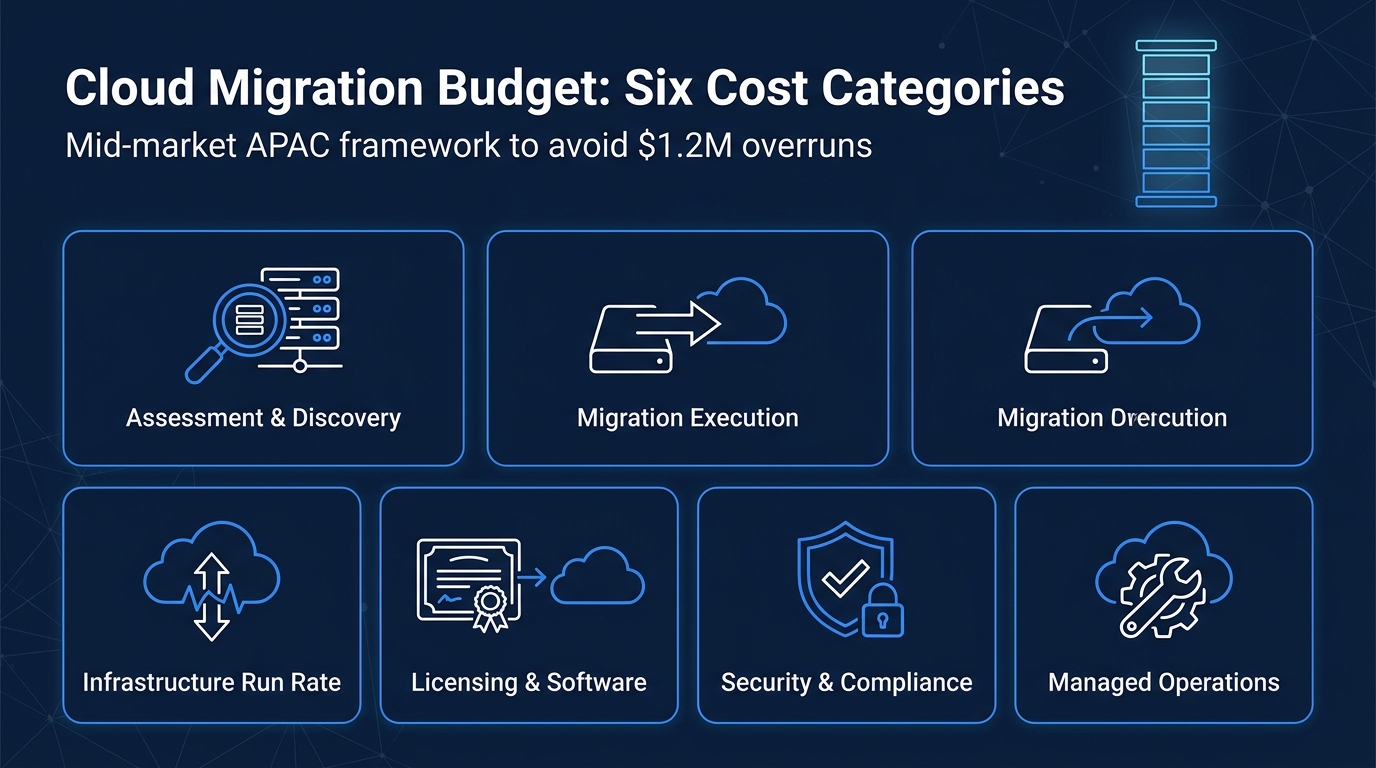
Cloud migration cost estimation is the process of forecasting every expenditure involved in moving workloads, data, and applications from on-premises or legacy infrastructure to cloud platforms. For mid-market enterprises across APAC, a credible estimate covers six distinct cost categories: assessment and discovery, migration execution, cloud infrastructure run rates, licensing, security and compliance, and ongoing managed support. Miss any one category and your budget will not hold.
TL;DR
Cloud migration budgets for mid-market workloads range from roughly $20,000 for small scopes to well over $1 million for complex enterprise environments.
A poorly planned migration costs enterprises an average of $1.2 million in overruns alone proper line-by-line estimation is not optional.
Six cost categories must be estimated independently: assessment, execution, infrastructure run rate, licensing, security/compliance, and managed cloud migration services post-go-live.
The global cloud migration services market is valued at $11.84 billion in 2026 and growing at a steady pace through 2033, meaning pricing and tooling will keep shifting.
Accurate estimation requires treating migration as an ongoing program, not a one-time project.
About the Author: 724SOFTWARE is a Vietnam-based technology company with delivery experience across 10+ countries and a dedicated practice in cloud migration, legacy modernization, and managed cloud services for mid-market enterprises in the APAC region.
Why Do Mid-Market APAC Enterprises Consistently Underestimate Cloud Migration Costs?
The root cause of most budget overruns is treating migration as a lift-and-shift exercise rather than a program of work. The average enterprise overspend on a poorly planned migration reaches $1.2 million, not because cloud is expensive, but because the hidden work is never scoped.
Common gaps in initial estimates include:
Data egress and transfer fees: Often excluded from vendor quotes but significant at scale.
Application refactoring: Discovered mid-migration when legacy code does not run in a cloud-native environment.
Parallel running costs: Old infrastructure cannot be decommissioned until the new environment is validated, so both run simultaneously.
Staff retraining: Engineers need time to develop cloud operations skills; that time has a cost.
Compliance re-certification: Regulated industries (Fintech, Healthcare) may need to re-validate controls after moving workloads.
The global cloud migration services market sits at $11.84 billion in 2026 which means there is no shortage of vendors willing to quote a number. The risk is accepting a quote that covers only the execution phase while leaving the five other cost categories unaddressed.
What Are the Six Line-Item Categories Every CTO Must Budget?
Building on the pattern of underestimation above, the practical solution is to break the estimate into six independent buckets and price each one before summing them.
Category 1: Assessment and Discovery
Definition: The work required to inventory current state, map dependencies, and produce a migration plan.
Application dependency mapping
Security posture baseline
Cloud readiness scoring per workload
Total Cost of Ownership (TCO) modeling
Typical scope: 2 to 6 weeks depending on estate size. This is an investment, not overhead -- discovery errors compound in every subsequent phase.
Category 2: Migration Execution
Definition: The labour and tooling cost to actually move workloads.
Rehosting (lift-and-shift): lowest labour cost, limited cloud benefit
Replatforming: moderate refactoring to use managed services
Refactoring/re-architecting: highest cost, highest long-term ROI
For mid-market workloads, total migration execution costs range from $20,000 for small, well-documented environments to multi-million-dollar programs for complex enterprise estates.
Category 3: Cloud Infrastructure Run Rate
Definition: The ongoing monthly spend on compute, storage, networking, and managed database services after go-live.
This is where most budgets drift. Right-sizing decisions made during migration directly determine the monthly run rate. Over-provisioning in year one is common; build in a quarterly right-sizing review from day one.
Category 4: Licensing and Software
Definition: Changes in licensing costs when moving from perpetual on-premises licences to cloud-based or SaaS equivalents.
Microsoft: SQL Server, Windows Server licensing under Azure Hybrid Benefit rules
Oracle: Database licensing on cloud can increase significantly without careful planning
Third-party integrations: APIs and SaaS tools that replace legacy software
Category 5: Security and Compliance
Definition: The cost of maintaining or achieving compliance standards after workloads move.
For regulated APAC industries, this is non-negotiable. Requirements may include:
Re-scoping SOC 2 Type II or ISO 27001:2022 assessments
Data residency controls (particularly relevant in Australia, Singapore, and Japan)
Penetration testing of cloud-native configurations
GDPR data mapping updates for cross-border data flows
Category 6: Managed Cloud Migration Services and Ongoing Operations
Definition: The cost of a partner or internal team managing the cloud environment post-migration.
This is the most frequently omitted line item. Migration is not complete at go-live; the operational model changes permanently. Managed cloud migration services cover monitoring, patching, incident response, cost optimisation, and architecture reviews on an ongoing basis.
How Do Costs Vary Across APAC Markets?
Stepping back from the technical detail, geography introduces meaningful pricing variation that must be reflected in any estimate.
Market | Key Cost Driver | Notable Compliance Requirement
|
|---|---|---|
Australia | AUD-denominated vendor contracts, data sovereignty rules | Australian Privacy Act, industry-specific frameworks |
Singapore | Premium for MAS-regulated workloads | MAS TRM Guidelines, data residency |
Japan | High local labour costs, language requirements | FISC standards, APPI compliance |
Vietnam/SEA | Lower infrastructure labour costs, growing cloud adoption | National Cybersecurity Law (Vietnam) |
In Australia specifically, cloud migration costs range from approximately AUD 70,000 for small-scope engagements to over AUD 700,000 for large government or regulated environments. Singapore and Japan typically track higher due to local labour and compliance overhead.
What Is the Right Way to Sequence a Migration Budget?
A related but distinct question is how to structure the budget over time rather than simply totalling the six categories. A phased approach reduces financial risk.
Phase 1 -- Assess (weeks 1 to 6): Commit to discovery budget only. Do not approve the full migration budget before this phase is complete.
Phase 2 -- Pilot (weeks 7 to 14): Migrate one non-critical workload. Validate cost assumptions against actuals before scaling.
Phase 3 -- Execute at scale (months 3 to 12): Migrate workloads in priority order with parallel running costs explicitly approved.
Phase 4 -- Optimise (ongoing): Quarterly right-sizing, reserved instance planning, and cost governance.
This sequencing means early-stage commitments are small and each phase unlocks the next based on validated cost data.
Frequently Asked Questions
What does cloud migration cost estimation actually include?
It includes six categories: discovery and assessment, migration execution, cloud infrastructure run rate, licensing changes, security and compliance re-certification, and ongoing managed operations. Estimates that cover only execution consistently produce overruns.
How accurate can a pre-migration cost estimate be?
With proper discovery, estimates can typically be held to within 15 to 20% variance. Without discovery, variance of 50% or more is common, which is where the $1.2 million average overrun figure originates.
What is the single biggest hidden cost in cloud migration?
Parallel running costs are frequently the most significant surprise. Until legacy infrastructure is formally decommissioned, organisations pay for both environments simultaneously. This can run for months longer than planned if testing and validation are under-resourced.
When should a mid-market enterprise engage managed cloud migration services?
From the assessment phase, not after go-live. A managed services partner who participates in discovery produces an operational model that is costed into the migration plan rather than added as an afterthought.
How does 724SOFTWARE approach cloud migration cost estimation?
724SOFTWARE begins every cloud migration engagement with a structured discovery phase to map workloads, dependencies, and compliance requirements before any execution cost is committed. The team includes DevOps and cloud engineers with experience across Azure and GCP environments, and all engagements operate under ISO 27001:2022 and SOC 2 Type II controls.
Does cloud migration cost more for regulated industries like Fintech or Healthcare?
Yes. Compliance re-scoping, data residency controls, and penetration testing of cloud configurations add material cost for regulated workloads. These must be budgeted as a discrete line item, not absorbed into general project contingency.
What is a realistic timeline for a mid-market cloud migration?
Most mid-market migrations run 6 to 18 months from initial assessment to stable operations, depending on workload complexity, refactoring requirements, and the organisation's internal capacity. Organisations that attempt to compress this timeline typically produce the overruns documented above.
About 724SOFTWARE
724SOFTWARE is a Vietnam-based technology company serving mid-market and enterprise clients across Singapore, Australia, the United States, and the broader APAC region. With 200+ professionals (58% senior-level), the company provides cloud migration, legacy modernisation, custom software development, and managed IT services as a long-term technology partner. Certified to ISO 9001, ISO 27001:2022, SOC 2 Type II, and GDPR standards, and holding official partner status with Claude (Anthropic) and Cursor, 724SOFTWARE combines Vietnam-based cost efficiency with the delivery quality and security rigour that regulated industries require. The company maintains a 95% client retention rate across engagements spanning Fintech, Digital Healthcare, Retail, and Enterprise ERP.
If you are a CTO or IT leader planning a cloud migration in 2026 and need a structured cost estimation framework or a delivery partner to manage the program end-to-end, reach out to the team at 724SOFTWARE.