

Re-platforming from Oracle or SQL Server to cloud-native PostgreSQL or Amazon Aurora is no longer a question of "if" for most mid-market APAC enterprises - it is a question of "when" and "how." The core answer: migrate when your licensing costs are growing faster than your revenue, when your team spends more time managing database infrastructure than building product, or when your current platform blocks the analytics and AI workloads your business now depends on. Done with the right cloud database migration strategy, this move cuts total cost of ownership, improves deployment flexibility, and positions your data platform for AI-era workloads - without requiring a full application rewrite.
About the Author: 724SOFTWARE is a Vietnam-based technology partner with hands-on delivery experience in database migration, cloud infrastructure, and enterprise ERP modernization across 10+ countries, including multiple APAC mid-market engagements. The team has shipped PostgreSQL-backed production systems across Fintech, Healthcare, and Edtech verticals.
TL;DR
Oracle and SQL Server licensing costs are a growing pain point for APAC mid-market companies; PostgreSQL and Aurora shift you from per-core licensing to consumption-based pricing.
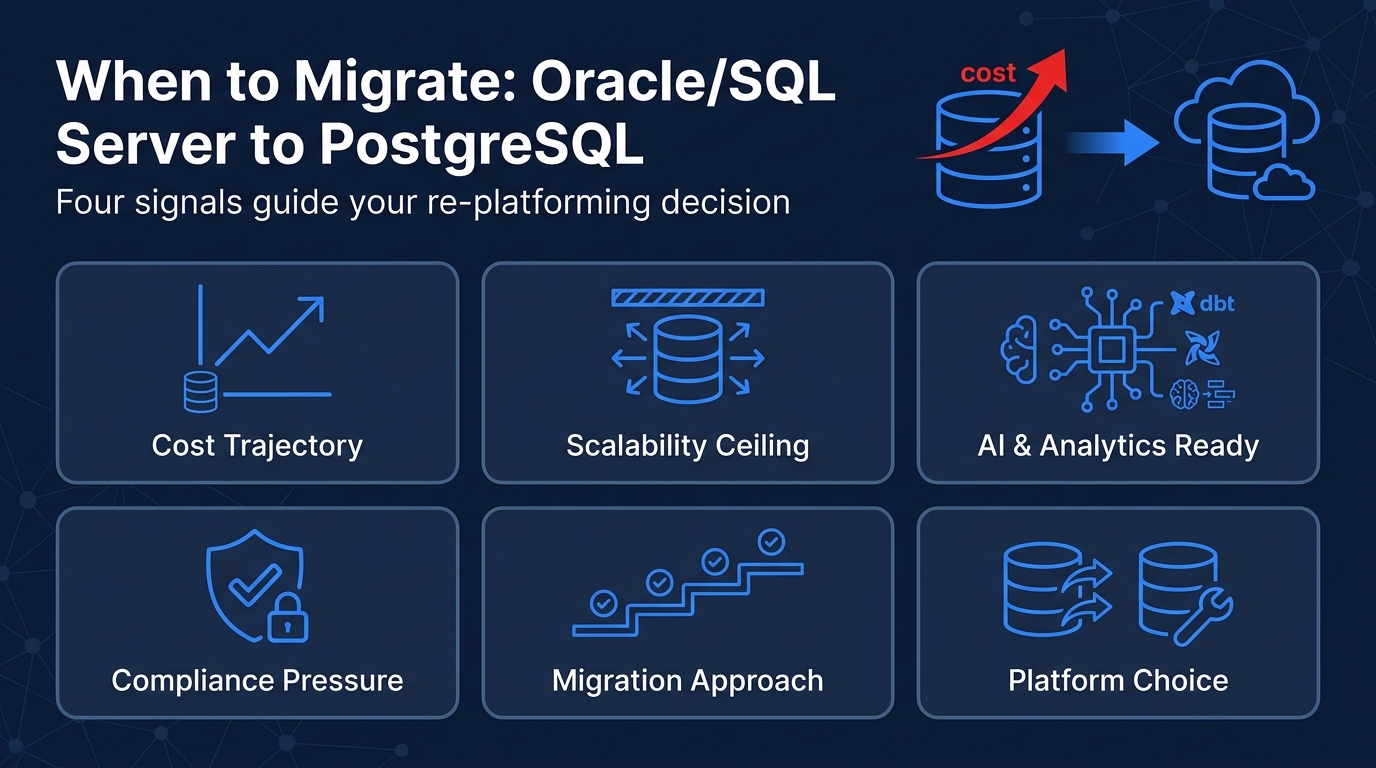
The right time to migrate is determined by four signals: cost trajectory, scalability ceiling, compliance requirements, and AI readiness.
An oracle to postgresql migration is not a lift-and-shift; stored procedures, data types, and application queries need deliberate re-engineering.
A phased cloud database migration strategy reduces risk far more reliably than a big-bang cutover.
Use a structured cloud database migration checklist to avoid the most common failure modes: schema incompatibilities, replication lag, and application-layer surprises.
Why Are Mid-Market APAC Companies Moving Away From Oracle and SQL Server?
The pressure is structural, not cyclical. Oracle and SQL Server both use per-core licensing models that become punishing as cloud workloads scale horizontally. For a mid-market company running 16 or 32 vCPUs in a cloud environment, the annual licensing bill can exceed the cost of the engineering team managing the database. That equation rarely improves over time.
Beyond cost, there are three compounding problems specific to APAC mid-market businesses:
Regulatory momentum: Singapore MAS, Australia APRA, and Vietnam's data-localization guidance all push toward infrastructure that is easier to audit and isolate. PostgreSQL's open-source lineage means no black-box vendor licensing clauses to navigate during a compliance review.
Talent availability: Senior Oracle DBAs are scarce and expensive across Southeast Asia. PostgreSQL and Aurora expertise is 40-50% more available in Vietnam and the Philippines compared to onshore Singapore or Australia hiring, reducing both recruitment time and annual compensation spend.
AI and analytics readiness: Modern AI and data engineering pipelines - dbt, Apache Airflow, Airbyte, LangChain - integrate natively with PostgreSQL. The same tools require workarounds or paid connectors for Oracle.
The application modernization services market in APAC is growing rapidly, driven by accelerated digital transformation and cloud adoption. Database re-platforming is often the foundational step that makes everything else possible.
What Are the Real Differences Between PostgreSQL and Amazon Aurora for This Migration?
This is a decision that often gets conflated. They are not interchangeable targets, and picking the wrong one early creates rework.
Factor | PostgreSQL (self-managed or RDS) | Amazon Aurora PostgreSQL
|
|---|---|---|
Operational overhead | Moderate (you manage patching, backups) | Low (AWS manages the storage layer) |
Read scalability | Manual replication setup | Up to 15 read replicas, auto-failover |
Cost model | Predictable; compute + storage | Slightly higher than RDS at small scale; better at >1TB |
APAC latency | Depends on region selection | Aurora Global Database for multi-region active reads across Asia-Pacific |
Compatibility with Oracle/SQL Server migration tools | Full | Full (Aurora is wire-compatible with PostgreSQL) |
Best for | Cost-sensitive, smaller datasets, full control | High-availability production workloads, multi-region APAC |
For most APAC mid-market companies with production workloads above a few hundred gigabytes and SLA requirements, Aurora PostgreSQL is the stronger default. For smaller workloads or teams that want full infrastructure control, self-managed PostgreSQL on a managed Kubernetes cluster or RDS is entirely sufficient.
What Does an Oracle to PostgreSQL Migration Actually Involve?
An oracle to postgresql migration involves more than moving data. It requires re-engineering three distinct layers, each with its own failure modes. 724SOFTWARE works with clients across these layers as a long-term modernization partner, using tools like Claude and Cursor to accelerate schema conversion and PL/SQL-to-PL/pgSQL transformation.
1. Schema translation
Oracle-specific data types (NUMBER, VARCHAR2, DATE semantics), sequences, and partitioning syntax do not map directly to PostgreSQL. Tools like AWS Schema Conversion Tool (SCT) or Ora2Pg automate a portion of this work, but plan for manual review of anything non-trivial. Generative AI tools such as Claude can assist in converting complex data type mappings and identifying edge cases in partitioning logic.
2. Stored procedure and function re-engineering
PL/SQL does not run on PostgreSQL. PL/pgSQL is syntactically similar but behaviorally different in edge cases around error handling, implicit type casting, and cursor behavior. This layer typically takes the most engineering time and is where migrations underestimate effort. AI-assisted code conversion tools like Cursor can reduce re-engineering time by automating syntax translation while maintaining semantic correctness.
3. Application query layer
ORM-generated queries usually survive the migration with minimal changes. Hand-written SQL with Oracle-specific hints, analytic functions, or proprietary join syntax needs review. A full SQL audit before migration starts is non-negotiable.
The path for an sql server to postgresql migration is similar in structure but differs in specifics: T-SQL's procedural extensions, identity columns, and datetime handling are the primary friction points. SQL Server's IDENTITY and GETDATE() have PostgreSQL equivalents, but the migration tooling (SSMA for PostgreSQL or pgloader) handles these unevenly.
What Does a Practical Cloud Database Migration Checklist Look Like?
A useful cloud database migration checklist is organized into four phases. This is not a one-size-fits-all template - adjust depth based on your schema complexity and team size.
Phase 1: Assessment (Weeks 1-3)
- Inventory all database objects: tables, views, stored procedures, triggers, packages, jobs
- Identify Oracle/SQL Server-specific syntax and features in use
- Profile query performance baselines (you will need these to validate post-migration)
- Map application connection strings and ORM configurations
- Confirm target platform (RDS PostgreSQL vs. Aurora vs. self-managed)
Phase 2: Schema and Data Migration (Weeks 4-8)
- Run automated schema conversion and document all exceptions requiring manual work
- Set up AWS DMS or equivalent for continuous replication during transition
- Migrate historical data in batches; validate row counts and checksums at each stage
- Re-engineer stored procedures and test each one against production-equivalent data
Phase 3: Application and Integration Testing (Weeks 9-12)
- Run the application query layer against the new database in a staging environment
- Execute full regression testing, including edge cases that exercise database-specific behavior
- Validate all ETL pipelines, reporting queries, and third-party integrations
- Test failover, backup restoration, and connection pool behavior under load
Phase 4: Cutover and Stabilization (Weeks 13-16)
- Schedule cutover during a low-traffic window; keep the source database in read-only mode during final sync
- Monitor query performance for at least two weeks post-cutover against pre-migration baselines
- Maintain rollback capability for 30 days minimum
- Decommission source database only after two clean billing cycles on the new platform
Frequently Asked Questions
Q: How long does an Oracle to PostgreSQL migration typically take for a mid-market company?
Timeline varies by schema complexity. A moderately complex Oracle database (500-1,000 objects, 10-20 stored procedures) typically takes 3-5 months from assessment to stable production. SQL Server migrations tend to be slightly faster due to better tooling.
Q: Can I migrate without downtime?
Near-zero downtime is achievable using AWS DMS for continuous replication with a final cutover window of under 30 minutes. This requires careful preparation of the replication setup and application connection switching.
Q: Will PostgreSQL handle the transaction volumes my Oracle database currently manages?
For most mid-market workloads (under 10,000 transactions per second), PostgreSQL and Aurora handle volume equivalently. At extreme throughput, Aurora's storage architecture provides better headroom.
Q: What are the most common reasons migrations fail?
The top three are: underestimating stored procedure re-engineering effort, skipping query performance profiling before migration, and attempting a big-bang cutover rather than a phased approach.
Q: Is PostgreSQL secure enough for Fintech and Healthcare workloads?
Yes. PostgreSQL supports row-level security, column-level encryption, SSL/TLS in transit, and audit logging. When hosted on Aurora or a certified cloud environment, it meets the compliance requirements of Singapore MAS, Australia APRA, and HIPAA-adjacent healthcare standards.
Q: Should I use managed RDS or self-hosted PostgreSQL?
Unless your team has strong database operations experience and a clear reason to manage the infrastructure layer, managed RDS or Aurora reduces operational risk substantially for a mid-market organization.
Q: What is the cost difference after migrating from Oracle to PostgreSQL?
Licensing cost savings are significant - Oracle per-core licensing is eliminated entirely. Total cost of ownership depends on compute sizing and managed service tier, but teams consistently report meaningful reductions in annual database spend after migration.
About 724SOFTWARE
724SOFTWARE is a Vietnam-based technology partner with 200+ professionals, 58% of whom are senior-level engineers, delivering software engineering, cloud migration, and data platform modernization across 10+ countries. The company holds ISO 9001, ISO 27001:2022, SOC 2 Type II, and GDPR certifications - making it a credible delivery partner for Fintech and Healthcare clients navigating compliance-sensitive database migrations.
With dedicated teams that scale from 1 to 50+ pre-vetted engineers in 2-4 weeks and an incident response commitment under 10 minutes, 724SOFTWARE operates as a long-term technology partner through dedicated teams and ongoing delivery engagement, not a one-off migration vendor. As an official partner with Claude (Anthropic) and Cursor, 724SOFTWARE integrates generative AI into database migration workflows to accelerate schema conversion and code re-engineering.
The team has production experience with PostgreSQL-backed systems across multiple APAC verticals, including capital markets, digital health, and enterprise ERP, backed by a 95% client retention rate.
If your Oracle or SQL Server licensing costs are climbing and your engineering team is spending more time managing the database than shipping product, it is worth having a concrete conversation about your options. Visit 724SOFTWARE to connect with a team that has navigated these migrations in production environments across the APAC region.