

Most conversations about outsourcing transparency stop at "we'll send you a monthly report." That is not transparency. Genuine delivery transparency means your partner gives you real-time visibility into how hours are spent, how your team is performing, and exactly what you are paying for, before you have to ask. In a long-term technology partnership, that level of openness is not a nice-to-have; it is the structural foundation that keeps trust intact across months and years of joint delivery.
TL;DR
Delivery transparency has three distinct layers: billing visibility, team health metrics, and hour-level reporting. Each serves a different accountability purpose.
Hour-level reporting eliminates the "black box" problem common in fixed-bid or milestone-only engagements.
Team health metrics, such as attrition, utilization, and seniority mix, predict delivery risk before it becomes a cost problem.
Billing transparency tied to actual working hours removes invoice disputes and builds the financial trust required for a long partnership.
The right partner instruments all three layers from day one, not as an afterthought when a client complains.
About the Author: 724SOFTWARE is a Vietnam-based technology company with a 95% client retention rate and delivery experience across 10+ countries. The company's ODC and dedicated team model is built on transparent, hour-based billing and direct client access to team health dashboards, making this a topic the team operates daily, not theorizes about.
What Does "Delivery Transparency" Actually Mean in a Tech Partnership?
Delivery transparency is the practice of making your partner's working activity, team composition, costs, and performance measurable and visible to the client at any point in time, without needing a formal audit to surface the data.
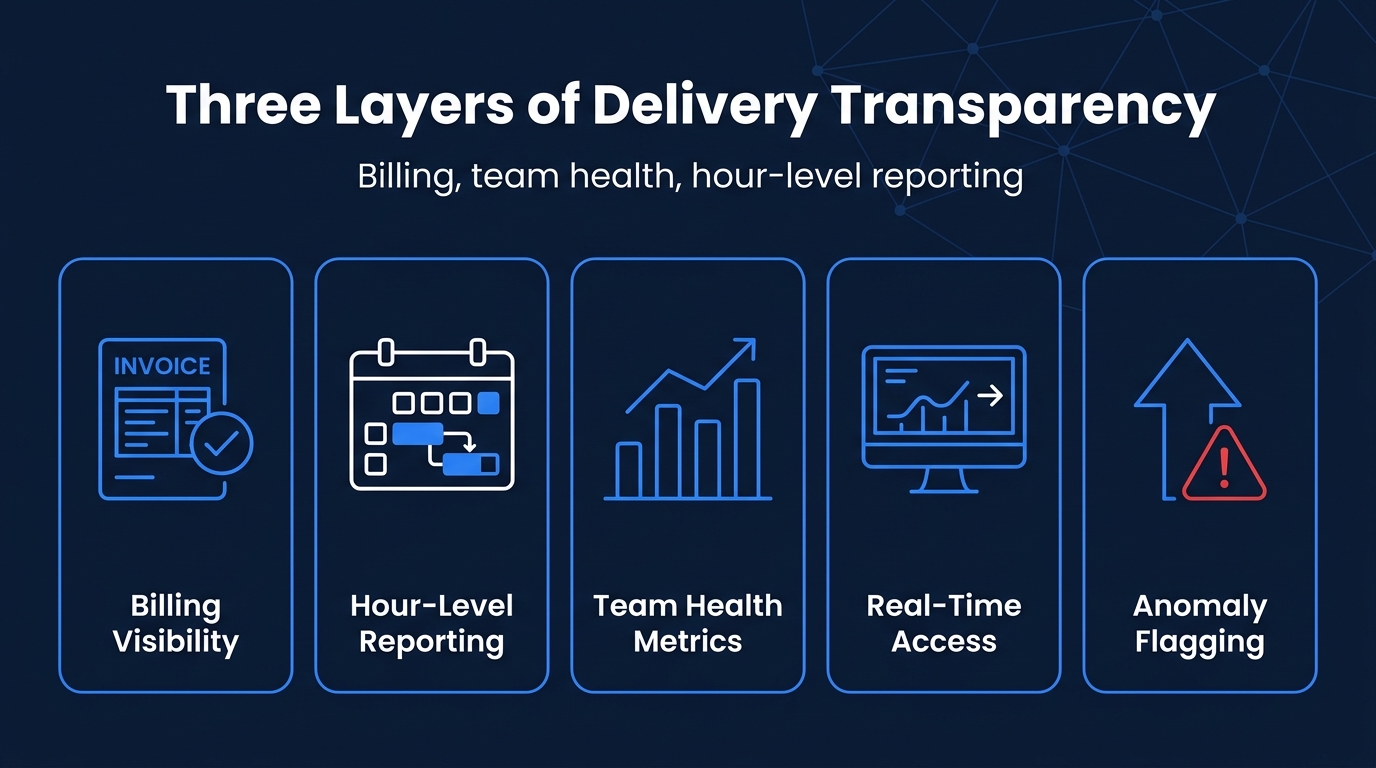
It breaks into three distinct layers:
Layer | What It Covers | Why It Matters
|
|---|---|---|
Billing Visibility | Invoices tied to actual hours worked, broken down by role | Eliminates invoice surprises; enables budget forecasting |
Team Health Metrics | Attrition, seniority mix, utilization rate, engagement signals | Predicts delivery risk and team stability over time |
Hour-Level Reporting | Daily or weekly logs by engineer, task, and sprint | Connects cost to output; replaces "trust me" with evidence |
The reason these three are often bundled under one vague label, "transparency," is that most partnerships only deliver one of them, usually a sanitized billing summary, while treating the other two as internal data the client has no right to see. That framing protects the vendor, not the client.
Why Is Hour-Level Reporting the Hardest Layer to Get Right?
Building on the framework above, hour-level reporting is where most partnerships either earn or lose long-term trust, because it directly links cost to productive output.
In a milestone or fixed-bid model, the client pays for a deliverable and has no visibility into whether that deliverable took 200 hours or 600 hours to produce. Scope changes, bug fixes that take three times longer than expected, and team scaling decisions all depend on visibility into actual hour allocation and resource consumption.
Hour-level reporting done correctly looks like this:
Daily time logs linked to specific tasks, tickets, or user stories, not just "development" as a catch-all category.
Per-engineer breakdown showing individual contribution, not only team-level aggregates.
Sprint or weekly summaries that roll up hours to delivery velocity, so a client can see whether the team is accelerating or slowing down.
Anomaly flagging when hours spike unexpectedly on a specific module, signaling complexity the client should know about.
This level of logging requires discipline from the engineering team and tooling investment from the partner. It also requires a partner that is not afraid to show the data, because the data will occasionally reveal inefficiency. A partner that hides behind aggregated reports is protecting its margins, not your product.
What Are Team Health Metrics, and Why Should a Client Track Them?
Stepping back from the operational detail, a separate but equally important concern is the stability of the team delivering your product. Team health metrics are leading indicators of delivery risk, not lagging ones.
By the time a team health problem shows up as a missed sprint or a degraded code quality score, it has already been building for weeks. The metrics that matter are:
Attrition rate: How many engineers leave the team per quarter? High attrition on a dedicated team means constant knowledge loss and onboarding overhead, both of which the client ultimately pays for in reduced velocity.
Seniority mix: What proportion of the team is senior versus junior? This directly affects output quality and the ability to make sound architectural decisions without hand-holding.
Utilization rate: Is the team fully engaged, or are engineers split across multiple accounts in ways that dilute focus?
Tenure on the client's codebase: Long-tenure engineers carry institutional knowledge that cannot be documented. Tracking tenure as a metric signals whether the partnership is building compounding value or constantly restarting.
A partner with a genuinely low attrition rate, such as one built on stable employment policies and a strong engineering culture, will have no problem sharing these numbers. If a partner resists publishing attrition or seniority data, that reluctance is itself informative.
How Does Billing Transparency Differ From Just Sending an Invoice?
A related but distinct question is what "transparent billing" actually requires beyond a line-item invoice. Billing transparency tied to actual working hours is meaningfully different from invoice delivery.
In a time-and-materials model anchored to actual hours worked, a transparent invoice includes:
Hours worked per engineer, per role, per period
The agreed rate for each role, confirmed against the original contract
Any adjustments (approved overtime, bench time, holiday coverage) with explanations attached
A reconciliation between hours logged in the time-tracking tool and hours billed, so the client can verify the two match
This structure removes the most common source of trust erosion in outsourcing partnerships: the invoice that arrives with a number the client cannot verify. When billing is anchored to actual hours with full logs behind it, disputes become rare because the data is available to both parties simultaneously, not reconstructed after the fact.
The healthcare industry has spent years learning that opaque billing destroys trust and drives clients away. The lesson applies equally to technology partnerships: when clients cannot understand what they are paying for, they leave. When they can, they stay.
Frequently Asked Questions
Q: How often should hour-level reports be shared with the client?
Weekly summaries with daily logs available on demand is the standard for a well-structured dedicated team. Monthly-only reporting is insufficient for active delivery.
Q: Can a client access team health metrics directly, or do they go through an account manager?
In a genuinely transparent partnership, clients should have direct access to dashboards, not filtered summaries from an intermediary. Requiring account manager mediation is a structural control on information flow that favors the vendor.
Q: What is a reasonable attrition rate for a dedicated offshore team?
There is no universal benchmark, but a team with stable employment policies and a strong engineering culture should see attrition well below the regional average. Ask any prospective partner for their historical team retention data on client accounts, not company-wide HR figures.
Q: Does hour-level reporting slow down the engineering team?
When integrated into the sprint tooling (Jira, Linear, GitHub Issues), time logging adds minimal overhead. Teams that resist it are usually not accustomed to accountability, not actually slowed down by it.
Q: How does transparency connect to compliance in regulated industries?
For Fintech and Healthcare clients, billing and delivery records are often part of vendor audit requirements. A partner certified to ISO 27001:2022, SOC 2 Type II, and GDPR standards will have the documentation infrastructure to satisfy audits without scrambling.
Q: What happens when the hour logs show an inefficiency? Will the partner hide it?
A partner committed to transparency will surface inefficiencies proactively, because hiding them creates larger problems later. This is the core test of whether a partner's transparency is structural or performative.
Q: Is transparent billing only relevant for time-and-materials engagements?
It is most directly relevant to T&M, but even hybrid models benefit from hour-level visibility because it gives the client the data needed to make informed decisions about scope changes, team size, and investment priorities.
About 724SOFTWARE
724SOFTWARE is a Vietnam-based technology company with 200+ professionals, of whom 58% are senior-level engineers, serving clients across Singapore, Australia, the United States, the United Kingdom, and the broader APAC region. The company operates under ISO 9001, ISO 27001:2022, SOC 2 Type II, and GDPR compliance standards, and delivers dedicated teams from 1 to 50+ pre-vetted engineers within 2 to 4 weeks. With a 95% client retention rate built on transparent, hour-based billing and direct client access to team performance data, 724SOFTWARE works as a long-term technology partner in building and operating digital products, not as a transactional project shop.
If you want to see what delivery transparency looks like in practice before committing to a partnership, the best first step is a direct conversation. Visit 724SOFTWARE to connect with the team and discuss how dedicated delivery, hour-level reporting, and billing visibility can be structured around your specific product and business requirements.