

Offshore software development costs are routinely underestimated because the advertised hourly rate is only one component of what you actually pay. When you factor in onboarding friction, rework cycles, communication overhead, and attrition, hidden costs can add 20-40% to your total engagement budget. Identifying where that gap exists is the first step to closing it.
TL;DR
Hourly rates advertised by offshore teams rarely reflect total engagement cost; hidden costs add 20-40% on average.
The biggest cost drivers are rework, attrition-related knowledge loss, communication overhead, and timezone misalignment.
Offshore rates vary significantly by region, but rate alone is a poor proxy for delivered value.
Structural choices like dedicated teams, pre-vetted talent, and transparent billing directly reduce hidden cost exposure.
Evaluating an offshore partner on security certifications, retention rates, and SLA commitments prevents costly surprises later.
About the Author: This article is written by the 724SOFTWARE team, a Vietnam-based technology company with delivery experience across 10+ countries and a 95% client retention rate. With 200+ professionals building and operating digital products for clients in Fintech, SaaS, and Enterprise ERP, 724SOFTWARE has accumulated direct, ground-level insight into where offshore engagements lose money.
Why Do Hidden Costs Exist in Offshore Engagements?
Hidden costs in offshore software development exist because buyers evaluate vendors on the most visible number available: the hourly or monthly rate. That number is real, but it captures only direct labour. Everything else required to actually deliver software sits outside it.
At a global level, offshore software development rates typically range between $15 and $150 per hour depending on region, seniority, and technology stack. Nearshore options in LATAM or Eastern Europe average $4,000-$7,000 per developer per month, while Vietnam-based delivery in APAC comes in at a lower cost structure without compromising on quality. That spread looks like a straightforward cost decision. The problem is that the rate you pay per hour and the cost per working feature are two different figures.
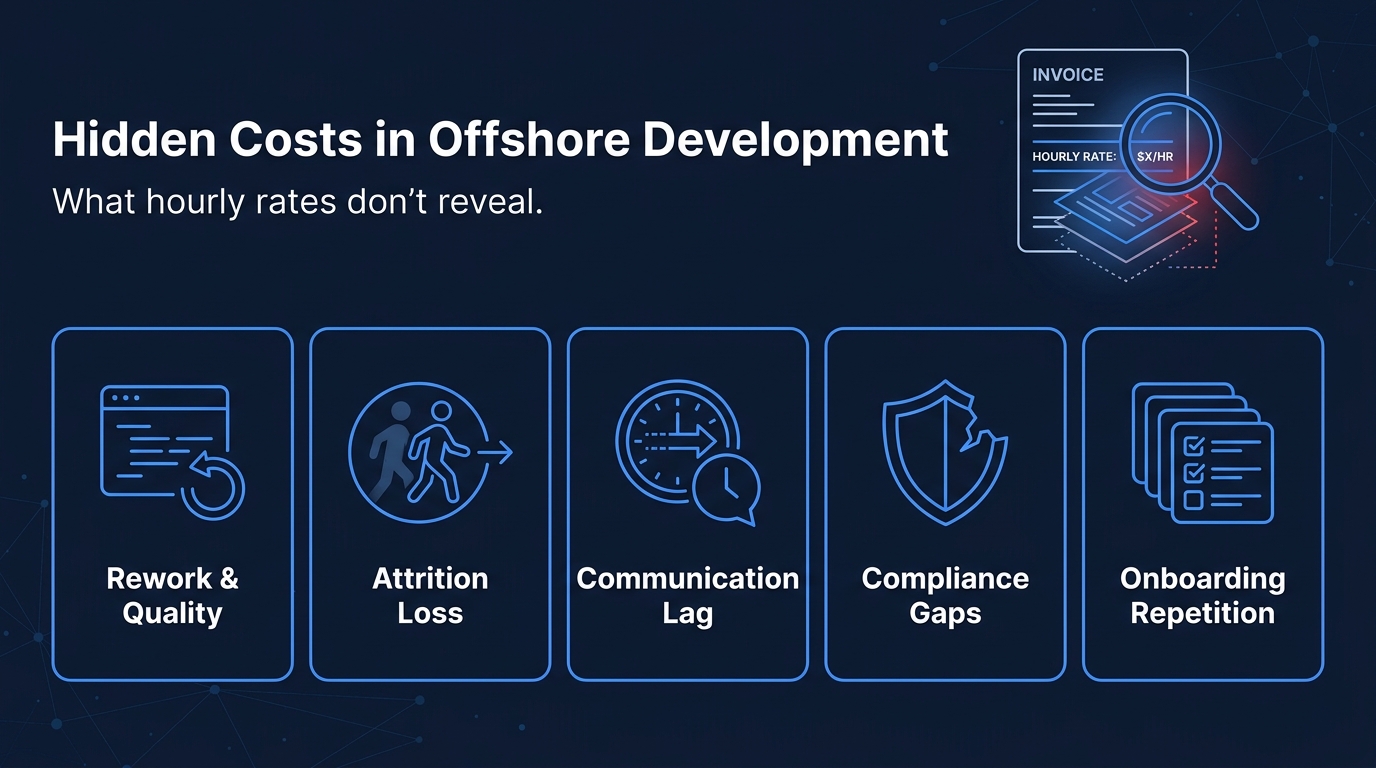
The hidden costs cluster into a few recurring categories:
Rework and quality gaps caused by unclear requirements or mismatched seniority
Attrition and knowledge loss when team members rotate off the project
Communication and coordination overhead from timezone misalignment and language friction
Compliance and security gaps that surface after go-live
Onboarding repetition when vendors treat every engagement as a new project rather than an ongoing relationship
Each of these has a measurable cost that never appears on an invoice line.
What Does Rework Actually Cost, and Why Does It Happen?
Rework is the most direct hidden cost and the hardest to attribute, because it shows up as additional sprint hours rather than a separate budget line. Research consistently places rework as one of the top contributors to offshore budget overruns.
It happens for two structural reasons. First, when teams are composed of pre-vetted engineers embedded in client workflows rather than assembled from a freelancer pool, context is established from day one. Engineers understand the product rather than guessing at requirements. Second, when senior-to-junior ratios maintain sufficient seniority, the initial output is reliable and review cycles are shorter with lower defect rates.
The practical test: ask a prospective vendor what percentage of their engineering team is senior-level, and ask for specific examples of engagements spanning 18+ months. Vague answers here are a signal.
How Does Attrition Create Costs That Never Appear on the Rate Card?
Attrition with staff turnover rates above 20% annually represents a significant hidden cost in offshore software development. Every time an engineer leaves a project, the engagement absorbs 4-8 weeks of reduced productivity while a replacement ramps up. That is a direct cost in lost velocity, plus the indirect cost of context that walked out the door.
High-churn offshore vendors compensate by rotating staff, which means clients effectively re-onboard team members every few months. The cumulative cost of that cycle can rival the apparent savings from a lower hourly rate.
This is why team stability should be treated as a quantifiable commercial factor, not a soft preference. Key questions to ask any vendor:
What is your annual attrition rate for client-facing engineers?
Do clients work with a dedicated team or a shared resource pool?
What is your average engagement length per client?
A vendor with a 95% client retention rate and documented low attrition offers something rate-card comparisons cannot show.
What Role Does Timezone and Communication Overhead Play in Total Cost?
Building on the attrition issue, a related but distinct cost driver is the overhead created by poor timezone overlap and language friction. These costs are diffuse, which is why they are rarely budgeted for.
Time lost to communication overhead typically manifests as:
Delayed answers that block engineering work for a full business day
Misinterpreted requirements that become rework in the next sprint
Meeting overhead when the overlap window is narrow and meetings must be long to compensate
A vendor operating under a follow-the-sun model with a guaranteed incident response time of under 10 minutes addresses the response latency problem directly. Multilingual support across English, Mandarin, Korean, and Japanese reduces the language friction cost for clients across APAC markets.
What Are the Compliance and Security Costs That Offshore Engagements Frequently Miss?
Stepping back from delivery efficiency, a separate category of hidden cost is compliance and security. This one tends to surface late, often after a client has already committed to a vendor.
For companies in Fintech, Digital Healthcare, or SaaS serving regulated markets, the relevant certifications are specific: ISO 27001:2022, SOC 2 Type II, and GDPR compliance. Working with a vendor that holds none of these means the client absorbs the compliance risk directly, which carries both remediation costs and, in regulated industries, potential liability.
Certification | What It Signals
|
|---|---|
ISO 9001 | Documented quality management processes |
ISO 27001:2022 | Information security controls audited against current standard |
SOC 2 Type II | Security, availability, and confidentiality controls tested over time |
GDPR Compliance | Data handling aligned to European privacy regulation |
Asking for certification documentation during vendor evaluation is not bureaucratic; it is a direct cost-avoidance step.
How Do Billing Transparency and Engagement Structure Affect Total Cost?
One structural cost that buyers rarely anticipate is the overhead created by opaque billing. When invoices show hours worked without visibility into how those hours mapped to delivery, disputes arise. Disputes cost time. Time has a cost.
Transparent billing based on actual working hours, combined with direct visibility into team health and delivery performance, removes that friction. It also creates a feedback loop that identifies productivity issues early rather than at invoice time.
The engagement model matters here as well. A dedicated team embedded in the client's workflow from the start costs less to operate over time than a project-shop model where every engagement starts from scratch. Pre-vetted engineers who already understand the client's stack, communication cadence, and standards reduce onboarding cost on each new workstream.
Frequently Asked Questions
What percentage of hidden costs can realistically be expected on an offshore project?
Hidden costs can add 20-40% to total offshore project budgets if not actively managed [kaopiz.com]. The exact figure depends on vendor attrition, rework rates, and communication structure.
Is a lower hourly rate always a worse deal in offshore software development?
Not automatically, but a lower rate from a vendor with high attrition, low seniority ratios, or no security certifications often costs more in total than a slightly higher rate from a stable, certified team.
What is the single biggest hidden cost in offshore engagements?
Rework and attrition together are consistently cited as the largest contributors to budget overruns [theitsource.asia] [coderio.com]. Both are addressable through vendor selection criteria rather than contract clauses.
How do I evaluate vendor stability before signing?
Ask for client retention rates, average engagement length, attrition figures, and references from clients with 18+ month engagements. Published certifications (ISO 27001:2022, SOC 2 Type II) are also verifiable stability signals.
Does Vietnam-based offshore delivery carry higher hidden costs than other APAC regions?
Vietnam's cost efficiency combined with strategic location within APAC delivers competitive rates and quality without requiring a tradeoff for teams with established processes, low attrition, and certified security controls.
What billing model reduces hidden cost exposure most effectively?
Hour-based transparent billing with direct visibility into team activity creates accountability and removes invoice disputes as a cost category.
How quickly can a well-structured dedicated team reach full productivity?
With pre-vetted engineers and a standardized onboarding process, a dedicated team of 1 to 50+ engineers can reach productive capacity within 2-4 weeks.
About 724SOFTWARE
724SOFTWARE is a Vietnam-based technology company providing dedicated engineering teams, custom software development, and managed IT services to startups, SaaS companies, and enterprises across Singapore, Australia, the United States, the United Kingdom, and the broader APAC region. With 200+ professionals (58% senior-level), ISO 9001, ISO 27001:2022, SOC 2 Type II, and GDPR compliance, and an official partnership with Claude (Anthropic) and Cursor, 724SOFTWARE integrates practical AI tools into the software delivery lifecycle to accelerate delivery by approximately 30%. The company's 95% client retention rate and dedicated team model are structured specifically to eliminate the hidden costs described in this article, from attrition and rework to billing opacity.
If you are evaluating offshore software development costs and want a detailed breakdown of what a dedicated Vietnam software team engagement actually costs end-to-end, the 724SOFTWARE team is ready to walk through the numbers with you. Visit https://724software.com.vn to start the conversation.