

Before you post a single job description or brief a recruitment partner, the most consequential work in offshore development center setup happens at your desk. CTOs who skip role definition and jump straight to sourcing consistently report the same problems: misaligned seniority levels, duplicated responsibilities, and engineers who technically pass the interview but don't fit the team's actual workflow. The fix is not a better recruiter - it is a tighter brief written before sourcing begins.
TL;DR
Define the problem your offshore team needs to solve before defining any specific role.
Map responsibilities to outcomes, not job titles, to avoid seniority inflation and scope creep.
Validate your role definitions against your delivery model (ODC vs. embedded team) before sourcing.
A pre-sourcing checklist reduces time-to-productivity for new hires and prevents costly mis-hires.
Role clarity at the definition stage is the single highest-leverage activity in offshore team design.
About the Author: This article is written by the 724SOFTWARE team, a Vietnam-based engineering partner with delivery experience across 10+ countries and a 95% client retention rate. The company has helped CTOs in Singapore, Australia, and the US build dedicated offshore engineering functions across Fintech, Healthcare, and SaaS.
Why Do CTOs Get Role Definition Wrong Before Offshore Sourcing?
The root cause is usually urgency. A CTO feels hiring pressure, copies an internal job description into a brief, and sends it to a recruitment partner or offshore vendor. The result is a role defined around a previous hire rather than a current need.
Three common failure modes:
Title-first thinking: Writing "Senior Backend Engineer" before deciding what backend problems need solving and at what frequency.
Scope mirroring: Cloning an onshore role description for an offshore context without adjusting for timezone, communication overhead, or collaboration patterns.
Seniority inflation: Requesting senior engineers for tasks that a mid-level engineer could own, which inflates cost and increases attrition risk when the work is under-stimulating.
The pre-sourcing checklist below is designed to eliminate all three.
What Should You Clarify Before Writing a Single Job Description?
Before drafting any role, answer these four questions in writing. If you cannot answer them, the role is not ready to be sourced.
1. What problem does this role solve in the next 90 days?
Not a general area of work - a specific, time-bound problem. "Reduce API response latency on the payments service" is sourceable. "Help with backend stuff" is not.
2. Who does this role collaborate with daily, and across which timezones?
This determines whether you need someone who can work asynchronously with high autonomy, or someone who needs to overlap with your onshore team for real-time pairing and review cycles.
3. What does "done well" look like at 30, 60, and 90 days?
Defining success criteria before sourcing lets you screen for candidates who have actually achieved similar outcomes, not just candidates who list the right technologies.
4. Is this a founding team role or a scaling role?
Founding roles in an offshore function require engineers who can operate with ambiguity, set conventions, and document decisions. Scaling roles require engineers who can follow established patterns at speed. These are genuinely different hiring profiles.
How Do You Structure the Pre-Sourcing Checklist?
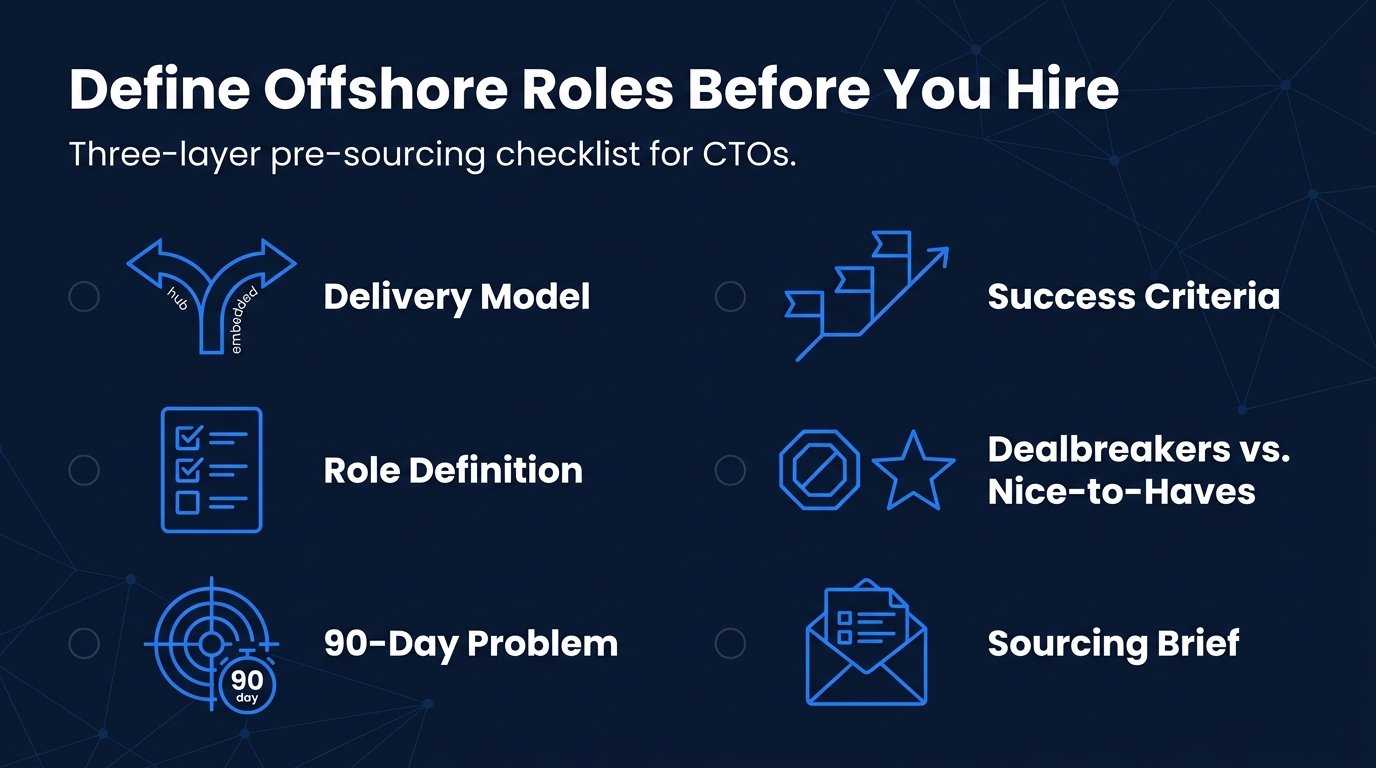
A practical checklist works in three layers: delivery model, role definition, and sourcing brief. Each layer must be complete before moving to the next.
Layer 1: Delivery Model Decisions
Decision | Questions to Answer
|
|---|---|
ODC vs. dedicated team | Do you want a self-contained offshore hub, or engineers embedded in your existing squads? |
Team size and ramp timeline | How many engineers do you need at launch vs. at 6 months? |
Management model | Will an offshore team lead manage locally, or will your onshore leads manage directly? |
Autonomy level | Can this team own a vertical end-to-end, or does it need close onshore pairing? |
Layer 2: Role Definition
For each role, complete this before sourcing begins:
Core ownership: The one thing this person is solely accountable for.
Collaboration surface: Which roles they interact with and how often.
Required depth vs. required breadth: Is deep specialization or T-shaped generalism more important for this role?
Minimum viable seniority: The lowest seniority level that could own the core responsibility - not the highest you could theoretically benefit from.
Dealbreakers vs. nice-to-haves: Separate these explicitly. Every item on the dealbreaker list adds weeks to your sourcing timeline.
Layer 3: The Sourcing Brief
Once role definitions are validated, translate them into a brief for your recruiting partner or offshore team provider. A good brief includes:
The 90-day problem statement
The success criteria at 30/60/90 days
The collaboration and timezone requirements
The minimum viable seniority definition
The dealbreaker list (short, defensible, non-negotiable)
A brief that is missing any of these forces your recruiter to make assumptions, which reintroduces the exact ambiguity you removed in Layer 2.
How Does Your Offshore Delivery Model Affect Role Definition?
Stepping back from the role-level detail, a separate structural question matters: whether you are building an ODC or embedding engineers into existing squads shapes which roles you define first.thoai
For an ODC (offshore development center setup):
The first roles to define are the connective tissue - a team lead, a delivery manager, or a senior engineer who can hold context and make local decisions without escalation. Individual contributor roles come after. Building in the wrong order creates a leaderless team that depends on your timezone for every decision.
For an embedded dedicated team:
The first roles to define are the ones that mirror the highest-friction handoffs in your current workflow. If your onshore team loses velocity every time a QA cycle runs, a QA engineer embedded in the offshore team reduces that friction directly. Start with friction mapping, not org chart copying.
Frequently Asked Questions
Q: How many roles should I define before beginning offshore sourcing?
Define all roles you plan to hire in the first 90 days. Leaving roles undefined until later creates mid-ramp scope confusion and delays productivity for engineers who are already onboard.
Q: Should I define roles differently for offshore hires than for onshore hires?
Yes. Offshore roles need explicit documentation of communication cadence, async work expectations, and escalation paths - elements that are often implicit in onshore roles.
Q: How detailed does a role definition need to be?
Detailed enough that two people reading it independently would make the same sourcing decision. If they would disagree on seniority level or required skills, the definition needs more specificity.
Q: What is the most common mistake in offshore role definition?
Conflating seniority with capability. A senior title does not automatically mean the right fit. Define the capability profile first, then match seniority to it.
Q: How do I validate a role definition before sourcing begins?
Share the draft with someone currently doing adjacent work - either internally or at your offshore partner. If they cannot immediately identify what success looks like, revise.
About 724SOFTWARE
724SOFTWARE is a Vietnam-based technology partner providing dedicated engineering teams, ODC services, and custom software development for companies in Singapore, Australia, the US, and across the APAC region. With 200+ professionals (58% senior-level), certifications including ISO 27001:2022 and SOC 2 Type II, and a 95% client retention rate, the company builds and operates long-term engineering functions for Fintech, Healthcare, SaaS, and Enterprise ERP clients. As an official partner with Claude (Anthropic) and Cursor, 724SOFTWARE integrates practical AI tooling into the software development lifecycle to accelerate delivery by approximately 30%.
If you are mapping out your offshore engineering function and want a partner who has done this across Fintech, SaaS, and Healthcare teams, the 724SOFTWARE team can walk you through the role-definition and team-design process before a single sourcing call is made. Visit https://724software.com.vn to start the conversation.