

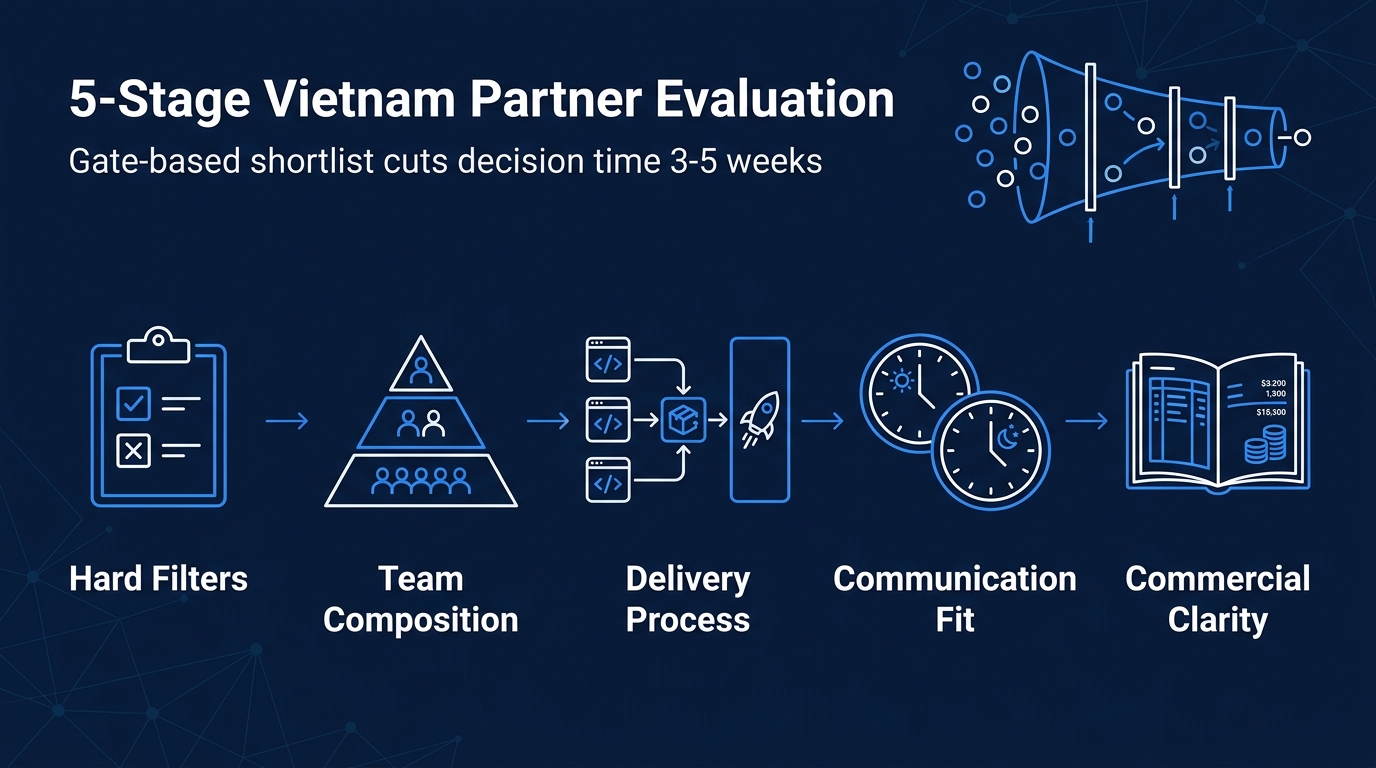
Shortlisting an offshore software partner in Vietnam does not have to take months. The most effective approach compresses evaluation into five sequential stages: verify credentials and certifications, assess technical depth and team composition, evaluate delivery process and tooling, stress-test communication and cultural fit, and confirm commercial transparency. Buyers who follow this sequence consistently reduce decision time by eliminating unqualified vendors early, rather than discovering disqualifying gaps after weeks of proposal review.
TL;DR
Start with hard filters (certifications, retention rates, proven industry experience) to cut your longlist from 20+ vendors to 5 or fewer before any demos.
Technical depth matters more than team size; a 58%-senior-engineer ratio signals a different delivery capacity than a predominantly junior pool.
Process maturity, specifically how a partner uses tooling like AI-assisted development, predicts delivery speed more accurately than portfolio logos alone.
Communication cadence and timezone overlap are measurable; test them during evaluation, not after signing.
Transparent billing and direct visibility into team health are non-negotiable in a long-term partnership, not optional add-ons.
About the Author: This article is written by the 724SOFTWARE team, a Vietnam-based technology company with delivery experience across 10+ countries, a 95% client retention rate, and direct operational experience helping clients in Singapore, Australia, the US, and the UK build and scale offshore engineering teams.
Why Do Most Vietnam Vendor Shortlists Take Too Long?
Most evaluation cycles drag because buyers apply equal scrutiny to every vendor on an initial longlist, regardless of whether those vendors meet basic qualifying criteria. The result is weeks of discovery calls with partners who would have been eliminated in the first 30 minutes of structured review.
A disciplined five-stage process inverts this. Each stage is designed as a gate: only vendors who clear Stage 1 enter Stage 2. This means your team's evaluation effort concentrates on the vendors most likely to become long-term partners, not the ones who responded fastest to your RFP.
Stage 1: Apply Hard Filters Before Any Conversation
Definition: Hard filters are non-negotiable qualifying criteria you can verify from public records, third-party directories, and documentation requests, without speaking to anyone.
The filters that matter most for Vietnam-based partners:
Security certifications: ISO 27001:2022 and SOC 2 Type II are the floor for Fintech, Healthcare, and enterprise clients. Ask for the certificate, check the scope, and verify the issuing body.
Quality management: ISO 9001 certification signals documented, repeatable delivery processes, not just individual engineer capability.
Client retention rate: A figure above 90% is a meaningful signal of partnership quality. Below that, ask for an explanation.
Industry delivery evidence: A vendor with five case studies in your domain (e.g., capital markets, ERP, Edtech) carries less evaluation risk than a generalist with 50 logos across unrelated sectors.
Regulatory compliance: GDPR compliance is required for any vendor handling EU-resident data, regardless of where they are headquartered.
Vendors who cannot produce documentation for the above within 48 hours of a request should be removed from your list. This single filter typically reduces a longlist of 15-20 vendors to 4-6.
Stage 2: Assess Team Composition, Not Just Team Size
Definition: Team composition analysis examines the ratio of senior to mid to junior engineers, the breadth of specialisations available, and the stability of the team over time.
A common mistake at this stage is equating headcount with capacity. A partner with 200+ professionals where 58% are senior-level engineers delivers meaningfully different output than one where the same headcount skews toward junior profiles. Senior engineers require less oversight, catch architectural problems earlier, and reduce the client's own management load.
Key questions to ask:
What is your current ratio of senior to junior engineers across the roles I need?
How long has your average engineer been with the company?
Can you scale my team from, say, 3 to 12 engineers, and in what timeframe?
A credible answer to the third question should include a specific ramp window (2-4 weeks is achievable for pre-vetted talent pools) and a description of how engineers are vetted before placement, not assembled after a client signs.
Also examine multilingual capability if your stakeholders operate across markets. For teams serving Singapore, Japan, or Korea, English-only communication can create friction during incident response or requirements gathering. Partners supporting Mandarin, Korean, and Japanese alongside English reduce that risk.
Stage 3: Evaluate Delivery Process and AI Tooling
Definition: Delivery process maturity is the degree to which a partner's SDLC is documented, measurable, and consistently applied, rather than dependent on individual engineers.
This stage is where differentiation becomes visible. Two vendors may present similar case studies but operate with fundamentally different process maturity.
Specific signals to probe:
AI-assisted development: Does the partner use tools like Cursor or Claude in the development workflow? If so, what is the measured impact on delivery speed? A partner with official partnerships with tools like Claude (Anthropic) and Cursor, and a documented 30% acceleration in delivery, is a different proposition from one that mentions "AI" generically.
Testing rigour: Is automation testing embedded in the sprint cycle, or is it a separate downstream activity? The latter adds elapsed time without adding coverage.
Incident response SLA: Ask for the contractual response time for production incidents. Anything slower than 10 minutes for P1 incidents warrants scrutiny in regulated industries.
Deployment and monitoring practices: CI/CD pipeline maturity, observability tooling, and rollback procedures are better predictors of production stability than portfolio descriptions.
Ask for a brief technical walkthrough of one recent project. The depth of the answer reveals process maturity more accurately than any written proposal.
Stage 4: Stress-Test Communication and Cultural Fit
Definition: Communication fit is the alignment between a partner's collaboration style, timezone coverage, and reporting cadence with your internal team's working patterns.
This stage is frequently underweighted and disproportionately responsible for partnership failures. Vietnam is UTC+7, which creates a 1-2 hour overlap with Singapore, a usable afternoon overlap with Australia, and a minimal same-day window with the US or UK. How a partner manages this overlap matters.
Practical tests to run during evaluation:
Send an email at the edge of business hours and measure response time. A partner operating a Follow-the-Sun model should respond within a defined window.
Request a short requirements document from the vendor based on a verbal briefing. The quality reveals how well they capture intent, not just instructions.
Ask how they handle disagreement on technical direction. Partners who push back with evidence are more valuable long-term than those who simply agree.
A 95% client retention rate is the quantitative proxy for communication and cultural fit working well at scale.
Stage 5: Confirm Commercial Transparency Before Signing
Definition: Commercial transparency means the client can directly observe what they are paying for, including actual working hours, team activity, and billing breakdowns, without relying on the vendor's self-reporting.
This is the final gate and the one most commonly glossed over in a procurement rush. Specific items to verify:
Transparency Criterion | What to Ask For
|
|---|---|
Billing model | Actual working hours, not blended daily rates or opaque retainers |
Team health visibility | Direct access to sprint dashboards or delivery metrics |
Attrition policy | What happens contractually if a key engineer leaves your team? |
Scaling terms | Written terms for ramp-up and ramp-down, including notice periods |
Partners who resist this level of visibility during pre-sales are unlikely to become more transparent after contract signature.
Frequently Asked Questions
How long should a Vietnam offshore vendor evaluation take using this process?
Following the five-stage gate process, a disciplined evaluation from longlist to signed partner typically takes 3-5 weeks, compared to 8-12 weeks for unstructured evaluations.
What certifications are most important for a regulated-industry partner in Vietnam?
ISO 27001:2022 and SOC 2 Type II are the most critical for Fintech and Healthcare. ISO 9001 adds process assurance. GDPR compliance is required for any engagement involving EU-resident data.
How do I verify a Vietnam vendor's claimed client retention rate?
Ask for reference contacts from clients retained for 2+ years, specifically in your industry. A genuine 95% retention rate will have multiple referenceable accounts.
What is a reasonable team ramp-up time for a pre-vetted Vietnam partner?
2-4 weeks is achievable for partners maintaining active pre-vetted talent pools. Longer ramp times (6-8 weeks) typically indicate the partner sources engineers reactively after a client commits.
Is AI-assisted development a real differentiator or marketing language?
It depends on specificity. Generic mentions of "AI tools" are marketing language. Documented partnerships with specific platforms (e.g., Claude by Anthropic, Cursor) and a measured delivery acceleration figure are verifiable differentiators.
How should I handle timezone gaps with a Vietnam-based team?
Look for partners with a defined Follow-the-Sun coverage model and a contractual incident response SLA (under 10 minutes for P1). For US or UK clients, agree on a 2-3 hour daily overlap window and make it part of the engagement terms.
What is the biggest mistake buyers make when shortlisting Vietnam offshore partners?
Evaluating all vendors on the same depth before applying hard filters. Spending discovery-call time on vendors who cannot produce ISO 27001 certificates or client references wastes weeks that a gate-based process eliminates in days.
About 724SOFTWARE
724SOFTWARE is a Vietnam-based technology company providing dedicated engineering teams, custom software development, and managed IT services to clients across Singapore, Australia, the US, the UK, and broader APAC. With 200+ professionals (58% senior-level), ISO 9001, ISO 27001:2022, SOC 2 Type II, and GDPR compliance, official partnerships with Claude (Anthropic) and Cursor, and a 95% client retention rate across 10+ countries, 724SOFTWARE works with mid-sized B2B companies and enterprises as a long-term technology partner, not a project vendor. The team scales from 1 to 50+ pre-vetted engineers in 2-4 weeks and operates with guaranteed incident response under 10 minutes.
If you are currently building a shortlist of Vietnam software teams and want to evaluate whether 724SOFTWARE fits your criteria, visit https://724software.com.vn to review case studies, certifications, and team profiles, or to request a structured discovery call.