

Hiring a developer who knows React or Python is straightforward. Hiring one who understands why a payment reconciliation window closes at midnight, how an LMS must behave under exam-day traffic, or what HIPAA actually demands of a data pipeline is a different challenge entirely. When you hire fintech developers, healthcare software engineers, or Edtech builders, the technical stack is table stakes. What separates a 2-week contributor from a 2-month one is domain context: the unwritten rules, failure modes, and regulatory constraints that shape the industry, not found in a GitHub repository.
TL;DR
Stack overlap gets an engineer into the codebase. Domain knowledge gets them shipping correctly from week one.
Fintech, Healthcare, and Edtech each carry distinct compliance, performance, and user-safety requirements that generic engineers must learn from scratch.
Healthcare IT staffing in particular demands familiarity with data-sensitivity constraints that no amount of Python fluency can substitute.
To reduce ramp-up time, source engineers who have shipped in the same regulated environment before, not just in the same language.
Long-term team stability, not one-off placement, builds domain knowledge into delivery speed over time.
About the Author: 724SOFTWARE is a Vietnam-based software engineering company with active delivery experience across Fintech, Digital Healthcare, and Edtech, including a live AI education platform and multiple regulated capital-markets products shipped for clients in Hong Kong, Singapore, and Australia.
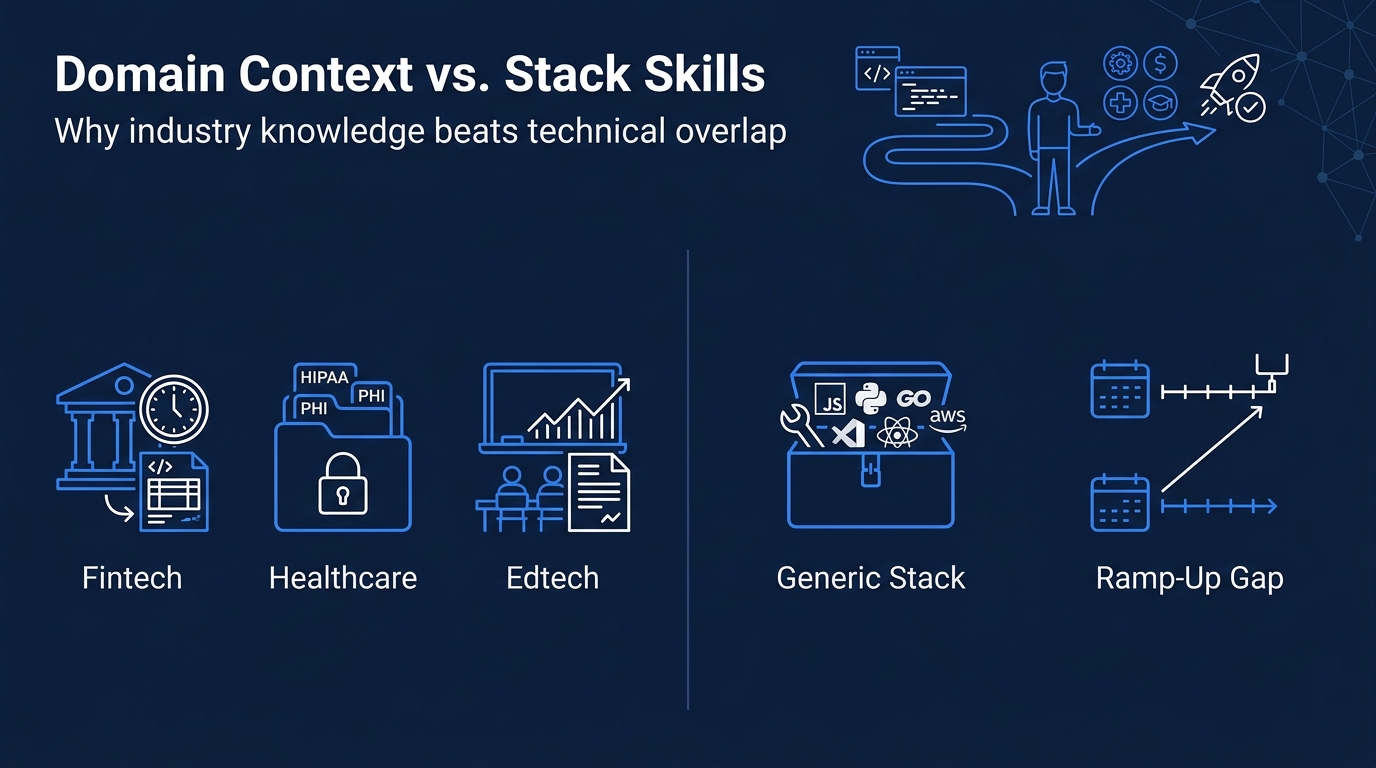
Why Does Domain Context Matter More Than Stack Compatibility?
Domain knowledge is the set of industry-specific rules, failure patterns, and stakeholder expectations an engineer carries before reading a single line of your code. Stack compatibility means an engineer can read and extend your codebase. Domain context means they already know which decisions in that codebase will cause a compliance audit, a settlement failure, or a parent-teacher complaint.
The practical difference shows up immediately in how engineers ask questions. A domain-experienced engineer asks, "Is this transaction idempotent across retry attempts?" A domain-naive one asks, "What does this transaction do?" Both are valid, but the first saves three weeks of discovery.
Concrete areas where domain context replaces ramp-up time:
Regulatory vocabulary: Knowing what KYC, AML, HIPAA, or FERPA implies without needing it explained
Edge-case intuition: Anticipating race conditions specific to financial settlement or concurrent test submissions
Stakeholder empathy: Understanding that a clinician's workflow tolerance differs from a trader's, which differs from a student's
Audit readiness: Writing code that is traceable and explainable to a regulator, not just functional
What Makes Fintech Engineering a Distinct Discipline?
Fintech engineering is a specialized field requiring millisecond-level execution, regulatory reporting obligations, and awareness of failure modes where a bug means financial loss, not just a broken UI.
Key domain requirements when you hire fintech developers:
Requirement | What a generic engineer must learn | What a domain engineer already knows
|
|---|---|---|
Idempotency | Must be taught with examples | Applies by default in payment flows |
ISO 8583 / FIX protocol | Requires weeks of study | Has implemented or maintained it |
Real-time risk calculation | New concept requiring modeling background | Has debugged margin call logic under live conditions |
Audit logging | Treats as optional | Treats as non-negotiable |
Reconciliation windows | Unknown concept | Shapes their architectural decisions |
The cost of missing any one of these is not just time. In a live trading or payment environment, it translates to direct exposure. 724SOFTWARE's work on the SHS Derivatives Trading Platform, for example, required engineers who understood millisecond-level execution to minimize slippage and a real-time risk engine for dynamic margin management. That kind of intuition cannot be onboarded in a two-week sprint.
Why Is Healthcare IT Staffing Different From Other Technical Hiring?
Building on fintech's regulatory complexity, healthcare software engineering adds a second layer: data sensitivity that affects architectural choices at every level. A healthcare software engineer is not just writing APIs. They are deciding how patient data flows, who can access it, how long it is retained, and what happens when a breach occurs.
Healthcare IT staffing must account for:
Data classification habits: Not all PII is equal. Protected Health Information (PHI) carries specific handling rules that shape database design, logging, and caching strategies.
Audit trail depth: Healthcare systems must be able to reconstruct what happened to a record and why, often for litigation or compliance review.
Workflow integration: Clinical staff have rigid workflows. An engineer who has never worked in healthcare often designs UX that clinicians simply will not adopt.
Integration complexity: HL7, FHIR, and EHR connectors are not standard web integrations. They require familiarity with the data standards of the industry.
A generic engineer hired for healthcare IT staffing may have excellent TypeScript skills. They will still spend their first month learning why PHI cannot be stored in a standard application log before they write a single feature.
How Should Edtech Hiring Differ From General SaaS Recruitment?
Stepping back from the compliance-heavy domains of Fintech and Healthcare, Edtech presents a different but equally demanding set of domain constraints. The primary risks are not financial loss or patient harm. They are pedagogical failure and trust erosion among educators, students, and parents.
A domain-aware Edtech engineer understands:
LTI and LMS integration: Canvas, Moodle, and Google Classroom each have integration standards that a platform must respect. Getting this wrong means the product cannot be adopted inside school infrastructure.
Peak-load architecture for exam seasons: Traffic patterns in Edtech are not smooth. They spike dramatically during exams and assignment deadlines. An engineer who has not seen this before will underestimate infrastructure requirements at exactly the wrong moment.
Bias-aware AI design: AI-assisted grading or content generation must be tuned to avoid unfair scoring patterns. This is a domain concern, not a model-selection concern.
Parental and institutional trust: Data governance for minors is stricter than for adults in most jurisdictions, and educational institutions are risk-averse adopters.
724SOFTWARE's Novalearn AI Mentor project required engineers who understood all of these simultaneously: LTI-ready LMS integration, peak-load stability under exam submissions, and bias-mitigation tuning for AI-generated feedback. Generic engineering competence alone would not have covered the delivery surface.
Frequently Asked Questions
Is it better to hire engineers with domain experience or train generalists?
For regulated industries like Fintech and Healthcare, domain experience consistently reduces the first delivery phase by weeks. Generalists can close the gap, but the training cost falls on your team.
How do I assess domain knowledge when hiring fintech developers?
Ask scenario-based questions about failure modes: "What happens if a payment webhook fires twice?" or "How would you handle a settlement discrepancy?" Technical assessments alone miss this.
What does a healthcare software engineer need to know beyond HIPAA?
Beyond HIPAA, expect familiarity with audit trail depth, HL7/FHIR data standards, and clinical workflow constraints. These are rarely covered by general backend experience.
Can a strong software architect cover for missing domain knowledge?
Partly. An architect can identify structural risks, but domain gaps show up in micro-decisions made by individual engineers daily. Architecture reviews do not catch every idempotency error or PHI logging mistake.
How quickly can a domain-experienced team reach productive velocity?
Engineers with prior experience in the same regulated vertical typically reach productive velocity within 2-3 weeks versus 6-8 weeks for domain-naive engineers entering the same environment.
Does domain expertise change the cost profile of engineering hiring?
Yes. Domain-experienced engineers typically carry a higher day rate, but the total cost of a project decreases when discovery, rework, and compliance remediation are reduced.
What is the best engagement model for domain-specific hiring: staff augmentation or a dedicated team?
For Fintech, Healthcare, or Edtech products with ongoing compliance requirements, a dedicated team with stable membership builds domain knowledge over time. Staff augmentation works for short gaps, not for regulated product delivery.
About 724SOFTWARE
724SOFTWARE is a Vietnam-based software engineering company with 200+ professionals, 58% of whom are senior-level engineers, delivering across 10+ countries. The company holds ISO 9001, ISO 27001:2022, SOC 2 Type II, and GDPR compliance, and operates as an official partner with Claude (Anthropic) and Cursor.
With a 95% client retention rate and active delivery experience in Fintech, Digital Healthcare, Edtech, and Enterprise ERP, 724SOFTWARE works with product companies and SaaS businesses as a long-term technology partner, building and operating digital products together. Teams of 1 to 50+ pre-vetted engineers can be assembled within 2-4 weeks, with a guaranteed incident response time under 10 minutes and a follow-the-sun support model.
If you are planning a product build or team expansion in Fintech, Healthcare, or Edtech and want engineers who already speak the language of your industry, visit 724SOFTWARE to discuss how a dedicated, domain-experienced team can be structured around your delivery goals.