

A technical discovery sprint is a time-boxed investigation phase, typically lasting two to six weeks, designed to replace guesswork with verified data about scope, architecture, and risk before full-scale development begins. When you run this phase with a Vietnam software team, you gain the cost structure of offshore delivery without sacrificing the engineering depth needed to make decisions you can actually build on. Done well, a discovery sprint means your first sprint of real development starts from a position of clarity, not assumption.
TL;DR
A technical discovery sprint (two to six weeks) identifies risks, unknowns, and architectural decisions before you commit budget to full delivery
Its purpose is diagnosis, not solution delivery; outputs are decisions and documented findings, not shipped features
A well-structured sprint with a Vietnam software team covers architecture review, technology selection, risk mapping, and delivery estimation.
Involving both technical and product stakeholders from day one prevents the silo effect that derails many discovery phases
The sprint should end with a decision artifact: a go / no-go recommendation with supporting evidence, not a slide deck full of open questions.
About the Author: 724SOFTWARE is a Vietnam-based technology partner with delivery experience across 10+ countries and a 95% client retention rate, having run discovery and delivery engagements for clients in Fintech, Healthcare, Edtech, and Enterprise ERP across Singapore, Australia, the US, and the UK.
What Is the Real Purpose of a Technical Discovery Sprint?
The discovery sprint exists to surface what you do not yet know, not to begin building. This distinction matters more than it sounds. Many teams treat discovery as a formality before the "real work" starts, producing a rough spec and moving on. That misses the point entirely.
The actual outputs of a technical discovery sprint are:
Validated assumptions about the problem, the users, and the system
Identified risks in architecture, integration, and compliance
A prioritized backlog that reflects what was learned, not what was assumed at the outset
A technology recommendation grounded in the specific constraints of the client's environment
The project discovery phase is, at its core, a risk reduction mechanism. Every week you skip in discovery is a risk you carry into delivery, where it costs far more to resolve.
Who Should Be in the Room During Discovery?
Building on the purpose above, the harder question is not what to do in discovery, but who needs to be involved to do it honestly.
A common failure pattern is running technical discovery as a purely engineering exercise. The result is a technically coherent plan that misses business constraints, user behavior, or stakeholder priorities that would have changed every decision.
Effective discovery sprint teams typically include:
Role | Contribution
|
|---|---|
Technical Lead / Architect | Architecture evaluation, technology selection, integration mapping |
Business Analyst | Requirements translation, stakeholder interviews, acceptance criteria |
Product Owner (client side) | Business goals, prioritization, commercial constraints |
QA Engineer | Testability review, edge-case identification |
Delivery Manager | Timeline feasibility, resource planning, dependency tracking |
A key principle here: your client and their stakeholders carry domain knowledge that no external team can replicate. A Vietnam software team working with, for example, a Singapore Fintech platform or an Australian SaaS company needs to treat client-side knowledge as a primary input, not a secondary validation step.
How Should You Structure the Sprint Week by Week?
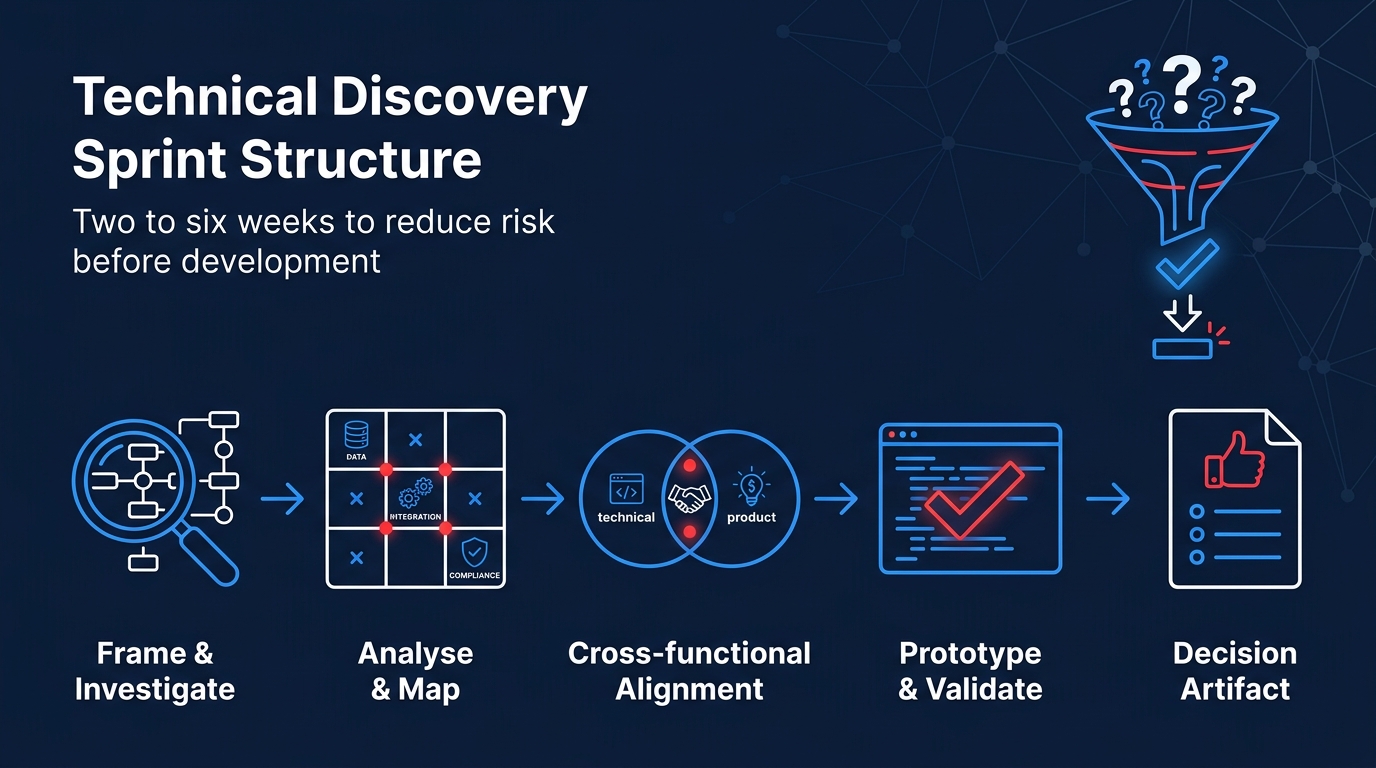
A two-to-six week window is standard, and the internal structure should follow a clear progression from exploration to synthesis to decision.
Week 1: Frame and Investigate
Define the discovery goals in writing before any technical work begins
Conduct stakeholder interviews to surface business constraints and success criteria
Audit existing systems, codebases, or third-party integrations
Document known unknowns as a list the team will work to resolve
Week 2: Analyse and Map
Evaluate the current architecture against stated goals
Identify technical risks by category: data, integration, performance, compliance, and scalability
Build a preliminary technical backlog, separating discovery findings from delivery tasks
Align with the product team on what the sprint has uncovered so far
Weeks 3-6 (if the engagement warrants it): Prototype and Validate
Build narrow proof-of-concept spikes to test the highest-risk assumptions
Validate technology choices against real constraints rather than theoretical benchmarks
Refine delivery estimates using data from the spike, not gut feel
A critical principle throughout: do not jump to a solution before the problem is fully understood. The pressure to propose an architecture in week one is real, especially when clients are eager to see momentum. Resist it.
What Are the Most Common Discovery Mistakes to Avoid?
Stepping back from the structural detail, a separate concern is the behavioral and organizational failures that cause well-structured sprints to produce poor outputs.
Mistake 1: Treating discovery as pre-sales, not diagnosis
Discovery outputs should be honest, even if they reveal that the proposed approach is wrong. A discovery sprint that only confirms the original plan is not discovery; it is a rubber stamp.
Mistake 2: Siloing technical and product tracks
Technical discovery and product discovery need to run in parallel and intersect deliberately. An architecture decision made without product context will be revisited in delivery at significant cost.
Mistake 3: Confusing outputs with deliverables
The output of a discovery sprint is a decision, not a document. A 40-page specification that still leaves the team uncertain about which technology to use has failed its purpose.
Mistake 4: Skipping the backlog
A discovery sprint should produce a prioritized technical backlog that reflects what was learned. Without it, the transition to delivery is a second scoping exercise disguised as planning.
What Should a Discovery Sprint Deliver at the End?
A related but distinct question from how to run the sprint is what you should walk away with. The end artifact should be a concise decision document covering:
Architecture recommendation with rationale and trade-offs documented
Technology stack selection tied to the client's existing ecosystem and team capabilities
Risk register with mitigation strategies for each identified risk
Delivery estimate broken into phases with confidence levels, not a single fixed number
Go / no-go recommendation that gives stakeholders a clear basis for the next decision
If the output cannot support a go / no-go decision, the sprint has not finished.
Frequently Asked Questions
How long should a technical discovery sprint take?
Most discovery sprints run two to six weeks depending on the complexity of the system and the number of open unknowns. Simpler integrations or greenfield projects can complete in two weeks; legacy system audits or regulated industries often need four to six.
Can discovery run in parallel with early development?
Occasionally, but it carries risk. Running discovery and development simultaneously means you may be building on assumptions that the discovery process is actively testing. Separate the phases unless the risk is explicitly managed.
What is the difference between product discovery and technical discovery?
Product discovery validates what to build and for whom. Technical discovery validates how it can be built and at what cost and risk. They should inform each other rather than run independently.
How does a Vietnam software team handle time-zone differences during discovery?
With a follow-the-sun delivery model and overlap sessions scheduled in advance, time-zone gaps become a planning variable rather than a blocker. 724SOFTWARE, for example, supports clients across Singapore, Australia, the US, and the UK from its Vietnam base, with an incident response time under 10 minutes for active engagements.
What happens if discovery reveals the original scope is not viable?
That is a successful discovery sprint. The purpose is to identify root causes and risks, not to validate assumptions you already held. A discovery sprint that surfaces a fundamental problem early saves far more than it costs.
How many engineers do you need for a discovery sprint?
A focused discovery team is typically three to five people: a technical lead, a business analyst, a product-aligned engineer, and optionally a QA engineer and delivery manager. Larger teams add overhead without proportional insight.
Should a discovery sprint produce working code?
Narrow proof-of-concept spikes are appropriate, but shippable features are not the goal. Code produced in discovery should validate assumptions, not be treated as production-ready output.
About 724SOFTWARE
724SOFTWARE is a Vietnam-based technology partner serving startups, SaaS companies, and enterprises across Singapore, Australia, the United States, and the United Kingdom. With 200+ professionals (58% senior-level), ISO 9001, ISO 27001:2022, SOC 2 Type II, and GDPR compliance, and a 95% client retention rate, the company runs technical discovery and full-scale delivery across Fintech, Digital Healthcare, Edtech, and Enterprise ERP.
As an official partner with Claude (Anthropic) and Cursor, 724SOFTWARE integrates generative AI into the software lifecycle to accelerate delivery by approximately 30%. Dedicated teams of one to 50+ pre-vetted engineers can be in place within two to four weeks, making the transition from discovery to full delivery fast and low-friction.
Ready to run a technical discovery sprint before committing to full-scale development? The team at 724SOFTWARE has run discovery and delivery engagements across more than 10 countries and can help you move from uncertainty to a verified plan, fast. Visit https://724software.com.vn/ to start the conversation.