

Fan platforms built for K-pop audiences operate under engineering constraints that most consumer apps never face. When a live music show triggers a global voting window, tens of thousands of users hit the same endpoints simultaneously, within seconds of each other. That is not a traffic spike in the conventional sense; it is a synchronized demand event. Building for it requires deliberate architectural choices around concurrency, fraud prevention, real-time data delivery, and horizontal scaling. If your platform is not designed for this from day one, the live show that should be your biggest marketing moment becomes your biggest outage.
TL;DR
Voting-driven fan platforms face synchronized traffic events, not gradual ramps, requiring different architecture than standard consumer apps.
The core engineering challenges are concurrency handling, vote fraud prevention, real-time chat/feed delivery, and fast horizontal scaling.
Designing for peak load from the start is cheaper than retrofitting after your first viral moment.
Vietnam-based engineering teams offer a practical path to building and maintaining this complexity without the cost burden of onshore hiring in Singapore, Japan, or the US.
724SOFTWARE has direct experience building a global K-pop fandom platform with 500,000+ downloads that handles exactly these traffic patterns.
About the Author: 724SOFTWARE is a Vietnam-based software engineering company with hands-on experience building a live K-pop fandom platform (Higher) for the South Korean market, including a voting system engineered to handle massive concurrent traffic spikes during broadcast events while actively preventing vote fraud.
What Makes Fan Platform Traffic Different from Normal Consumer App Traffic?
Most consumer apps scale for gradual growth. Fan platforms built around live broadcast events scale for cliff-edge demand. When platforms like Fancast or BIGC host real-time voting tied to broadcast schedules, the traffic pattern looks less like an e-commerce sale and more like a DDoS attack on your own infrastructure.
The key differences:
Traffic Type | Consumer App Norm | Fan Platform Reality
|
|---|---|---|
Onset | Gradual ramp | Near-instant spike |
Duration | Hours to days | Minutes to ~1 hour |
User intent | Browse or purchase | Single action, repeated rapidly |
Fraud risk | Payment fraud | Vote manipulation at scale |
Fallback tolerance | High (retry later) | Zero (vote window closes) |
Global K-pop fandom platforms operate across multiple time zones, meaning a South Korean broadcast at 6PM KST may trigger simultaneous traffic from fans in Southeast Asia, Europe, and North America. Your infrastructure needs to absorb this load globally, not just in one region.
What Are the Core Technical Requirements for a Real-Time Voting System?
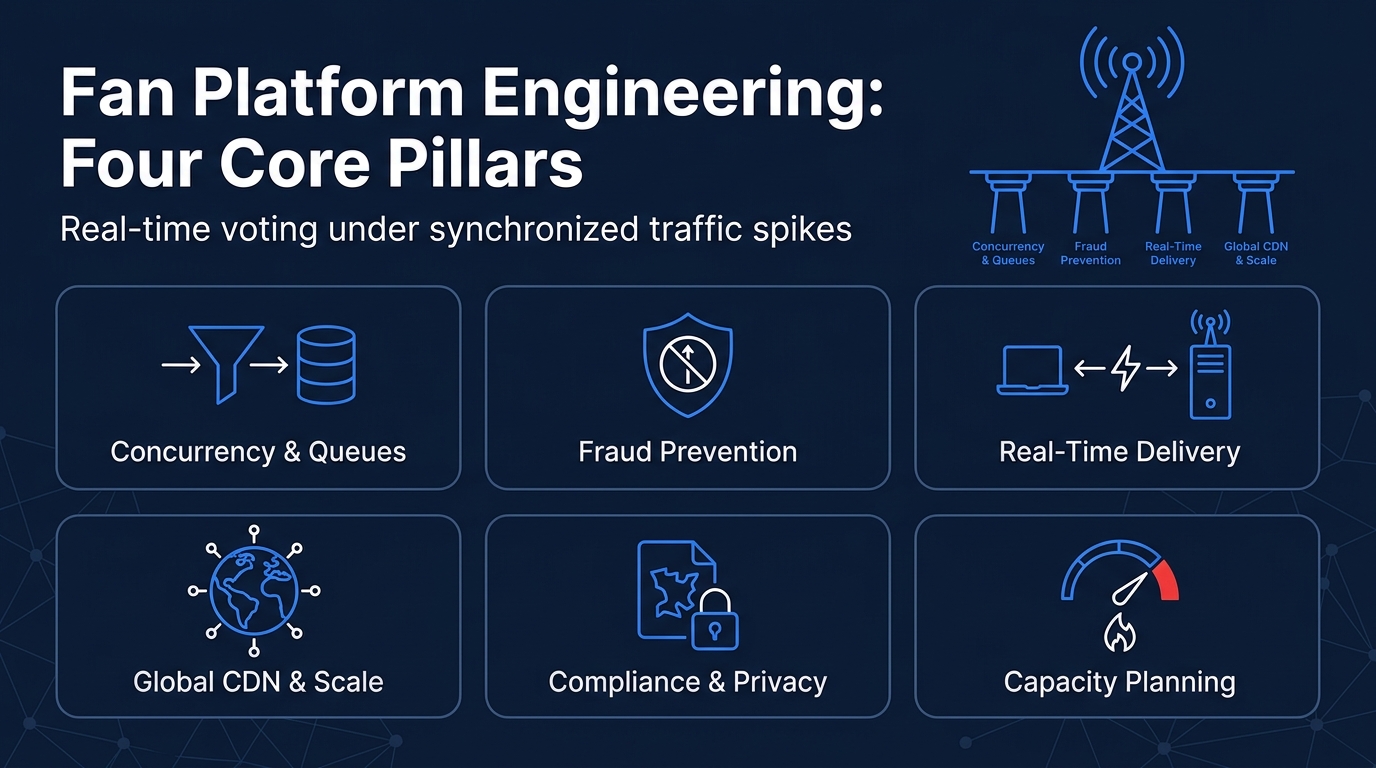
A voting system for a live fan platform rests on four engineering pillars:
1. Concurrency and Queue Management
Write contention is the first thing that breaks. When thousands of users vote simultaneously, naive database writes cause lock contention, timeouts, and data inconsistency. Votes are accepted into a fast in-memory queue (Redis or Kafka), processed asynchronously, and persisted to the primary database. This decouples the accept-rate from the write-rate.
2. Fraud Prevention Without Killing UX
Vote manipulation is a genuine threat in fan ecosystems, where organized fan communities coordinate to inflate counts. Effective countermeasures include device fingerprinting, rate limiting per account and per device, anomaly detection on velocity patterns, and CAPTCHA triggers for suspicious sessions. The engineering challenge is that these controls must not add perceptible latency to legitimate votes during peak windows.
3. Real-Time Results Delivery
Users expect to see live vote counts update as they watch the broadcast. WebSocket connections or Server-Sent Events (SSE) handle this, but both require careful connection management when tens of thousands of concurrent sessions are open. Connection pooling, regional WebSocket servers, and graceful degradation to polling address this requirement.
4. Global Content Delivery
Fan platforms serve users worldwide. Static assets, leaderboards, and artist content need edge caching through a CDN. Dynamic vote tallies require regional aggregation points to avoid every client querying a single origin database.
How Should You Architect for Peak Load When You Cannot Predict Exact Traffic Volume?
Stepping back from the technical detail, a separate concern is capacity planning under uncertainty. You rarely know exactly how many fans will vote during a given show, especially if an artist is having a breakout moment.
The answer is horizontal auto-scaling paired with load testing at multiples of your expected peak:
Define your baseline: What is your average daily active user count?
Model your spike multiplier: Fan platform spikes routinely reach 20 to 50 times baseline within seconds.
Test to destruction: Run load tests at 3x your expected peak before every major voting event, not just during initial launch.
Pre-warm infrastructure: Auto-scaling has a warm-up delay of 60 to 90 seconds for most cloud providers. Pre-warming key services before a known broadcast event eliminates the gap between spike onset and capacity response.
Implement circuit breakers: If a downstream service (payment, notification, analytics) begins failing under load, circuit breakers prevent cascading failures from reaching your core voting service.
This is where custom mobile app development decisions compound over time. A platform built on a monolith that mixes voting logic with content delivery and notifications cannot scale individual components independently. Service separation is not premature optimization for fan platforms; it is a baseline requirement.
What Data Privacy Obligations Apply to a Global Fan Platform?
A related but distinct question is compliance. Global fan platforms collect account data, behavioral data, and in some cases, payment data from users across multiple jurisdictions. When the user base includes minors, the obligations increase significantly.
Key compliance considerations:
GDPR applies to any user in the EU, regardless of where the platform is incorporated.
COPPA (US) and equivalent regulations in South Korea and Japan govern collection of data from minors.
Data residency requirements in some markets (notably South Korea) restrict where user data can be stored.
Privacy due diligence is increasingly a factor in investment decisions for K-pop startup ventures.
Building compliance into the data architecture from the start (consent management, data minimization, audit logging, right-to-erasure workflows) is substantially cheaper than retrofitting it after a regulatory inquiry.
Frequently Asked Questions
Q: How do we handle vote fraud without adding friction for legitimate users?
Use server-side rate limiting and device fingerprinting first. Only surface user-facing challenges (CAPTCHA) when anomaly detection flags suspicious patterns. This keeps the legitimate user experience clean.
Q: What database technology works best for high-concurrency voting?
Redis for the vote ingestion queue, with async persistence to PostgreSQL or a distributed SQL database. Avoid single-table writes as the primary ingestion path.
Q: Do we need a separate infrastructure setup for each regional market?
Not necessarily. A CDN with regional edge nodes handles most static and semi-static content. WebSocket servers benefit from regional placement if your user base is geographically dispersed.
Q: How quickly can a team be assembled for a fan platform build?
With pre-vetted engineers, a dedicated team of 8 to 12 can typically be in place within 2 to 4 weeks, which matters when you have a hard launch date tied to a broadcast schedule.
Q: Is Vietnam a viable location for building this type of platform?
Yes. Vietnam has a deep pool of engineers experienced in Node.js, React Native, and real-time infrastructure. As a Vietnam IT outsourcing company destination, it offers cost efficiency relative to Singapore or US onshore hiring without the quality tradeoff, which is why platforms like Higher were built and scaled here.
Q: What monitoring should we run during a live voting event?
Real-time dashboards on queue depth, write latency, WebSocket connection count, error rates by endpoint, and fraud detection trigger rates. Alert thresholds should be set at 70% of tested capacity limits, not 100%.
Q: How do we ensure 24/7 support during a voting event that spans time zones?
A follow-the-sun support model with a defined incident response time of less than 10 minutes is the standard approach. For production consumer platforms, response times exceeding 10 minutes during a live event can translate directly into lost votes and user trust.
About 724SOFTWARE
724SOFTWARE is a Vietnam-based software engineering company with 200+ professionals, 58% of whom are senior-level engineers, delivering technology products across 10+ countries. The company built Higher, a global K-pop fandom platform for the South Korean market, handling real-time concurrent voting spikes, fraud prevention, and live broadcast traffic at scale, reaching 500,000+ downloads.
As an ISO 27001:2022 and SOC 2 Type II certified organization with a 95% client retention rate, 724SOFTWARE works as a long-term technology partner for SaaS companies, startups, and enterprises, not as a one-off project shop. The company is also an official partner with Claude (Anthropic) and Cursor, integrating practical AI into the software delivery lifecycle to accelerate development by approximately 30%.
If you are building a consumer app that needs to handle synchronized traffic events, real-time data delivery, or a user base that spans global time zones, the architectural decisions you make early will define whether your platform holds or breaks at its most critical moments. Visit https://724software.com.vn/ to talk with engineers who have built exactly this type of system.