

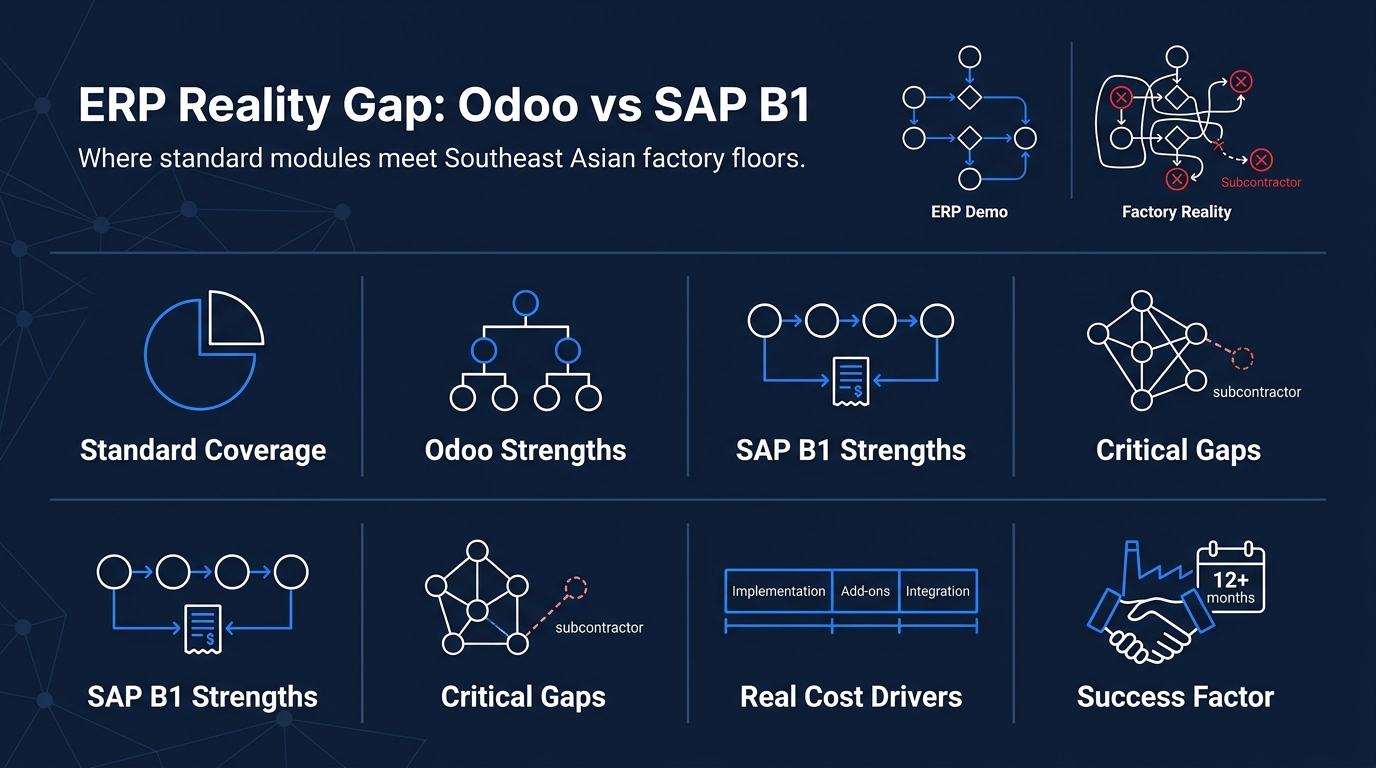
Manufacturers in Southeast Asia routinely discover the same uncomfortable truth: what an ERP demo shows and what survives contact with a real factory floor are two different things. Whether you are evaluating the Odoo manufacturing module or SAP Business One manufacturing capabilities, the standard features cover roughly 70-80% of your operational logic. The remaining 20-30% is where projects stall, budgets overrun, and go-lives get pushed. This article draws on real deployment experience across Vietnam, Singapore, and the broader APAC region to explain exactly where that gap appears and what it takes to close it.
TL;DR
Both Odoo and SAP B1 have credible manufacturing modules, but neither ships ready for the specific bill-of-materials logic, routing complexity, and compliance requirements common in Southeast Asian factories.
The most expensive ERP implementation challenges are not technical; they are process translation problems that surface after go-live.
SAP Business One pricing and Odoo licensing look very different on paper, but total cost of ownership depends far more on customization depth than on license fees.
ERP production planning features in both platforms require significant configuration to handle multi-site, multi-currency, and regional regulatory variation.
A long-term implementation partner matters more than platform choice for manufacturers operating in high-variance environments.
About the Author: 724SOFTWARE is a Top 5 Odoo service partner in Vietnam with completed deployments across manufacturing, retail, F&B, and hospitality. The team has delivered SAP Business One and Odoo implementations for clients including one of Samsung's largest Vietnam dealers, a 101-outlet F&B chain, and a baby-food manufacturer managing multi-channel sales and lot-based COGS calculations.
Why Do ERP Standard Modules Disappoint Manufacturers?
Standard ERP modules are designed for the median use case, not the specific one. For a Southeast Asian manufacturer, the median is a poor fit. Production environments in Vietnam, Thailand, Indonesia, and Malaysia typically involve multi-tier subcontracting, informal warehouse practices, locally specific accounting standards (Vietnam's VAS, for example), and mixed-language workforces operating equipment that predates any ERP by decades.
The result is a predictable mismatch. The software assumes clean, sequential workflows. The factory runs parallel, exception-heavy processes. Reconciling the two is where most ERP implementation challenges originate.
This is not a criticism of either platform. It is a structural reality that any honest implementation assessment should lead with.
How Do the Odoo Manufacturing Module and SAP B1 Manufacturing Features Actually Compare?
Building on that structural reality, the next question is which platform's gap is narrower for your specific context.
Odoo manufacturing module strengths:
- Work order management with real-time progress tracking
- Bill of Materials (BoM) with multi-level variants
- Manufacturing orders linked directly to sales orders
- Quality control checkpoints at configurable production stages
- Relatively short configuration cycle for simple discrete manufacturing
SAP Business One manufacturing strengths:
- Production orders with detailed routing and operation sequencing
- MRP engine that handles dependent and independent demand across multiple warehouses
- Tighter native integration between production, procurement, and financials
- More structured cost-accounting trails, which matters in regulated industries
- Better fit for manufacturers who need auditable landed-cost and variance reporting
Where both platforms fall short in SEA factory contexts:
Gap Area | Odoo Limitation | SAP B1 Limitation
|
|---|---|---|
Subcontract visibility | Limited multi-tier tracking out of the box | Requires add-ons or customization |
Shift-based scheduling | No native shift planning module | Requires third-party integration |
Mixed-unit BoMs | Partial support; needs customization | Supported but complex to configure |
Local compliance (VAS, GST variants) | Requires localization extensions | Country-specific add-ons vary in quality |
Machine downtime integration | No native IoT connection | Available via SAP partner ecosystem only |
The honest answer is that neither platform wins unconditionally. SAP B1 carries more depth for complex discrete and process manufacturing. Odoo moves faster to a working baseline for mid-sized operations with simpler workflows.
What Does SAP Business One Pricing Actually Mean for a Mid-Sized Manufacturer?
SAP Business One pricing is one of the most misunderstood topics in ERP evaluation conversations. The license model has moved substantially toward subscription, but the number that matters for manufacturers is not the per-user fee.
The real cost drivers are:
- Implementation services: Configuration of the manufacturing module, routing setup, and MRP tuning typically represent the majority of project cost.
- Localization add-ons: Vietnam, Indonesia, and Malaysia each require tax and accounting extensions not included in the base license.
- Integration work: Connecting SAP B1 to warehouse management systems, production floor terminals, or logistics partners adds cost that rarely appears in initial quotes.
- Post-go-live support: Production environments generate exceptions daily. Support contracts are not optional for manufacturers.
Odoo's licensing is more transparent and module-based, which makes early budgeting easier. But customization depth to match factory-specific logic can close much of the cost gap. The SAMNEC deployment (Samsung's largest Vietnam dealer) illustrates this: achieving the advanced promotion and discount engine required across wholesale and retail operations demanded significant Odoo customization beyond standard modules.
Where Does ERP Production Planning Break Down in Practice?
ERP production planning is the capability that manufacturers expect most from an ERP and where disappointment runs deepest. The core failure modes follow a pattern:
1. Demand signal quality: MRP engines in both platforms assume reliable sales forecasts. Most SEA manufacturers operate with informal or Excel-based forecasting that does not map cleanly into ERP demand inputs.
2. Lead time accuracy: Standard lead times in both systems are static. Real factories deal with supplier variability, customs delays, and peak-season compression that make static parameters wrong before the ink dries.
3. Multi-site coordination: Manufacturers with assembly in one location and finishing in another run into data-model limitations in both platforms without deliberate architectural work upfront.
4. Lot and batch traceability: For food, pharmaceutical, and electronics manufacturers, lot-level tracking from raw material to finished goods is non-negotiable. This is achievable in both Odoo and SAP B1, but requires careful module configuration, not default settings. The Baby Corporation Vietnam deployment for FrutoNyanya is a direct example: complex COGS by lot and batch across multiple sales channels required custom engineering on top of standard Odoo manufacturing logic.
Stepping back from the technical detail, a separate concern is organizational. ERP production planning only works if production supervisors trust the data. Adoption failure is as common as configuration failure in Southeast Asian deployments, particularly in environments with low prior digital exposure.
Frequently Asked Questions
Is Odoo or SAP B1 better for a Vietnamese manufacturer?
It depends on complexity. Odoo is faster to deploy and more cost-efficient for mid-sized discrete manufacturers. SAP B1 offers deeper production order management and financial integration for more complex operations.
What are the biggest ERP implementation challenges in Southeast Asia?
Process translation (mapping informal factory workflows to system logic), local compliance gaps, and post-go-live adoption are consistently the top three. Technical integration with legacy equipment is a close fourth.
Can the Odoo manufacturing module handle multi-level BoMs?
Yes, but multi-level variant BoMs with subcontracting require customization beyond the standard module to work reliably in practice.
How long does an ERP implementation take for a mid-sized manufacturer?
Timelines vary significantly by scope. A focused Odoo deployment covering manufacturing, inventory, and purchasing typically runs 4-12 months. SAP B1 projects with full MRP configuration tend to run longer.
Is SAP Business One pricing transparent?
The per-user licensing is published, but total project cost depends heavily on implementation services, localization, and integration scope, which are not standardized.
What is the risk of choosing a short-term implementation vendor?
Post-go-live, factories generate constant exceptions requiring ERP adjustments. A vendor focused on project delivery alone leaves manufacturers maintaining complex customizations without ongoing partner support to handle the operational reality that emerges after launch.
Do generative AI tools help with ERP implementations?
Yes, practically. AI tools like Claude and Cursor can accelerate requirements documentation, configuration testing, and user-acceptance test scripting by approximately 30%, reducing implementation cycle time measurably.
About 724SOFTWARE
724SOFTWARE is a long-term technology partner specializing in ERP implementation, custom software development, and managed IT services for manufacturers, retailers, and enterprises across Southeast Asia and APAC. As a Top 5 Odoo service partner in Vietnam with completed SAP Business One deployments across F&B, retail, and manufacturing, the team of 200+ professionals (58% senior-level) brings hands-on experience closing the gap between standard ERP modules and real operational requirements. 724SOFTWARE holds ISO 9001, ISO 27001:2022, SOC 2 Type II, and GDPR certifications, and operates as a dedicated delivery partner with ongoing ODC and managed services, not a project-only vendor, with a 95% client retention rate that reflects that commitment.
If your manufacturing ERP is underperforming against factory-floor reality, the gap is usually solvable with the right long-term partner and the right customization approach. To discuss your specific deployment challenges and explore how 724SOFTWARE can support your operation over the long term, visit https://724software.com.vn.