

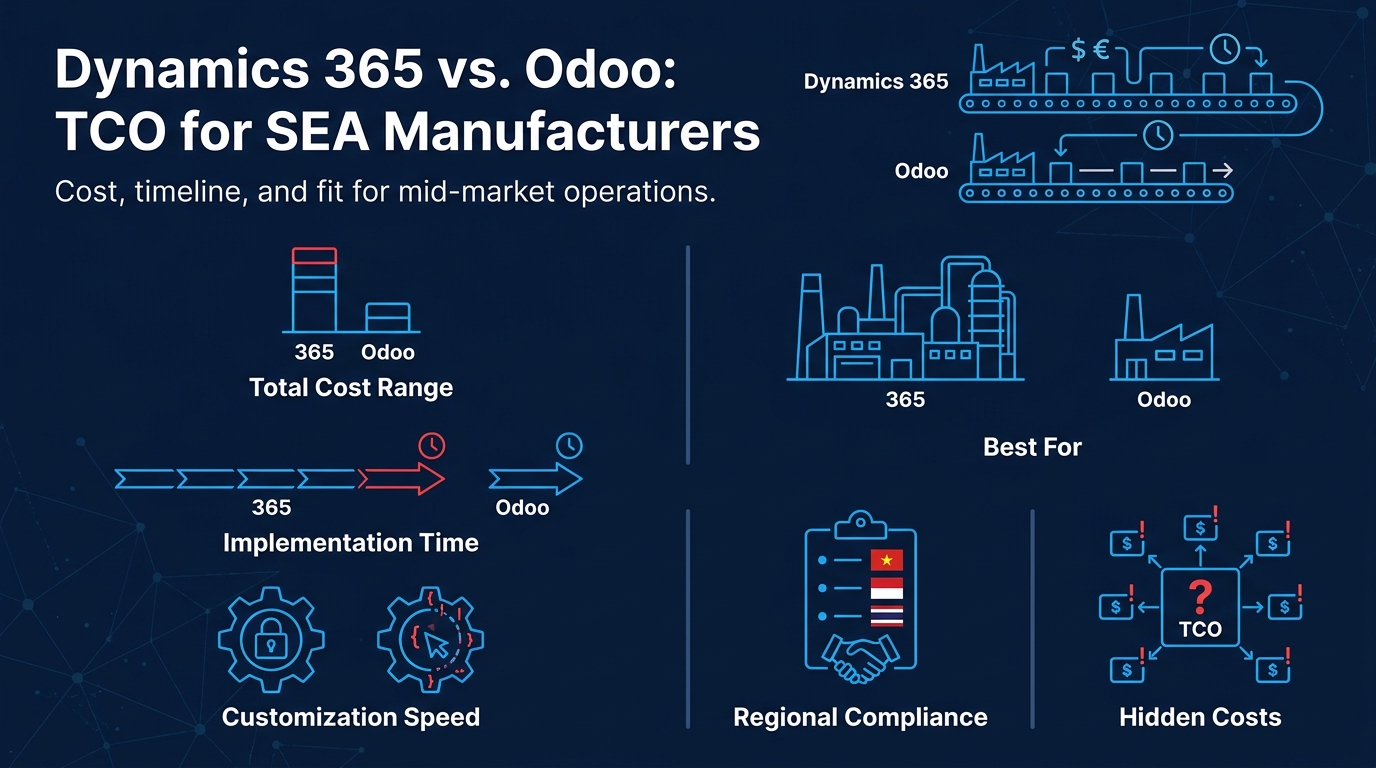
For mid-market manufacturers in Southeast Asia evaluating ERP systems in 2026, the choice between Microsoft Dynamics 365 and Odoo is not simply a features comparison. It is a financial and operational commitment that will shape your manufacturing operations for years. Dynamics 365 typically runs $150,000 to $1,000,000+ in total cost with a 6 to 14-month implementation timeline, while Odoo comes in at $10,000 to $80,000 with a 1 to 4-month deployment window. For most mid-market manufacturers in the SEA region, that gap has a name: opportunity cost.
TL;DR
Dynamics 365 total cost ranges from $150K to $1M+; Odoo ranges from $10K to $80K for comparable mid-market scope.
Dynamics 365 implementation takes 6 to 14 months; Odoo typically goes live in 1 to 4 months.
Odoo is generally the stronger fit for small to mid-sized manufacturers that prioritize customization speed and cost efficiency.
For SEA manufacturers, local implementation partner quality and regional compliance readiness matter as much as the platform itself.
Total cost of ownership includes licensing, implementation, customization, integration, training, and ongoing support. Compare all six, not just the subscription line.
About the Author: This analysis is written by the team at 724SOFTWARE, a certified Odoo service partner in Vietnam and a certified Microsoft platform implementer, with direct delivery experience across manufacturing, retail, logistics, and enterprise ERP projects in Southeast Asia and the APAC region.
What Does Total Cost of Ownership Actually Mean for ERP in Manufacturing?
Total cost of ownership (TCO) is the full financial picture of running an ERP platform over a defined period, typically three to five years. It goes well beyond the subscription fee.
For manufacturers, TCO breaks down into six components:
Cost Component | Dynamics 365 | Odoo
|
|---|---|---|
Licensing (annual) | Per-user, per-module; pricing varies by tier | Community (free) or Enterprise ($24 to $47/user/month) |
Implementation | $150K to $1M+ | $10K to $80K |
Implementation timeline | 6 to 14 months | 1 to 4 months |
Customization | High; requires certified developer ecosystem | Modular, Python-b |
Integration effort | Deep Microsoft ecosystem; complex for non-MS stacks | Open API; integrates with most third-party tools |
Ongoing support | Enterprise support contracts; higher baseline cost | Community support + partner-based support tiers |
For SEA manufacturers specifically, add currency exposure, local tax compliance (GST, VAT, e-invoicing mandates), and the availability of regional implementation partners to that list.
Why Do Mid-Market SEA Manufacturers Lean Toward Odoo?
Building on the cost gap above, the harder question is why that gap exists and whether it reflects a quality tradeoff or a scope tradeoff.
The honest answer is: mostly scope.
Dynamics 365 Finance and Operations is architected for enterprise-scale complexity: multi-entity consolidation, advanced regulatory compliance across dozens of jurisdictions, and deep integration with Azure and the Microsoft 365 ecosystem. That architecture is legitimate and valuable at the right scale. But for a Vietnamese, Indonesian, or Thai manufacturer running $5M to $30M in annual revenue, those capabilities come bundled into a platform that takes 6 to 14 months to implement, requires certified Dynamics 365 implementation partners, and produces consulting fees that can dwarf the software cost itself.
Three specific reasons mid-market SEA manufacturers choose Odoo instead:
Implementation overhead: D365 F&O implementations average 12 to 24 months. Odoo's 1 to 4-month window means faster ROI.
Customization flexibility: SEA manufacturing operations often carry regional specifics, such as local accounting standards, multi-currency workflows, and trade compliance nuances. Odoo's Python-based module architecture allows targeted customization without rearchitecting the entire system.
Total cash outlay: At the $10K to $80K implementation range, Odoo leaves budget for integration work, staff training, and continuous improvement. That reinvestment compounds over time.
Where Does Dynamics 365 Still Win for Manufacturers?
Stepping back from the cost argument, a separate concern is capability ceiling. Odoo's flexibility has limits, and there are manufacturing scenarios where Dynamics 365 is the more defensible choice:
Multi-entity, multi-jurisdiction manufacturers consolidating financials across three or more legal entities with different tax regimes.
Microsoft-first IT environments where Power BI, Azure, and Microsoft 365 are already central to operations. The native integration reduces total integration cost significantly.
Manufacturers with complex supply chain finance requirements, such as intercompany transactions, advanced cost accounting, or regulated industry reporting (medical devices, aerospace components).
Publicly listed or PE-backed manufacturers where audit trail depth and compliance documentation meeting investor reporting standards are non-negotiable.
Dynamics 365 is also faster for organizations where the Microsoft ecosystem is already in place, because the integration overhead is lower. The platform's power is real; it is the implementation and customization cost that makes it a difficult fit for most mid-market SEA buyers.
What Should SEA Manufacturers Evaluate Beyond the Platform?
A related but distinct question is whether platform selection is even the most important decision. In practice, the implementation partner's regional knowledge often determines outcome more than the software itself.
Key evaluation criteria for SEA manufacturers:
Local compliance coverage: Does your partner have experience with Vietnamese, Indonesian, or Thai e-invoicing and tax standards built into their implementation methodology?
Industry-specific modules: Manufacturing requires MRP, BOM management, quality control, and warehouse integration. Confirm these are configured, not just licensed.
Data migration capability: Moving from legacy systems (Excel, local ERP, or paper-based workflows) without production disruption is a significant technical lift.
Post-go-live support model: A platform is only as good as the support behind it. Confirm SLA terms, response times, and escalation paths before signing.
Team stability: Frequent consultant turnover mid-implementation is one of the leading causes of ERP project failure. Ask for named leads and tenure data.
Frequently Asked Questions
Is Odoo suitable for manufacturers with complex production scheduling?
Yes. Odoo's Manufacturing module includes MRP, work orders, Bill of Materials management, and capacity planning. For most mid-market SEA manufacturers, these cover the majority of scheduling requirements without custom development.
Can Dynamics 365 and Odoo integrate with local SEA accounting and e-invoicing standards?
Both platforms support integration with local tax and e-invoicing systems, but the depth of out-of-the-box compliance varies by country. Partner-built localization is typically required for Vietnam, Indonesia, and Thailand. Partner experience with local standards is the deciding factor.
How long does an Odoo implementation take for a mid-market manufacturer?
Typically 1 to 4 months for a standard scope. Complex customizations or multi-site deployments extend this timeline. A phased approach with a core module go-live followed by incremental rollout is common.
Is the Odoo Community edition a viable option for cost savings?
Community is free but lacks several features important to manufacturers: advanced inventory valuation, multi-company consolidation, and official support. Most mid-market implementations use Odoo Enterprise, priced per user per month, which remains significantly cheaper than Dynamics 365 at comparable user counts.
What hidden costs should SEA manufacturers watch for in Dynamics 365 projects?
The most common underestimated costs are partner consulting fees, data migration complexity, change management and user training, and post-go-live hypercare support. These can push total project cost well above initial license estimates.
How do I evaluate an ERP implementation partner's quality?
Ask for reference clients in your industry and country, review their certified headcount on the specific platform, and confirm their post-go-live support SLA in writing. Certifications such as ISO 9001 and ISO 27001 indicate process maturity and data handling standards.
Can a manufacturer start with Odoo and migrate to Dynamics 365 later?
It is technically possible but operationally disruptive. Most manufacturers who start with Odoo and scale the platform find that Odoo's Enterprise tier, combined with targeted customization, continues to meet their needs without migration. Plan for your five-year growth scenario upfront.
About 724SOFTWARE
724SOFTWARE is a Vietnam-based technology partner with 200+ professionals (58% senior-level) and direct delivery experience across 10+ countries. As a certified Odoo service partner in Vietnam and a certified Microsoft platform implementer, 724SOFTWARE has implemented ERP solutions for manufacturers, retailers, and distributors across Southeast Asia, covering Odoo, Microsoft Dynamics 365, and SAP Business One. The company holds ISO 9001 and ISO 27001:2022 certifications and operates a 24/7 support model with incident response under 10 minutes, making it a practical choice for manufacturers who need a committed, long-term implementation and support partner rather than a one-time project vendor.
If you are a mid-market manufacturer in Southeast Asia evaluating Dynamics 365 or Odoo for 2026, the right platform decision starts with the right partner conversation. Reach out to the team at https://724software.com.vn to discuss your specific production environment, compliance requirements, and budget, and get a clear TCO estimate for both paths before you commit.