

When APAC clients evaluate offshore engineering partners, language capability is rarely the headline criterion. It should be. Technical skill determines what a team can build; language alignment determines whether the right thing gets built at all. Engineering teams that can collaborate in Mandarin, Korean, or Japanese reduce the miscommunication overhead that silently inflates timelines, introduces specification errors, and strains client relationships. The difference is not cosmetic. It runs deep into how teams understand requirements and deliver outcomes.
TL;DR
Language barriers in engineering teams cause miscommunication, specification drift, and delayed delivery that compound over time.
Mandarin, Korean, and Japanese fluency in an offshore team removes a hidden friction layer that English-only setups cannot eliminate for APAC clients.
Multilingual capability is a delivery mechanism, not a cultural nicety: it directly shortens feedback loops and reduces rework cycles.
724SOFTWARE operates with multilingual collaboration across English, Mandarin, Korean, and Japanese, with a 95% client retention rate across 10+ countries.
The right question is not "can the team code?" but "can the team understand precisely what the client needs, in the language the client thinks in?"
About the Author: 724SOFTWARE is a Vietnam-based technology partner with 200+ professionals and delivery experience across 10+ countries, including active long-term engagements with clients in Hong Kong, South Korea, Japan, and Singapore. The company's multilingual engineering capability, covering English, Mandarin, Korean, and Japanese, is a deliberate delivery strategy, not an after-thought.
Why Does Language Friction Matter More Than Most Engineering Leaders Admit?
Language barriers in engineering teams do not announce themselves as "language barriers." They show up as requirements that were almost understood, as sprint reviews where the client nods but revises the next day, and as handoff documents that lose precision in translation. By the time the rework is logged, the root cause is invisible.
Research into cross-cultural business communication confirms that cultural and linguistic differences significantly affect the performance of teams working across language boundaries. In engineering contexts, this is compounded because technical vocabulary is already compressed and context-dependent. A term like "soft delete," "idempotent request," or "settlement finality" does not translate cleanly through a linguistic intermediary without domain knowledge on both sides.
For APAC clients specifically, the problem is structural. A Singapore Fintech company with Mandarin-speaking founders, a Korean e-commerce platform, or a Japanese enterprise rolling out ERP across regional offices cannot rely on English-only communication to capture the precision their delivery requires. Nuance, hierarchy, and implied context in business communication vary significantly across Japanese, Korean, and Mandarin-speaking business cultures.
What Specifically Changes When a Team Can Communicate in the Client's Language?
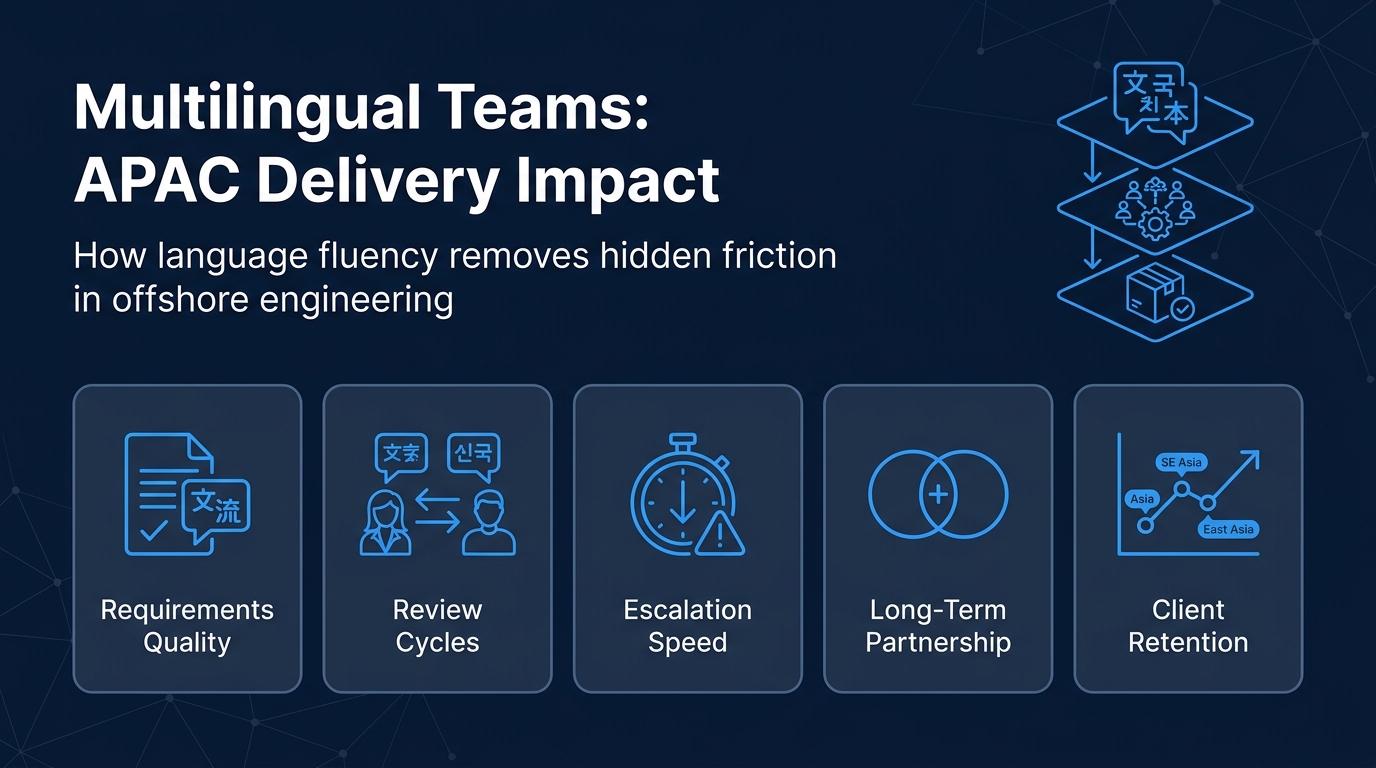
Building on that structural friction point, the operational impact of multilingual capability shows up in three concrete places: requirements quality, review cycles, and escalation speed.
Requirements quality: When a client can articulate a business rule in Mandarin or Korean and be understood directly, without a relay through an interpreter or a simplified English paraphrase, the specification that enters the development backlog is more accurate from the start. Fewer assumptions are baked in. Fewer assumptions mean fewer corrections downstream.
Review cycles: Sprint reviews, UAT sessions, and stakeholder demos are where language gaps most visibly erode trust. A client who cannot precisely express what is wrong in English may approve a deliverable they are not satisfied with, only to raise it during production. Multilingual review capacity collapses this gap.
Escalation speed: When an incident occurs, the ability to communicate urgency and technical detail directly in the client's language cuts resolution time. Layers of translation add minutes to critical incidents. At 724SOFTWARE, incident response is guaranteed at under 10 minutes, and that SLA is only credible when the communication channel is as direct as the technical one.
A directly relevant example: HCLTech's global tech support work demonstrates that deploying multilingual engineers with Japanese, Korean, and Mandarin capabilities is a deliberate architectural choice for serving complex APAC clients, not a hiring convenience.
Is Mandarin, Korean, or Japanese Capability Equally Relevant for Every APAC Engagement?
Not equally, but each language opens a distinct client segment with different delivery dynamics.
Language | Primary Client Context | Key Delivery Impact
|
|---|---|---|
Mandarin | Hong Kong Fintech, Singapore regional HQs, China-linked enterprises | Precision in financial logic, regulatory terminology, founder-level requirements |
Korean | Seoul-based product companies, K-content platforms, Korean enterprise expansions in SEA | Fast-paced sprint culture, direct feedback norms, specific QA expectations |
Japanese | Japanese enterprises with Vietnam or SEA operations, ERP rollouts, IT outsourcing | High-context communication, documentation precision, formal review protocols |
Japan's corporate engineering culture places particular weight on documentation quality and process fidelity. Money Forward's widely discussed transition to an English-first engineering environment illustrates how deliberately language choices are treated in Japanese engineering organisations. An offshore partner that can meet Japanese clients in their preferred communication register, rather than asking the client to adapt, removes a significant barrier to engagement.
How Does Multilingual Capability Affect Long-Term Partnership, Not Just Project Start?
A related but distinct question is whether multilingual capability matters beyond initial onboarding. It does, and the effect compounds over time.
Long-term technology partnerships with APAC clients develop institutional vocabulary: product-specific terms, internal process names, business logic shorthand that evolves over months of shared delivery. A team that can absorb and use that vocabulary in the client's language builds shared context faster and retains it more durably. This is part of why 724SOFTWARE maintains a 95% client retention rate. The teams do not just understand the code; they understand the client's business in the language the client uses to describe it.
The Higher case study is illustrative. 724SOFTWARE's engagement with a South Korean K-pop fandom platform ran for 24+ months with a team of 8 engineers. Sustaining that relationship over two years, across a voting system that handles massive concurrent traffic spikes during live broadcasts, required more than technical competence. It required the ability to communicate precisely with a Korean product team about user behaviour, fraud prevention logic, and real-time performance under pressure. That communication happened directly, not through an intermediary.
What Should APAC Clients Actually Ask When Evaluating an Offshore Engineering Partner's Language Capability?
Stepping back from delivery specifics, the evaluation question most clients ask is too shallow. "Do your engineers speak Japanese?" is less useful than asking:
Can engineers conduct technical requirement sessions in Japanese/Korean/Mandarin without an interpreter?
Is language capability distributed across the team, or concentrated in one account manager?
Has the team worked with clients in that language for multi-year engagements, not just onboarding calls?
Can engineers read and write technical documentation in the target language, not just speak conversationally?
The distinction between conversational fluency and technical fluency in a target language is significant. Conversational fluency handles pleasantries and status updates. Technical fluency handles a debate about database schema naming conventions, a disagreement about UAT criteria, or a compliance requirement explained in regulatory Japanese.
Frequently Asked Questions
Does language capability replace the need for strong English communication in a global team?
No. English remains the operational lingua franca for most global engineering workflows. Multilingual capability is additive: it removes friction in client-facing communication without replacing English as the internal delivery language.
How do you verify that an engineer has technical, not just conversational, language fluency?
Ask the engineer to conduct a mock requirements session or review a technical specification in the target language. Conversational fluency breaks down quickly under domain-specific vocabulary.
Does multilingual capability slow down hiring or team ramp-up?
It does not have to, if the partner has a pre-vetted talent pool with those capabilities. 724SOFTWARE scales teams from 1 to 50+ engineers in 2 to 4 weeks, with multilingual capability factored into the staffing profile.
Is multilingual support more relevant for certain industries?
Yes. Fintech, Healthcare, and Enterprise ERP in APAC tend to involve the most language-sensitive delivery because compliance terminology, financial logic, and business process language are least forgiving of approximation.
What certifications should an offshore partner hold for APAC enterprise clients?
For regulated industries, look for ISO 9001, ISO 27001:2022, SOC 2 Type II, and GDPR compliance as minimum standards. These are independent of language capability but equally important for enterprise trust.
Can a Vietnam-based team realistically support Japanese or Korean enterprise clients at the required communication standard?
Yes, and the evidence is in sustained client relationships. Vietnam has a growing population of engineers with Japanese and Korean language skills, partly due to strong bilateral economic ties and language training programs. The key is selecting a partner where those engineers are embedded in the delivery team, not just in a support or sales function.
How does Follow-the-Sun delivery interact with multilingual capability?
Timezone alignment between Vietnam and APAC client markets (Japan, Korea, Singapore, Hong Kong) is already close. Combined with a Follow-the-Sun model and under-10-minute incident response, multilingual teams can handle escalations in the client's language at the moment they matter most.
About 724SOFTWARE
724SOFTWARE is a Vietnam-based technology partner delivering engineering services, custom software development, and managed IT services to clients across Singapore, Australia, the United States, the United Kingdom, and the broader APAC region. With 200+ professionals (58% senior-level), ISO 9001, ISO 27001:2022, SOC 2 Type II, and GDPR compliance, and multilingual capability across English, Mandarin, Korean, and Japanese, the company operates as a dedicated long-term partner, not a project-by-project vendor. As an official partner of Claude (Anthropic) and Cursor, 724SOFTWARE integrates practical generative AI tooling into the software delivery lifecycle to accelerate delivery by approximately 30%. With a 95% client retention rate and a team that scales from 1 to 50+ engineers in 2 to 4 weeks, 724SOFTWARE is built for clients who are not just launching products, but operating them over the long term.
If your APAC client base includes Mandarin, Korean, or Japanese-speaking stakeholders and you are evaluating whether your current offshore partner can genuinely serve them, the conversation starts at https://724software.com.vn.