

When you hire an offshore software team to build for Singapore, Japanese, or Korean markets, English fluency alone is not enough. The real friction in these engagements comes from cultural context gaps, localisation blind spots, and the inability to read native-language documentation, regulatory text, or stakeholder feedback without a translation layer in between. Teams that operate only in English consistently produce longer feedback cycles, higher rework rates, and products that miss subtle but commercially important nuances in their target markets.
TL;DR
English-only offshore teams introduce avoidable friction when building for Japanese, Korean, and Singaporean markets where regulatory, cultural, and UX expectations are language-dependent.
Japan's immigration policy now explicitly requires Japanese language proficiency for certain engineering roles, raising the bar on what "bilingual delivery" means in practice.
Multilingual collaboration is not just a communication perk; it directly affects requirements accuracy, compliance documentation, and user acceptance testing quality.
Offshore teams with native or near-native language support reduce the revision cycles that inflate project timelines and erode delivery confidence.
The right long-term technology partner combines multilingual capability with engineering depth, not one at the expense of the other.
About the Author: 724SOFTWARE is a Vietnam-based software engineering company with delivery experience across 10+ countries, including Singapore, Japan, South Korea, Hong Kong, and Australia. The company's engineering team includes multilingual professionals operating in English, Mandarin, Korean, and Japanese, and has built production-grade digital products for capital markets, Edtech, and enterprise ERP clients across APAC.
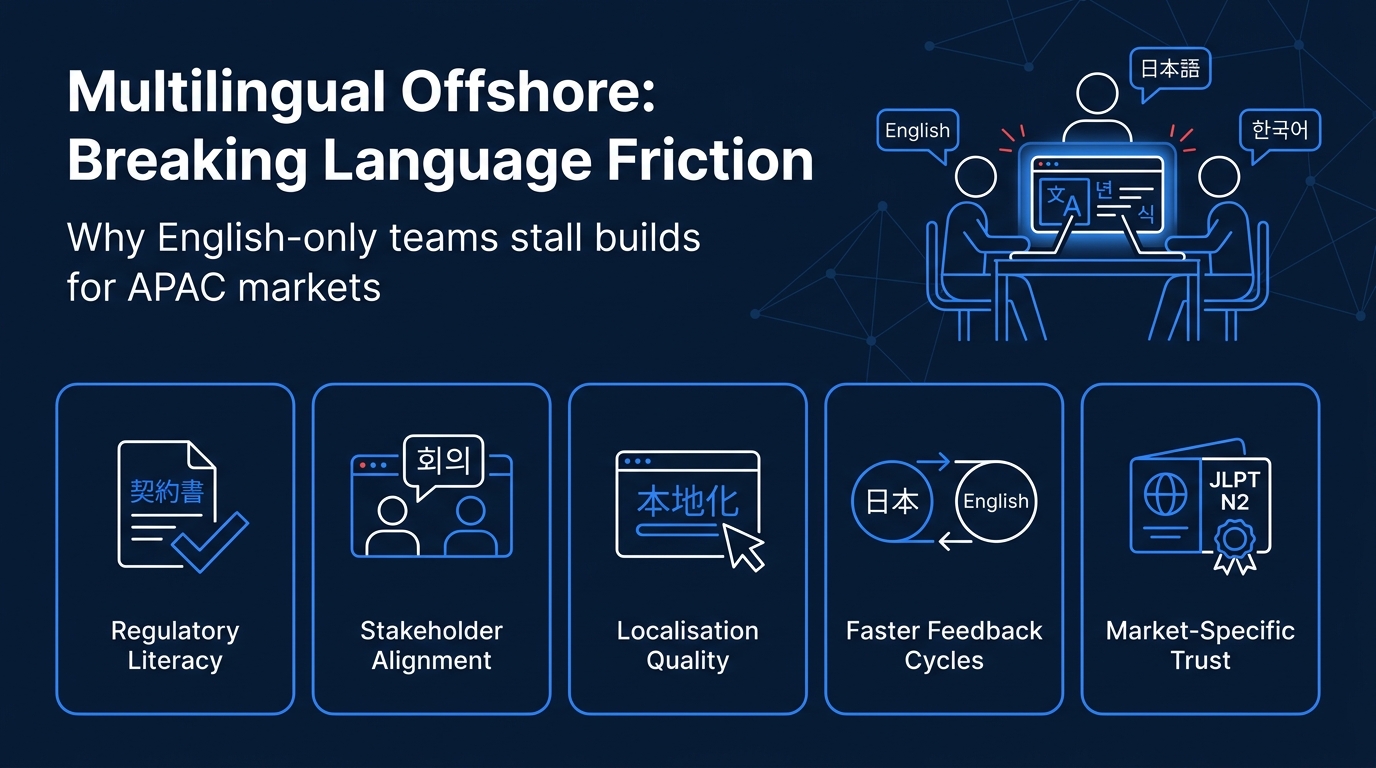
What Does "Language Friction" Actually Cost an Offshore Build?
Language friction is the accumulated delay, rework, and misalignment that occurs when an offshore team cannot engage directly with market-specific inputs: local regulatory documents, native UX copy reviews, client stakeholder calls in a second language, or user acceptance feedback written in Japanese or Korean.
This friction is measurable in concrete ways:
Longer requirements cycles: A Singapore Fintech client writing compliance requirements that reference MAS guidelines, or a Korean client sending feedback in Hangul, must pause and translate before the offshore team can act. Each translation handoff adds latency.
Higher defect rates in localisation: UI strings, date formats, currency symbols, and right-to-left or character-based rendering decisions require someone on the team who reads the target language natively, not just runs it through a machine translator.
Stakeholder trust erosion: When a client in Tokyo cannot get a direct answer from their offshore team in Japanese, the relationship defaults to email chains and formal handoffs. That pattern is incompatible with agile delivery.
Language barriers are consistently cited as a root cause of delayed timelines and reduced quality in offshore projects, particularly where cultural differences compound the communication gap.
Why Japan's Market Is Raising the Language Bar in 2026
Building on the general friction problem, Japan presents a specific and rapidly escalating case. The Japanese government has moved from encouraging language proficiency to requiring it. As of mid-April 2026, applicants for the engineer and specialist in humanities/international services visa must submit proof of Japanese language proficiency at JLPT N2 level or CEFR B2 equivalent if the role qualifies under the updated criteria.
This is not a soft cultural preference. It is a regulatory requirement that affects how offshore teams engage with Japanese clients on-site, how Japanese-based subsidiaries staff projects, and how any engineer placed in Japan must be credentialed.
What this means for teams building Japanese-market products:
Documentation, sprint reviews, and client-facing communication increasingly need to function in Japanese, even when the delivery team is offshore.
Japanese enterprise clients are accustomed to high-context communication norms. An English-only team cannot navigate nemawashi (consensus-building), ringi (approval workflows), or omotenashi (service orientation) expectations without a cultural and linguistic bridge.
Regulatory filings, system audit trails, and compliance records for Japanese financial or healthcare products are written in Japanese. A team that cannot read them is building blind.
Interestingly, some Japanese technology companies are moving the opposite direction internally. Money Forward, a major Japanese Fintech company, has transitioned its engineering organisation of over 400 members to operate fully in English. This trend toward English-first internal engineering at Japanese firms does not eliminate the need for Japanese fluency with external stakeholders; it actually increases demand for bilingual engineers who can operate in both registers.
How Singapore and Korea Create Their Own Distinct Language Requirements
Stepping back from Japan's regulatory specifics, Singapore and South Korea present different but equally real language requirements for offshore teams.
Singapore operates as a multilingual business hub where English is the administrative language, but Mandarin is the dominant language for a large portion of the enterprise client base and the broader regional supply chain. Many Singapore-headquartered companies have teams or subsidiaries in mainland China, Taiwan, or Malaysia where Mandarin documentation is standard. An offshore team that can only work in English will hit a wall the moment the engagement touches those layers.
South Korea presents one of the steeper language barriers in APAC for offshore collaboration:
Korean business culture places high value on direct communication with senior stakeholders in Korean, particularly during sales cycles, change management discussions, and post-launch support.
Korean-market consumer products, particularly in entertainment, gaming, and finance, have highly specific UX copy expectations that machine translation consistently fails to replicate at the quality level Korean users expect.
Regulatory documents from the Financial Services Commission (FSC) or the Ministry of Science and ICT are published in Korean, with English translations often lagging or unavailable for new guidelines.
A practical example from 724SOFTWARE's own delivery: the Higher platform, a K-pop fandom application built for a South Korean client over 24+ months, required ongoing engagement with Korean stakeholders managing artist campaigns, voting mechanics, and fan community moderation. That product reached 500,000+ downloads in part because the team could engage directly with Korean-language requirements and user feedback, rather than routing every input through an interpreter.
What Should You Actually Look for in a Multilingual Offshore Partner?
A related but distinct question is: what does genuine multilingual capability look like in practice, versus a team that simply claims it on a capabilities slide?
Capability | What to Ask | Red Flag
|
|---|---|---|
Language depth | Which engineers speak which languages at what level? | "Our PM speaks some Japanese" |
Documentation handling | Can the team read and write in the target language for specs and UAT? | All docs require client-side translation |
Stakeholder communication | Can a technical lead join a client call in the target language? | English-only video calls with async translation |
Regulatory literacy | Has the team worked with local compliance documents before? | No prior market-specific delivery experience |
Cultural context | Does the team understand local UX and business norms? | Generic UI/UX with no localisation testing |
724SOFTWARE's engineering team operates in English, Mandarin, Korean, and Japanese, which is a direct response to the geographic profile of its client base across Singapore, Japan, South Korea, Hong Kong, and the broader APAC region. This is not a translation service sitting alongside the engineering team; it is language capability embedded within it.
Frequently Asked Questions
Does an offshore team really need to speak Japanese or Korean, or can English suffice for technical work?
For purely internal technical tasks, English can function. But requirements gathering, UAT feedback, regulatory review, and stakeholder alignment all require direct language capability in markets like Japan and Korea. The cost of translation overhead compounds across a project's lifetime.
Is machine translation good enough for handling Korean or Japanese documentation?
Not for compliance-sensitive or UX-critical content. Machine translation handles vocabulary but misses register, formality level, and domain-specific regulatory terminology, all of which matter in Fintech, Healthcare, and enterprise software.
How has Japan's 2026 visa policy changed offshore engagement models?
Japan now requires JLPT N2 proof for certain engineer visa categories. This raises the credentialing bar for any offshore engineer placed in Japan and signals that Japanese-language proficiency is becoming a formal expectation, not just a preference.
Does Singapore require Mandarin capability in an offshore team?
Not legally, but commercially yes. A large share of Singapore's enterprise and SME base operates in Mandarin with cross-strait or regional supply chains. Teams limited to English will miss significant communication layers.
How quickly can a multilingual offshore team be assembled?
At 724SOFTWARE, pre-vetted engineers with specific language profiles can be added to a dedicated team within 2-4 weeks, using the same ramp model applied to technical skill sets.
What industries benefit most from multilingual offshore teams?
Fintech, Digital Healthcare, and Edtech in APAC markets see the highest benefit, because regulatory documentation, user trust, and localisation quality are all directly tied to language accuracy.
Is this only relevant for large enterprises?
No. Mid-sized SaaS companies and product teams building for Japanese or Korean users face the same friction. The scale of the problem is proportional to how much the product depends on market-specific content, compliance, or stakeholder engagement.
About 724SOFTWARE
724SOFTWARE is a Vietnam-based software engineering company providing dedicated teams, custom software development, and managed IT services for startups, SaaS companies, and enterprises across Singapore, Australia, the United States, the United Kingdom, and the broader APAC region. With 200+ professionals (58% senior-level), ISO 9001 and ISO 27001:2022 certifications, SOC 2 Type II and GDPR compliance, and a 95% client retention rate, the company operates as a long-term technology partner rather than a project-based vendor. Multilingual delivery in English, Mandarin, Korean, and Japanese is built into the team structure, not bolted on as a support function.
If your next build targets Singapore, Japan, or South Korea and your current offshore team operates only in English, the friction is already costing you time and quality. Visit 724SOFTWARE to discuss how a multilingual dedicated team can be structured around your specific market and product requirements.