

Choosing between Odoo and a fully custom software build is one of the most consequential technology decisions a mid-market company in APAC will make in 2026. The surface-level price comparison, license fee versus developer day rate, obscures the full picture. The answer is found in total cost of ownership (TCO) calculated across a 3-5 year horizon, factoring in implementation, customization, integration, support, and the compounding cost of getting the decision wrong.
TL;DR
Odoo licensing starts at $0 (Community) and scales across paid tiers: Standard at $16.90/user/month (annual) or $21.10/user/month (monthly), and Custom at $25.50/user/month (annual) or $31.90/user/month (monthly), but licensing is only one cost layer.
Full Odoo implementation for a mid-market company typically runs $20,000 to $100,000+ depending on scope, modules, and integrations.
Custom builds carry higher upfront costs but can deliver a lower TCO over 5+ years if your workflows are genuinely outside what Odoo covers.
Hidden costs, including data migration, change management, and ongoing module maintenance, consistently account for 30-50% of total spend in both paths.
The answer depends on your workflow complexity, integration footprint, and how much you plan to scale. A structured software development cost calculator approach, laid out below, helps make this concrete.
About the Author: 724SOFTWARE is a Top 5 Odoo service partner in Vietnam with end-to-end implementation experience across retail, manufacturing, logistics, and distribution, and a custom software practice that has shipped production systems for clients across 10+ countries.
What Does Odoo Actually Cost in 2026?
Odoo pricing in 2026 operates across three tiers, and the gap between them is wider than most buyers initially expect.
Tier | License Cost | Key Constraint
|
|---|---|---|
Community (Free) | $0 | No official support, limited modules |
One App Free | $0 | Single-app only |
Standard | ~$16.90/user/month (annual) / ~$21.10/user/month (monthly) | Multi-app, cloud hosted |
Custom (Enterprise) | ~$25.50/user/month (annual) / ~$31.90/user/month (monthly) | Full module access, custom hosting |
The license fee is the predictable part. What follows is not.
Typical implementation cost ranges for mid-market companies:
Discovery and scoping: $5,000 to $12,000
Configuration and setup: up to $10,000
Custom module development: $1,500 to $40,000+ depending on scope
Data migration from legacy systems: costs vary significantly by data volume and source system complexity
Training and change management: often underestimated, typically 10-15% of implementation fees
Total first-year cost for a mid-sized company: commonly $20,000 to $100,000+
For APAC companies in markets like Singapore, Australia, or Vietnam, the partner rate for Odoo implementation varies considerably. Vietnam-based partners deliver the same certified Odoo implementation at a fraction of the cost of onshore Singapore or Australian consultants, without cutting corners on quality.
What Does a Custom Software Build Actually Cost Over 3 Years?
Building on the Odoo cost picture above, the custom build comparison requires a different accounting framework because the cost profile is front-loaded differently.
A custom build for a mid-market APAC company with standard ERP-adjacent requirements (inventory, sales, finance, HR) will typically involve:
Year 1 (Build Phase):
- Requirements analysis and architecture: $10,000 to $30,000
- Core development (5-12 engineers, 6-18 months): costs depend on team location, seniority mix, and scope
- QA and security testing: 15-20% of development cost
- DevOps, infrastructure setup, and deployment: variable by cloud provider and architecture
Year 2-3 (Operate and Evolve Phase):
- Bug fixes, regression testing, and patching: ongoing
- Feature additions as the business scales: often underestimated at procurement
- Infrastructure costs: server, database, CDN, monitoring
- Engineering team retention or re-engagement costs if the original team disperses
The honest framing: custom software almost never gets cheaper after Year 1. It accumulates maintenance debt that compounds if the team that built it is not the team that maintains it.
How to Build Your Own TCO Comparison: A Practical Calculator Framework
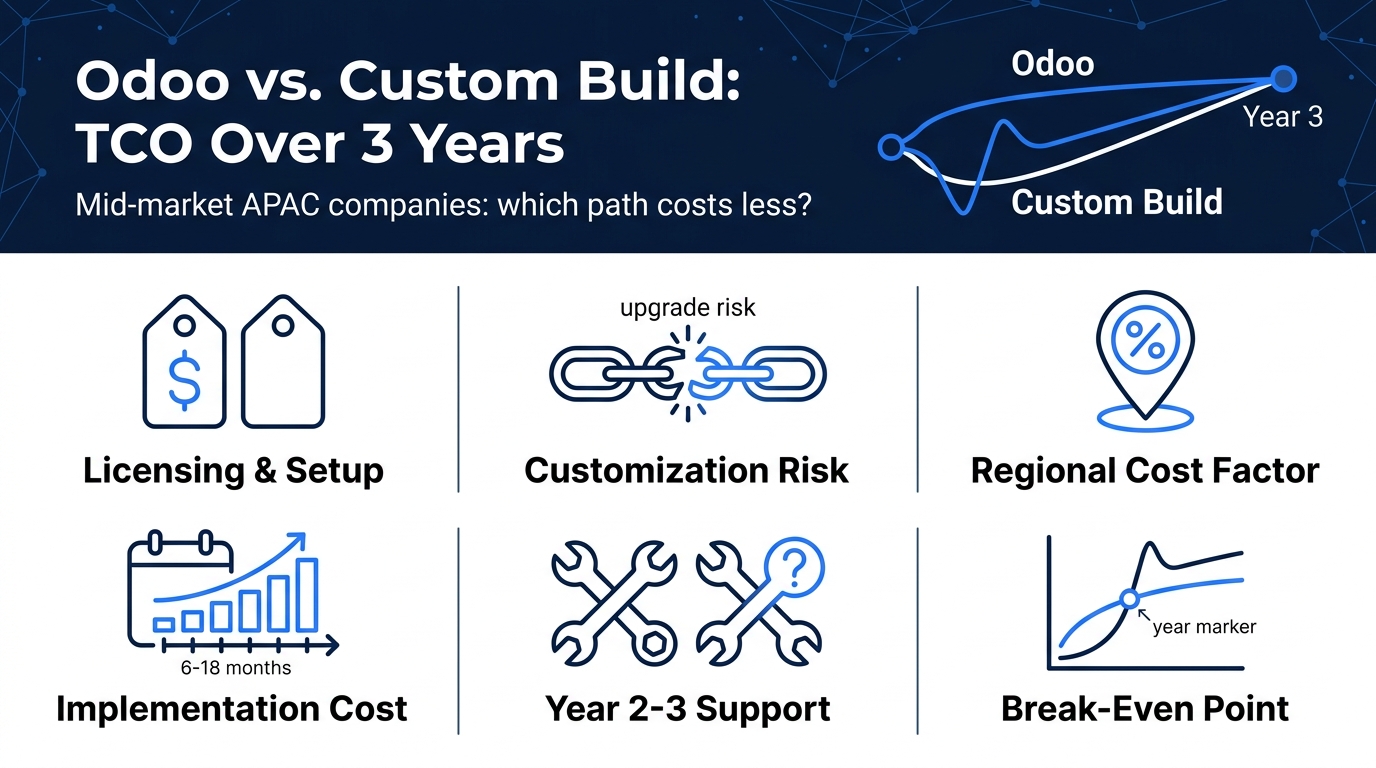
A useful software development cost calculator for this decision covers six cost categories across a 3-year window.
Step 1: Define your user count and module scope
Odoo pricing is per-user. A 50-user deployment on the Custom plan at $25.50/user/month (annual billing) adds up to roughly $15,300 per year in license fees, or $19,140 per year if paying month-to-month at $31.90/user/month. Custom software has no per-user license fee but has no ceiling on infrastructure cost either.
Step 2: Estimate implementation cost
Use the ranges above as your baseline, then adjust for:
- Number of Odoo modules (each adds configuration and testing cost)
- Number of third-party integrations (each API connection adds risk and time)
- Data migration complexity from your current system
Step 3: Calculate your customization premium
This is where Odoo vs. custom converges. Heavily customized Odoo (more than 30% of core workflows modified) can approach the cost of a targeted custom build, while introducing upgrade risk]. If your process fits 70-80% into standard Odoo modules, you are in the sweet spot. If your process requires fundamental changes to Odoo's core data model, a custom build may be cheaper by Year 3.
Step 4: Factor in ongoing support costs
Both paths carry support costs. Odoo Enterprise includes official support; Odoo Community does not. Custom software requires dedicated engineering capacity to maintain. A dedicated team model (rather than re-engaging a project shop each time) produces more predictable Year 2-3 costs due to team continuity and process knowledge retention.
Step 5: Apply a regional cost multiplier
For APAC companies, where the engineering team is located matters as much as what you build. A Vietnam-based implementation team or dedicated engineering team delivers comparable output at 40-50% of the cost of onshore Singapore or Australian teams, without sacrificing quality or security compliance.
Step 6: Stress-test your assumptions against a 5-year horizon
Small businesses commonly invest $5,000 to $20,000 for Odoo implementation. Mid-market companies with complex workflows regularly see total 5-year ownership costs exceed $150,000 when support, upgrades, and incremental customization are included. Custom builds can look expensive at Year 1 but flatten out if the architecture was done well.
Odoo vs. Microsoft Dynamics: A Mid-Market Reality Check
The Odoo vs Microsoft Dynamics comparison comes up frequently for APAC companies moving off spreadsheets or legacy on-premise systems. The practical distinction for a 20-100 person company:
Dynamics 365 carries higher per-user licensing and a more complex implementation footprint, typically suited to companies with dedicated internal IT and finance teams.
Odoo's modular structure and lower per-user cost make it more accessible at the 20-100 employee range, especially when paired with a certified implementation partner.
The integration story differs: Dynamics 365 integrates natively with Microsoft 365, Azure, and Power Platform. If your organization is already in the Microsoft ecosystem, this native connectivity reduces integration work and cost.
Each platform excels in different contexts. The decision traces back to your existing stack, your internal IT capacity, and your 3-year growth plan.
Frequently Asked Questions
Q: Can I start with Odoo Community and upgrade to Enterprise later?
Yes, migration from Community to Enterprise is technically possible, but any custom modules built on Community will require re-testing and potential rework. Factor this into your initial architecture decision.
Q: How long does a typical mid-market Odoo implementation take?
Scope-dependent, but a 5-8 module implementation for a 50-user company typically runs 3-6 months from kickoff to go-live, assuming properly structured data migration and available internal stakeholders.
Q: What are the most commonly overlooked Odoo costs?
Data migration from legacy systems, user training (especially in low digital-literacy environments), and post-go-live module maintenance are consistently underestimated.
Q: When does a custom build make more financial sense than Odoo?
When your core workflows require changes to Odoo's fundamental data model, when you need deep integration with proprietary systems that Odoo cannot connect to cleanly, or when you are building a product (not an internal tool) that will be sold to customers.
Q: Does a Vietnam-based implementation team affect quality or compliance?
Quality and compliance depend on partner certifications, not geography. ISO 9001 and ISO 27001:2022 certification cover the delivery process, not just the final product. Partners with SOC 2 Type II and GDPR compliance meet requirements for regulated industries in Singapore, Australia, and the UK.
Q: How do I calculate ROI on an ERP investment?
Track three metrics: reduction in manual processing hours, reduction in errors or rework, and speed of financial close. Most mid-market Odoo deployments recover implementation cost within 18-24 months if go-live is clean.
Q: What is the risk of over-customizing Odoo?
Heavy customization creates upgrade debt. Each new Odoo version may break custom modules, requiring re-testing and re-development. The practical ceiling for sustainable customization is around 20-30% of core module behavior.
About 724SOFTWARE
724SOFTWARE is a Vietnam-based technology company and a Top 5 Odoo service partner in Vietnam, delivering end-to-end ERP implementation, custom module development, and long-term support for mid-market companies across APAC. With 200+ professionals (58% senior-level), ISO 9001, ISO 27001:2022, SOC 2 Type II, and GDPR compliance, the company operates as a dedicated technology partner rather than a one-off project vendor.
Clients include large-scale Odoo deployments in retail, logistics, distribution, and manufacturing. A 95% client retention rate reflects the depth of these partnerships and the company's commitment to ongoing delivery and operational support.
If you are working through an Odoo vs. custom build decision for your business and want a structured TCO analysis applied to your specific context, the team at 724SOFTWARE has done this calculation for companies across Singapore, Australia, Vietnam, and the broader APAC region. Contact 724SOFTWARE at https://724software.com.vn/ to discuss your implementation roadmap.