

Choosing the wrong offshore engagement model costs more than money. It costs time, continuity, and control. The three most common models - Offshore Development Center (ODC), Dedicated Team, and Staff Augmentation - solve genuinely different problems, and confusing them leads to either over-engineering a simple capacity gap or under-investing in a long-term product need. The short answer: Staff Augmentation fills short-term skill gaps quickly; a Dedicated Team embeds a pre-vetted group into your workflow for sustained delivery; an ODC is a wholly owned offshore capability hub built for strategic, multi-year operation.
TL;DR
Staff Augmentation is best for plugging specific, short-term skill gaps - fast to start, but limited in team cohesion and continuity.
A Dedicated Team is the mid-to-long-term play: a stable, embedded group that operates as an extension of your internal team.
An ODC is a capital investment - your own offshore delivery hub, with the highest setup cost but the greatest long-term control.
When comparing these models on the "staff augmentation vs outsourcing" spectrum, the key variables are time horizon, desired control, and acceptable management overhead.
For most mid-market SaaS and product companies, a Dedicated Team offers the best balance of speed-to-value, quality, and cost efficiency without the overhead of running your own offshore entity.
About the Author: This article is written by the 724SOFTWARE team - a Vietnam-based technology partner with 200+ professionals, 95% client retention, and delivery experience across 10+ countries spanning Fintech, Digital Healthcare, Edtech, and Enterprise ERP.
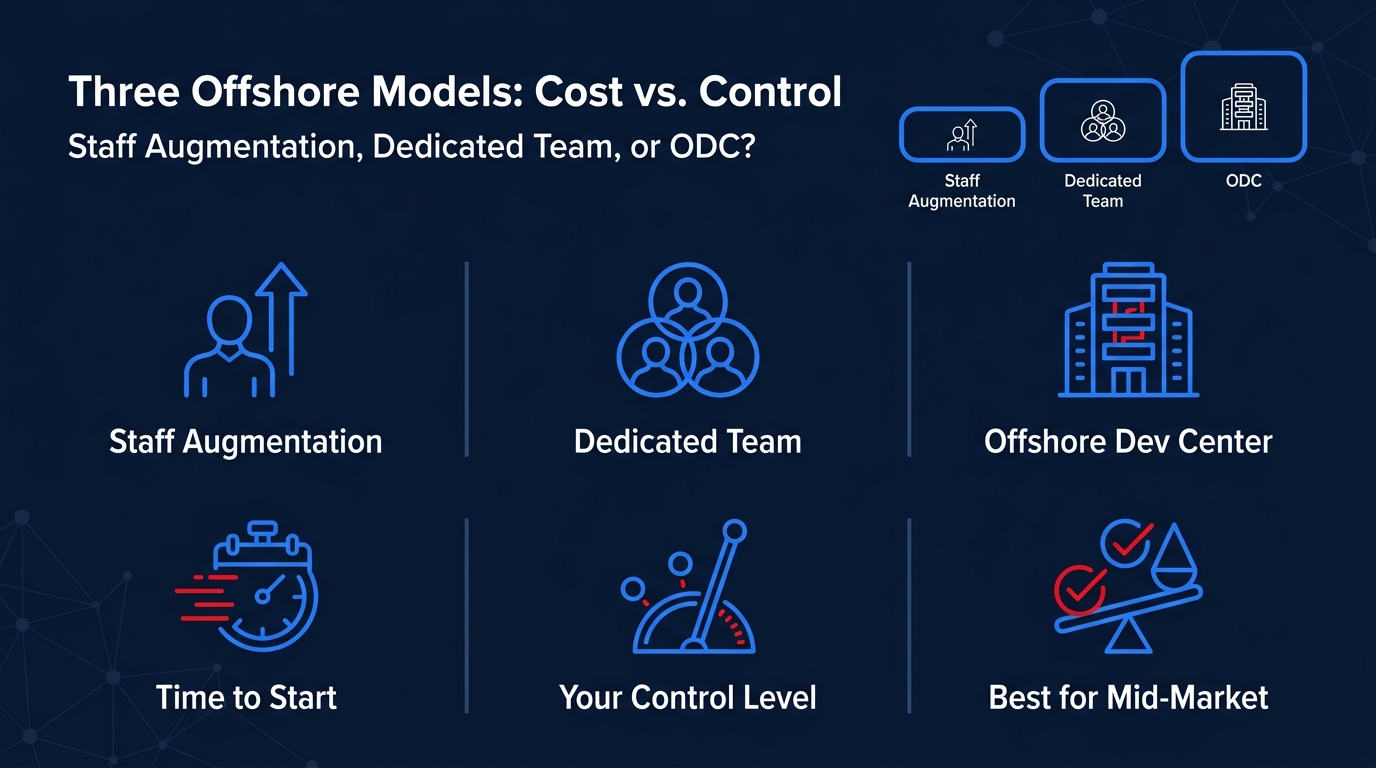
What Exactly Are These Three Models?
These terms are often used interchangeably, which creates real confusion when scoping an engagement.
Staff Augmentation: You hire individual engineers or specialists from an external provider to work within your existing team, under your direct management. The vendor handles HR and payroll; you handle direction.
Dedicated Team: A provider assembles and manages a full team - developers, QA, DevOps, BA - that operates exclusively for you. The team is embedded in your workflow but the vendor retains employer responsibilities.
Offshore Development Center (ODC): You establish a permanent offshore delivery hub, typically under your own brand. The vendor provides infrastructure, HR, and admin support. You own the process, the IP, and the roadmap.
How Do the Three Models Compare on Cost and Control?
Building on those definitions, the real decision point is understanding the tradeoffs across five dimensions: cost structure, time to start, control level, management overhead, and suitability for long-term work.
Dimension | Staff Augmentation | Dedicated Team | ODC
|
|---|---|---|---|
Cost structure | Pay per individual resource | Fixed monthly team rate | Setup cost + ongoing operational cost |
Time to start | Days to 2 weeks | 2-4 weeks | 3-6+ months |
Client control | High (direct management) | Medium-high (shared) | Very high (full ownership) |
Management overhead | High (you direct everyone) | Low-medium (vendor PM layer available) | High (you run the center) |
Team continuity | Low (individuals rotate) | High (stable, dedicated group) | Very high (your permanent workforce) |
Best for | Short-term skill gaps | Ongoing product delivery | Strategic, multi-year capacity |
Minimum commitment | Often 3-6 months per resource | Typically 6-12 months | 12-24+ months |
When Does Staff Augmentation Actually Make Sense?
Staff Augmentation is the right call in a narrower set of scenarios than most buyers assume. Because individual contributors rotate and there is no shared team context, augmentation works best when:
A specific technical skill is missing for a defined period (e.g., a security engineer for a penetration-testing sprint).
Your internal team can absorb and manage the extra headcount without friction.
The engagement is unlikely to extend beyond six months.
IP ownership and knowledge transfer are not a primary concern.
Where it breaks down: when you need autonomous delivery. Augmented staff require your managers' time, and that overhead compounds as headcount grows. For product companies that need a team shipping features every sprint, augmentation is structurally the wrong model.
When Is a Dedicated Team the Better Choice?
A Dedicated Team occupies the practical middle ground on the staff augmentation vs outsourcing spectrum, and for most mid-market product and SaaS companies, it is the model that delivers the best return across cost, speed, and continuity.
Key scenarios where it outperforms the alternatives:
Sustained product development where institutional knowledge compounds over time (team members who have been on the product for 12+ months are measurably faster than new hires).
Fast ramp-up requirements without the capital expenditure of an ODC. A well-structured dedicated team provider can place a pre-vetted group in 2-4 weeks.
Mid-market budgets that cannot justify the setup and administration costs of a fully owned offshore center.
Companies that want senior talent without Singapore or US-equivalent hiring costs.
At 724SOFTWARE, dedicated teams of 1 to 50+ engineers can be assembled in 2-4 weeks from a pool of pre-vetted professionals, 58% of whom are senior-level. That ramp speed matters: for a Singapore-headquartered SaaS company, the alternative is a 3-6 month local hiring cycle at 3-4x the per-seat cost.
When Does an ODC Justify the Overhead?
An ODC is not for everyone, and it is rarely the right first move. It makes sense when:
Scale is large enough to absorb setup and governance costs (typically 30+ engineers sustained over 24+ months).
IP control is paramount and the company wants its offshore team to legally and operationally mirror its own headcount.
Long-term strategic investment in a geography is planned, with the eventual possibility of transferring full ownership
The trade-off is real: ODCs require the client to invest in offshore HR, facilities, compliance, and management infrastructure. The payoff is maximum control and, at scale, lower per-seat cost. But for companies under 100 employees, the overhead rarely justifies the benefit before a Dedicated Team model has been validated first
What Does Each Model Cost in Practice?
Precise figures depend on geography, seniority, and stack. However, the cost logic is consistent across providers:
Staff Augmentation carries the lowest per-engagement setup cost but the highest management overhead per dollar spent, because every resource requires direct client-side direction.
Dedicated Teams bundle team management, delivery processes, and reporting into the monthly rate, which typically makes the total cost of ownership lower than augmentation at equivalent headcount
ODCs have the highest setup cost (legal entity, infrastructure, HR systems) but the lowest marginal per-seat cost at scale once the center is operational.
Vietnam-based delivery providers offer a cost structure that is meaningfully more efficient than onshore hiring in Singapore, Australia, or the US without the quality tradeoff that buyers sometimes associate with offshore models. The variable is not just the hourly rate - it is the total cost including ramp time, attrition, and management overhead.
Frequently Asked Questions
What is the main difference between staff augmentation and a dedicated team?
Staff Augmentation adds individual contractors to your existing team under your direct management. A Dedicated Team is a fully assembled group that operates as an independent unit within your workflow, with shared context and continuity
Is staff augmentation the same as outsourcing?
Not exactly. On the staff augmentation vs outsourcing spectrum, augmentation keeps management on the client side, while outsourcing (including dedicated teams and ODCs) transfers varying degrees of operational responsibility to the vendor
Which model is fastest to start?
Staff Augmentation, typically within days to two weeks. Dedicated Teams can be operational in 2-4 weeks with a provider that maintains a pre-vetted bench. ODCs require 3-6+ months to establish
Which model gives the client the most control?
ODC gives the highest long-term control since the client owns the offshore entity. For day-to-day engineering decisions, Staff Augmentation also gives high control since the client directly manages individuals. Dedicated Teams sit between the two
What is the minimum team size for a dedicated team model to make sense?
Most providers can start a dedicated team at 2-3 engineers. The model becomes more cost-effective than augmentation once you need 5 or more people working together on the same product continuously.
How do I choose between an ODC and a Dedicated Team?
Start with a Dedicated Team unless you already have 30+ engineers and a confirmed multi-year strategic need in a specific geography. ODCs are the graduation path from a proven dedicated team engagement, not the starting point.
What certifications should I look for in a dedicated team or ODC provider?
For any regulated industry (Fintech, Healthcare), prioritize providers with ISO 27001:2022, SOC 2 Type II, and GDPR compliance. ISO 9001 covers delivery quality management. These certifications are not marketing labels - they imply auditable processes, not just policies.
About 724SOFTWARE
724SOFTWARE is a Vietnam-based technology partner providing dedicated teams, ODC delivery, and full-stack software engineering for mid-market SaaS companies, Fintech firms, and enterprises in Singapore, Australia, the US, the UK, and across the APAC region. With 200+ professionals (58% senior-level), ISO 9001, ISO 27001:2022, SOC 2 Type II, and GDPR compliance, and a 95% client retention rate, the company works as a long-term technology partner, building and operating digital products with clients through dedicated teams and ongoing delivery. As an official partner of Claude (Anthropic) and Cursor, 724SOFTWARE integrates generative AI tools directly into the software delivery lifecycle to accelerate delivery by approximately 30%, with a guaranteed incident response time under 10 minutes and a follow-the-sun support model.
If you are evaluating which offshore model fits your product roadmap and budget for 2026, the 724SOFTWARE team can walk you through a practical side-by-side based on your actual team size, timeline, and compliance requirements. Visit https://724software.com.vn to start the conversation.