

A proof-of-concept (POC) with an offshore Vietnam software team does not have to be a binary choice between "small test" and "full commitment." The right structure lets you validate technical fit, team quality, and working rhythm before scaling, while building a clear, pre-agreed path toward a long-term engagement if the evidence supports it. Done well, a POC is not a gate that blocks progress; it is the first stage of a continuous delivery relationship.
TL;DR
A POC tests whether an idea or technology works in principle; a pilot tests whether it works at operational scale. Knowing the difference prevents you from running the wrong experiment.
Define success criteria before the work starts, not after, so both sides agree on what "passing" looks like.
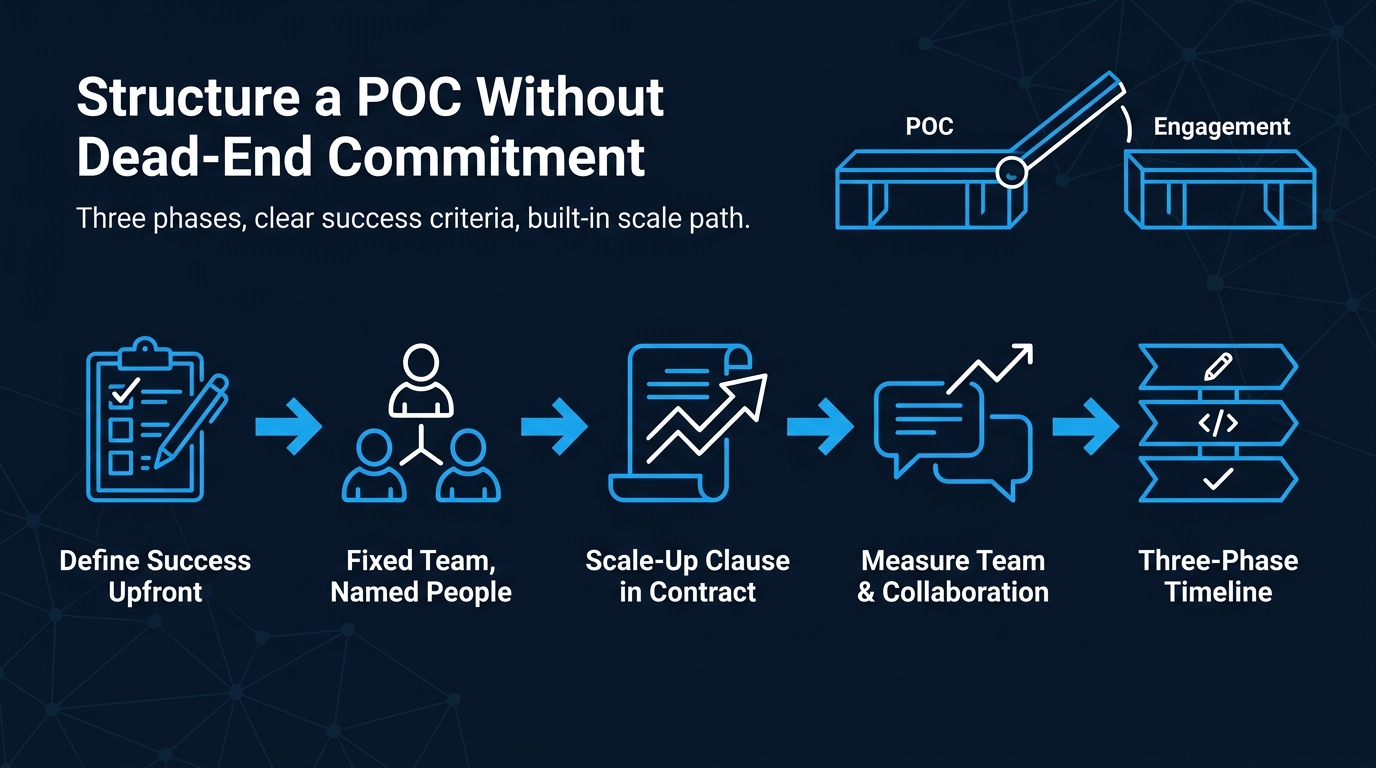
Structure the POC in three phases: scoping, execution, and decision. Build the escalation path to a dedicated team into the contract from day one.
The biggest risk is not failure; it is ambiguity. A POC without exit criteria or a scale-up clause traps both parties.
Cost efficiency from Vietnam delivery is real, but the strategic value of a well-structured POC is that it de-risks the long-term partnership, not just the technology.
About the Author: This article is written by the 724SOFTWARE team, a Vietnam-based technology partner with 200+ professionals, a 95% client retention rate, and delivery experience across 10+ countries spanning Fintech, Edtech, and Enterprise ERP.
What Exactly Is a POC, and Why Does the Definition Matter?
A proof-of-concept is a focused, time-boxed exercise designed to answer one question: can this idea work? It is not a prototype, not a minimum viable product, and not a pilot. The distinctions matter because each stage demands different resources, timelines, and success criteria.
Stage | Primary Question | Typical Scope | Risk Level
|
|---|---|---|---|
POC | Can it work technically? | Single feature or module | Low cost, high ambiguity |
Pilot | Does it work at real scale? | Limited but live deployment | Medium cost, real users [monday.com] |
Full Engagement | Can we build and operate this continuously? | Full product or platform | Full investment |
Conflating a POC with a pilot is the most common structural mistake. If you ask a Vietnam software team to build a "quick POC" but measure it against production-quality standards, you will either fail an experiment that would have succeeded with the right frame, or you will spend pilot-level money on POC-level scope.
How Do You Write a POC That Does Not Create a Dead-End?
Building on the definition above, the harder question is not what a POC is but how to structure one so it connects forward, not backward. The answer lies in writing the exit criteria and the escalation path before a single line of code is written.
A well-structured POC with a Vietnam software team follows three phases:
Phase 1: Scoping (1-2 weeks)
- Write a specific, testable hypothesis. Example: "A two-engineer team can build a working API integration between our CRM and a third-party payment gateway within three weeks, with sub-200ms response time under a 500 concurrent user load."
- Define what "pass," "conditional pass," and "fail" mean in measurable terms.
- Agree on the team composition for the POC and the team size the engagement will scale to if the POC passes.
- Negotiate a scale-up clause: a pre-agreed right to expand the team within a defined window (for example, 2-4 weeks) without renegotiating the entire contract.
Phase 2: Execution (2-6 weeks, depending on scope)
- Assign a fixed, named team to the POC, not rotating contractors. You are evaluating working rhythm as much as technical output.
- Track delivery metrics weekly: velocity, defect rate, communication turnaround, and documentation quality.
- Run at least one structured retrospective mid-POC to catch misalignments early.
Phase 3: Decision (1 week)
- Score outcomes against the pre-agreed criteria.
- Produce a one-page decision brief: what was proven, what remains open, and what the recommended next step is.
- Activate the scale-up clause or formally close the engagement with documented learnings.
The scale-up clause is the structural element that prevents a dead-end. Without it, a successful POC restarts the commercial negotiation from scratch, which wastes momentum and often kills deals that should have progressed.
What Should You Actually Measure During a POC?
Stepping back from the process, a separate concern is the metrics. Most POCs measure technology. The best ones measure the team and the working relationship.
Metrics worth tracking in two categories:
Technical metrics:
- Does the output meet the stated hypothesis criteria?
- Code quality indicators: test coverage, documented APIs, review turnaround time.
- Security posture: does the team follow agreed standards from day one?
Collaboration metrics:
- Response time to questions and blockers.
- Quality of written communication in async tools (Slack, Jira, Confluence).
- Proactive flag-raising when requirements are ambiguous.
The second category predicts long-term partnership health better than the first. A team that ships clean code but goes silent for 48 hours when blocked will cost more to manage over 24 months than a team with slightly lower initial velocity but strong communication discipline.
How Does a POC Differ From a Pilot, and When Should You Run Each?
A related but distinct question is when to skip the POC and go straight to a pilot. The answer depends on what you already know
Run a POC when:
- The technology or integration is unproven in your context.
- You have not worked with a Vietnam software team before and need to evaluate working fit.
- The business case is not yet funded and you need evidence to secure budget.
Run a pilot when:
- The technology is proven, but you need to validate it at scale with real users.
- You have already completed a POC and the results are positive.
- Stakeholders need market or operational evidence, not technical evidence.
A common mistake is running a pilot when the team has not yet earned that level of trust. A structured POC protects both sides by making the evaluation explicit and fair.
Frequently Asked Questions
How long should a POC with a Vietnam software team take?
Most POCs run between two and six weeks. Scope creep beyond six weeks usually signals that the hypothesis was too broad, not that the team is slow. Restate the hypothesis and cut scope.
Can a POC team become our dedicated long-term team?
Yes, and this is the preferred outcome. Pre-agree in the SOW that the POC team has right-of-first-assignment to the expanded engagement. This reduces ramp-up time and preserves context.
What team size is appropriate for a POC?
Two to four engineers is typical for a technical POC. One senior engineer and one mid-level with a part-time BA or PM covers most scenarios. Avoid over-staffing a POC; it distorts cost comparisons with the eventual dedicated team.
What happens if the POC fails?
A POC that produces a clear "fail" result against defined criteria is valuable. It surfaces a risk early, at low cost. Document the findings, identify whether the failure was technical, process-related, or scoping-related, and decide whether a revised hypothesis is worth testing .
How do we protect IP during a POC?
Ensure the SOW includes IP assignment clauses, NDA coverage, and access controls from day one. Do not treat IP protection as a post-POC formality. For regulated industries, look for partners certified to ISO 27001:2022 and SOC 2 Type II.
How do we avoid the POC becoming a forever-test?
Fix a hard end date and a decision deadline in the contract. A POC without a decision date drifts into an indefinite trial that serves neither party.
Is a POC cheaper if we hire freelancers instead of a team?
Freelancers reduce day-rate cost but increase coordination overhead and eliminate the institutional knowledge that transfers into the long-term engagement. If the goal is a lasting technology partnership, a structured team POC generates more usable signal.
About 724SOFTWARE
724SOFTWARE is a Vietnam-based technology company with 200+ professionals, 58% of whom are senior-level engineers, delivering custom software, managed IT, and ERP services to clients across Singapore, Australia, the United States, and the United Kingdom. The company holds ISO 9001, ISO 27001:2022, SOC 2 Type II, and GDPR compliance, and operates with a 95% client retention rate. As an official partner with Claude (Anthropic) and Cursor, 724SOFTWARE integrates practical AI tooling into the software delivery lifecycle to accelerate output by approximately 30%. Teams of 1 to 50+ pre-vetted engineers can be in place within 2 to 4 weeks, with a follow-the-sun support model and a guaranteed incident response time under 10 minutes.
If you are evaluating a Vietnam software team and want to structure a POC that connects forward to a long-term engagement rather than ending in a commercial reset, the 724SOFTWARE team is ready to help you design it. Visit https://724software.com.vn to start the conversation.