

Embedding QA automation from the very first sprint is one of the most measurable decisions a software team can make. When testing is treated as a parallel track to development rather than a final gate, defects are caught while the code that caused them is still fresh, context-switching costs drop, and release cycles compress. This article explains the mechanism behind that cost reduction, what it demands operationally, and why a dedicated Vietnam development team structured around in-sprint automation is a practical delivery model for mid-sized product companies.
TL;DR
Defects found in production cost significantly more to fix than those caught during the sprint they were introduced.
In-sprint automation testing means QA engineers write and run automated tests within the same sprint as feature development, not after.
Shift left testing benefits compound over time: faster feedback, fewer regression surprises, and lower cost-per-defect.
Embedding QA into a dedicated team in Vietnam reduces hiring and infrastructure costs compared to onshore QA staffing in Singapore or the US, while maintaining full quality standards.
The model only works when QA is staffed from day one, not bolted on at sprint 5.
About the Author: This article is written by the 724SOFTWARE team, a Vietnam-based software engineering and QA services provider with 200+ professionals delivering automation testing, CI/CD integration, and quality engineering across Fintech, Healthcare, and SaaS products in 10+ countries.
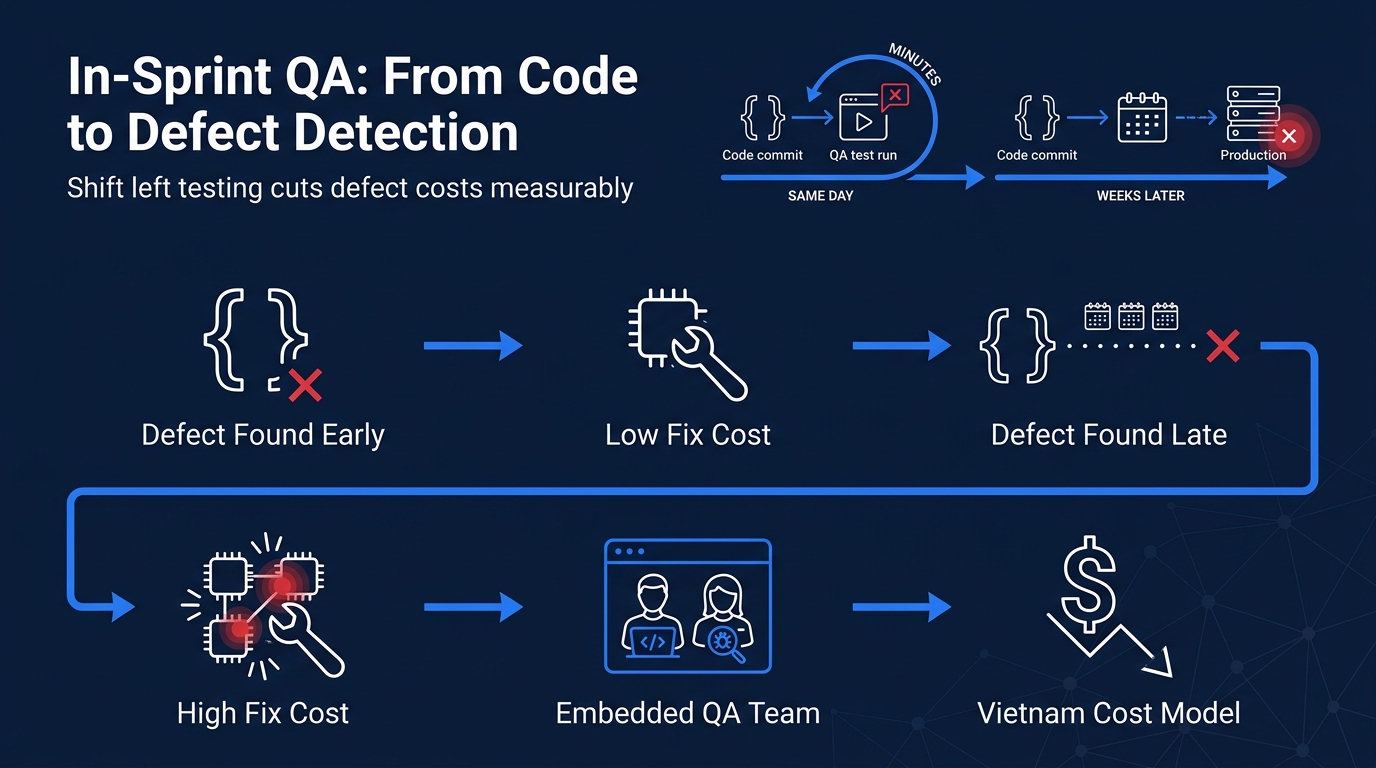
What Does "In-Sprint Automation Testing" Actually Mean?
In-sprint automation testing means QA engineers create and execute automated test scripts within the same sprint in which a feature is built, not in a subsequent hardening sprint or a separate QA cycle. The test is written, reviewed, and passing before the story is marked done.
This is distinct from having automated tests exist somewhere. Many teams have automation suites that run nightly or before releases. In-sprint automation means the coverage moves with the sprint, so regression risk does not accumulate between cycles.
The operational requirement is simple to state but hard to retrofit: QA must be embedded in the team, present in sprint planning, assigned to stories, and treated as a delivery contributor, not a reviewer of finished work.
Why Do Defects Cost More the Later You Find Them?
Building on that definition, the financial case for in-sprint automation rests on a well-documented cost curve: the later in the development lifecycle a defect is found, the more expensive it is to fix.
The reasons are structural, not bureaucratic:
Context loss: A developer who wrote a function two sprints ago must re-read, re-understand, and re-test it before fixing it.
Integration complexity: A bug in a single component becomes a multi-component problem once other features are built on top of it.
Production impact: A defect that reaches users triggers support tickets, incident response, and potential data repair, costs that dwarf any testing investment.
Teams practicing continuous integration benefit most from early automation because every commit triggers the test suite, and failures are surfaced while the developer's mental model of the change is intact.
What Are the Concrete Shift Left Testing Benefits?
Shift left testing benefits are measurable across three dimensions: speed, cost, and quality signal clarity.
Dimension | Without Shift Left | With In-Sprint Automation
|
|---|---|---|
Defect detection | End of sprint or later | Same day as code commit |
Regression coverage | Manual, periodic | Automated, continuous |
Feedback loop | Days to weeks | Minutes to hours |
Release confidence | Low without hardening sprint | Higher with passing suite |
QA bottleneck | Frequent | Rare with embedded team |
The feedback loop compression delivers measurable value: when a developer receives a failing test within minutes of a commit, the fix is trivial. When the same defect surfaces two sprints later in a QA cycle, the fix requires investigation, stakeholder communication, and a potentially delayed release.
Modern teams in 2026 are also integrating AI-assisted test generation into this loop. Tools like Cursor and Claude can accelerate test case authoring by approximately 30%, reducing the time QA engineers spend on boilerplate while increasing coverage depth
How Do You Structure a Vietnam Development Team Around In-Sprint QA?
Stepping back from the cost mechanics, the practical question is how to actually build a team that executes this model consistently.
A Vietnam software team structured for in-sprint automation typically includes:
Dedicated QA automation engineers assigned to feature squads, not to a separate QA department
A shared test framework established in sprint zero, covering unit, integration, and end-to-end layers
CI/CD pipeline hooks so automated tests run on every pull request, not just before release
Clear definition of done that includes passing automated test coverage for each story
The critical setup decision is staffing QA from sprint one. Teams that add QA at sprint 5 spend several sprints playing catch-up on coverage while simultaneously trying to keep pace with new features. The technical debt in testing is identical in character to the technical debt in code: it compounds.
At 724SOFTWARE, dedicated teams are pre-vetted before placement and can be scaled from 1 to 50+ engineers within 2 to 4 weeks. QA automation engineers are available as standalone resources or as embedded squad members, depending on the team topology the client needs. With 58% of the engineering team at senior level, the QA engineers placed on client squads arrive with framework experience, not just testing familiarity.
What Should You Automate First in Sprint One?
A related but distinct question is prioritisation. Not everything should be automated in the first sprint, and attempting full coverage immediately is a common failure mode.
A practical sprint-one automation sequence:
Smoke tests covering the application's core user paths (login, primary data flow, critical transactions)
API contract tests for any backend endpoints the frontend consumes
One regression test per story delivered, tagged to the CI pipeline
A test data strategy so tests do not depend on shared state that causes false failures
This scope is achievable within a sprint while delivering real defect detection value. Coverage expands sprint-by-sprint as the suite grows alongside the product.
Frequently Asked Questions
Does in-sprint automation work for teams using Agile or Scrum?
Yes. In-sprint automation was designed for iterative delivery. The sprint structure provides a natural cadence for adding test coverage story by story.
How many QA engineers do you need per developer to make this work?
A common starting ratio is one QA automation engineer per three to four developers for feature-heavy squads, though this depends on test complexity and the maturity of the existing test framework.
What testing tools are most commonly used in Vietnam development teams?
Selenium, Playwright, Cypress, and Appium for UI automation; Postman and REST-assured for API testing; Jest and PyTest at the unit layer. CI integration typically runs through GitHub Actions, GitLab CI, or Jenkins.
What is the risk of relying only on manual QA in a fast sprint cadence?
Manual-only QA cannot keep pace with rapid delivery. Coverage gaps accumulate, regression testing becomes the bottleneck, and release confidence drops as the codebase grows.
How does 724SOFTWARE handle QA for regulated industries like Fintech or Healthcare?
The team operates under ISO 9001, ISO 27001:2022, SOC 2 Type II, and GDPR compliance. QA processes for regulated clients include audit logging of test runs, traceability between requirements and test cases, and security testing as part of the delivery cycle.
Can a Vietnam-based QA team integrate with our existing CI/CD pipeline?
Yes. Integration with existing pipelines is standard practice, not a custom engagement. The team works within the client's toolchain rather than requiring migration to a new one.
Is AI being used in test automation in 2026?
Increasingly, yes. AI tools are being used to generate test cases from user stories, identify gaps in coverage, and reduce manual authoring time. 724SOFTWARE, as an official partner with Claude (Anthropic) and Cursor, integrates these tools into QA workflows where they produce measurable time savings.
About 724SOFTWARE
724SOFTWARE is a Vietnam-based technology partner providing dedicated software engineering teams, automation testing services, and managed delivery to product companies and enterprises across Singapore, Australia, the US, and the UK. With ISO 9001, ISO 27001:2022, SOC 2 Type II, and GDPR certifications, the company delivers QA, DevOps, and full-stack engineering at a cost structure that reflects Vietnam delivery without the quality tradeoff of onshore hiring in Singapore or the US. The team maintains a 95% client retention rate and has delivered across Fintech, Digital Healthcare, Edtech, and Enterprise ERP, with multilingual collaboration in English, Mandarin, Korean, and Japanese.
If you are evaluating how to embed QA automation into your development team from sprint one, the 724SOFTWARE team is available to discuss team structure, toolchain fit, and delivery timelines. Visit https://724software.com.vn to start the conversation.