

When B2B SaaS teams ask which LLM customization approach to use, the honest answer is: it depends on whether your challenge is behavioral, related to knowledge gaps, or centered on specialized task mastery. Prompt engineering shapes how a model responds. Retrieval-augmented generation (RAG) connects a model to fresh, proprietary data.
Fine-tuning retrains a model on domain-specific examples to change what it knows or how it behaves. Each solves a different problem, and picking the wrong one wastes months of engineering effort. At 724SOFTWARE, our Data and AI teams have applied all three patterns across Fintech, Edtech, and enterprise SaaS products, giving us a ground-level view of where each technique earns its keep.
TL;DR
Prompt engineering is the fastest and cheapest starting point; it solves tone, structure, and task framing issues without touching model weights or architecture.
RAG solves knowledge recency and factual grounding problems by retrieving your own data at inference time, not by retraining the model.
Fine-tuning is the right call when behavior, style, or a narrow specialized task cannot be reliably achieved through instructions alone.
Most production B2B SaaS systems use a layered approach: prompt engineering first, then RAG, with fine-tuning reserved for specific high-value cases.
The decision framework is not just technical; it also factors in update frequency, data sensitivity, latency requirements, and total cost of ownership.
About the Author: 724SOFTWARE is a Vietnam-based technology partner with 200+ professionals building and operating AI-integrated products across Fintech, Digital Healthcare, and Edtech. Our Data and AI practice has delivered LLM-integrated solutions for clients across 10+ countries, including the Novalearn AI Mentor platform, which uses LangGraph and LiteLLM for production AI content generation and automated grading at scale.
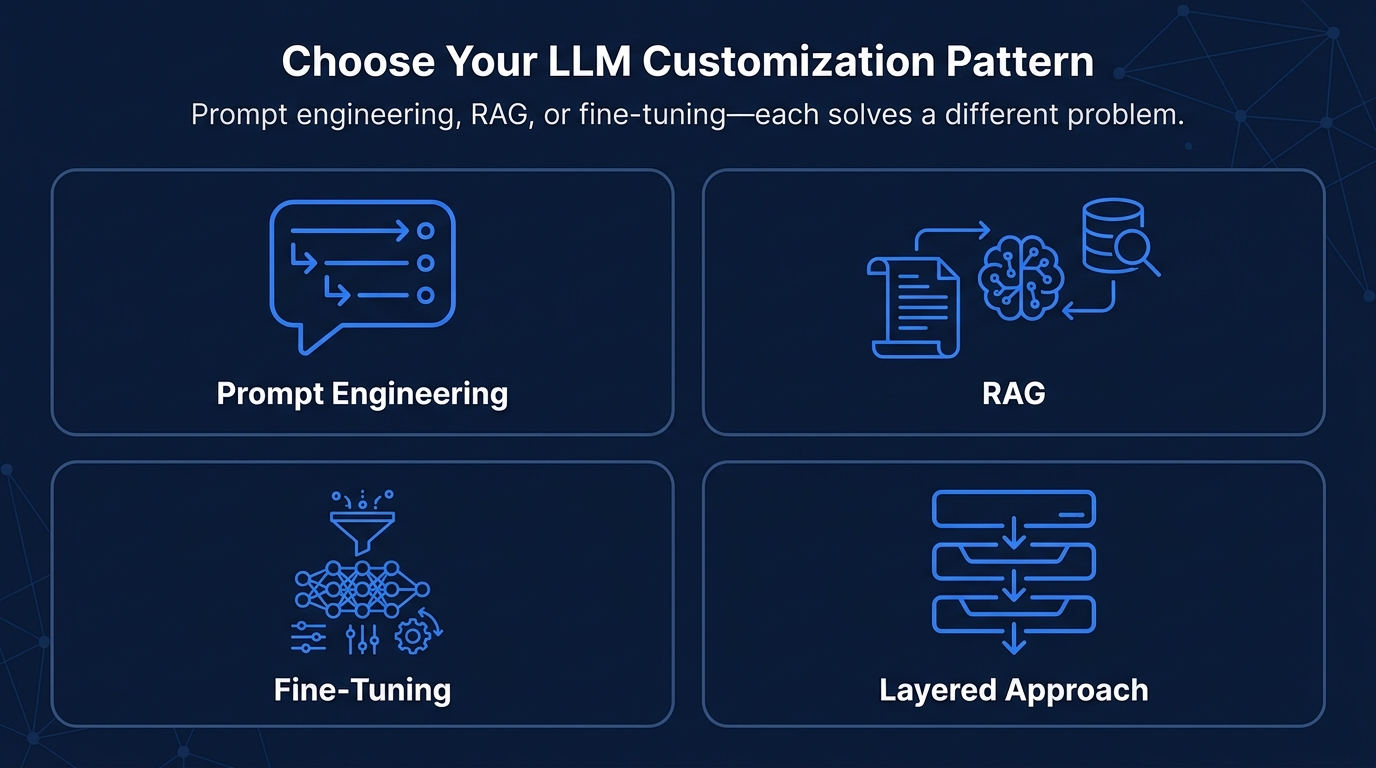
What Problem Does Each Approach Actually Solve?
These three techniques are often compared as if they compete, but they address structurally different problems.
Approach | What It Changes | Primary Problem Solved
|
|---|---|---|
Prompt Engineering | The instruction sent to the model | Tone, format, task framing |
RAG | What information the model sees | Knowledge recency, factual grounding |
Fine-Tuning | The model weights themselves | Behavior, style, narrow task mastery |
Prompt engineering is best described as writing precise instructions for a model that already knows a great deal. You are not changing the model; you are directing its attention and shaping its output format. Done well, it can resolve many common LLM quality issues before any infrastructure investment is made.
RAG inserts retrieved documents or records into the model's context window at inference time. The model has not learned your proprietary data; it reads it dynamically during each reques. This makes RAG ideal when your source data changes frequently or when the model must cite specific, verifiable records.
Fine-tuning adjusts the model's weights using a curated training dataset. The result is a model that has internalized specific patterns, terminology, or behaviors. This is the highest-cost, highest-commitment option and is warranted only when the task cannot be accomplished through instructions or retrieval alone.
When Should a B2B SaaS Team Start with Prompt Engineering?
Prompt engineering should always be the first step, not a fallback.
The reason is practical: it costs almost nothing to iterate on, can be deployed in hours, and often reveals that the "model quality problem" was actually an "instruction quality problem". Most B2B SaaS use cases involving content generation, summarization, classification, and structured output can be handled well with disciplined prompt design.
Prompt engineering best practices for LLM-integrated products:
Use system prompts to set role, tone, and constraints before any user input arrives.
Provide few-shot examples inside the prompt when output format consistency is critical.
Break complex tasks into smaller sequential prompts rather than asking one prompt to do everything.
Version-control your prompts the same way you version-control code; prompt drift is a real maintenance risk.
Use temperature settings deliberately: lower for factual, structured outputs; higher for creative tasks.
For our Novalearn AI Mentor build, prompt engineering governed the automated grading rubric behavior before any retrieval layer was added. Structuring the instruction set carefully produced consistent, subject-aligned feedback, which was the primary requirement, without the added complexity of RAG.
When Does RAG Outperform Prompt Engineering Alone?
RAG becomes necessary the moment your application's correctness depends on data the base model was not trained on or that changes after the model's training cutoff.
For B2B SaaS products, this typically means:
Customer support bots that must reference your latest product documentation, release notes, or pricing.
Internal knowledge assistants that answer questions about proprietary SOPs, contracts, or compliance records.
Sales enablement tools that pull from a live CRM or product catalog.
Fintech applications where the model must cite real account data, transaction history, or regulatory updates.
RAG vs. prompt engineering is less a competition and more a staging decision: prompt engineering sets the behavior; RAG supplies the knowledge. From a data sensitivity perspective, RAG also keeps proprietary information out of model training, which matters significantly for ISO 27001:2022-compliant and SOC 2 Type II-aligned pipelines. Sensitive records remain in your retrieval store and are never baked into model weights.
The practical RAG architecture checklist:
Decide on a chunking and embedding strategy before building retrieval (chunk size affects precision dramatically).
Build evaluation metrics for retrieval quality separately from generation quality.
Plan for index freshness: how often does your source data change, and how does the index stay current?
Add a re-ranking step if retrieval precision is insufficient at the first pass.
When Is Fine-Tuning the Right Investment?
Fine-tuning is often over-prescribed. The clearest signal that fine-tuning is warranted is when a well-prompted model with good retrieval still cannot reliably produce the output style, terminology, or behavior your product requires.
Concrete B2B SaaS cases where fine-tuning earns its cost:
A legal document drafting tool that must replicate a specific firm's clause structure and citation style.
A clinical notes assistant in Digital Healthcare that must consistently use controlled medical vocabulary.
A code-generation assistant trained on your company's internal framework conventions, where a general coding model keeps suggesting patterns your codebase does not use.
Fine-tuning carries real costs: labeled training data curation, compute for training runs, version management, and retraining cycles as your domain evolves. The decision to fine-tune should be based on a clear, measured performance gap that prompt engineering and RAG cannot close, not on a general sense that "a custom model would be better."
How Do Production Teams Layer All Three?
The practical answer for most B2B SaaS products is a layered architecture rather than a single technique.
A recommended decision sequence:
Start with prompt engineering to establish baseline behavior, tone, and task structure.
Add RAG when factual accuracy, data recency, or proprietary knowledge becomes the bottleneck.
Evaluate fine-tuning only when you have measured evidence that the combination of steps 1 and 2 still does not meet the performance bar your product requires.
This sequence also maps to cost and risk. Prompt engineering changes are reversible in minutes. RAG infrastructure requires an index pipeline but stays decoupled from model weights. Fine-tuning locks in a specific training snapshot and requires a retraining process every time the domain shifts significantly.
Frequently Asked Questions
Is prompt engineering enough for enterprise B2B SaaS applications? For many use cases, yes. Summarization, classification, structured data extraction, and simple Q&A can often be handled with well-designed prompts alone. The gap appears when proprietary knowledge or specialized behavior is required.
What is the main risk of fine-tuning too early? You spend significant time and budget on a training dataset, only to find that a better prompt or a retrieval layer would have solved the problem in a fraction of the time.
Can RAG and fine-tuning be combined? Yes. A fine-tuned model can still use a retrieval layer. The fine-tuning handles style and behavior; RAG handles factual grounding. This is a more advanced and more expensive architecture, and it is justified only in narrow, high-value applications.
How does data sensitivity affect the choice? RAG keeps sensitive data in your retrieval store and out of model weights, which is preferable for regulated industries. Fine-tuning on sensitive data requires careful governance. For Fintech and Healthcare clients, this compliance consideration often becomes a deciding factor.
How long does each approach typically take to implement? Prompt engineering can show results in days. A basic RAG pipeline typically takes a few weeks to implement well. A fine-tuning workflow, including data curation and evaluation, is typically a 2 to 6 month effort.
Does 724SOFTWARE recommend a specific LLM for each approach? We work with Claude (Anthropic), Gemini, and open-source models depending on the client's requirements. As an official partner with Claude (Anthropic) and Cursor, we apply these tools directly inside our SDLC to accelerate delivery by approximately 30%.
How do we know which approach is right for our product? Map the problem first: is it a behavior problem (prompt engineering), a knowledge problem (RAG), or a task mastery problem (fine-tuning)? If you are unsure, the right starting point is almost always prompt engineering.
About 724SOFTWARE
724SOFTWARE is a Vietnam-based technology partner providing engineering, Data and AI, and managed IT services to B2B SaaS companies, Fintech firms, Digital Healthcare platforms, and enterprise ERP clients across Singapore, Australia, the US, the UK, and the broader APAC region. With 200+ professionals (58% senior-level), ISO 27001:2022, SOC 2 Type II, and GDPR compliance, and an official partnership with Claude (Anthropic) and Cursor, the company integrates practical generative AI into real client delivery workflows.
As a long-term technology partner rather than a project-by-project vendor, 724SOFTWARE builds and operates digital products alongside clients, with dedicated teams that can scale from 1 to 50+ pre-vetted engineers within 2 to 4 weeks and a follow-the-sun support model with a guaranteed incident response time under 10 minutes.
If you are evaluating LLM customization options for your B2B SaaS product and want a practical assessment grounded in real delivery experience, visit 724SOFTWARE to start the conversation.