

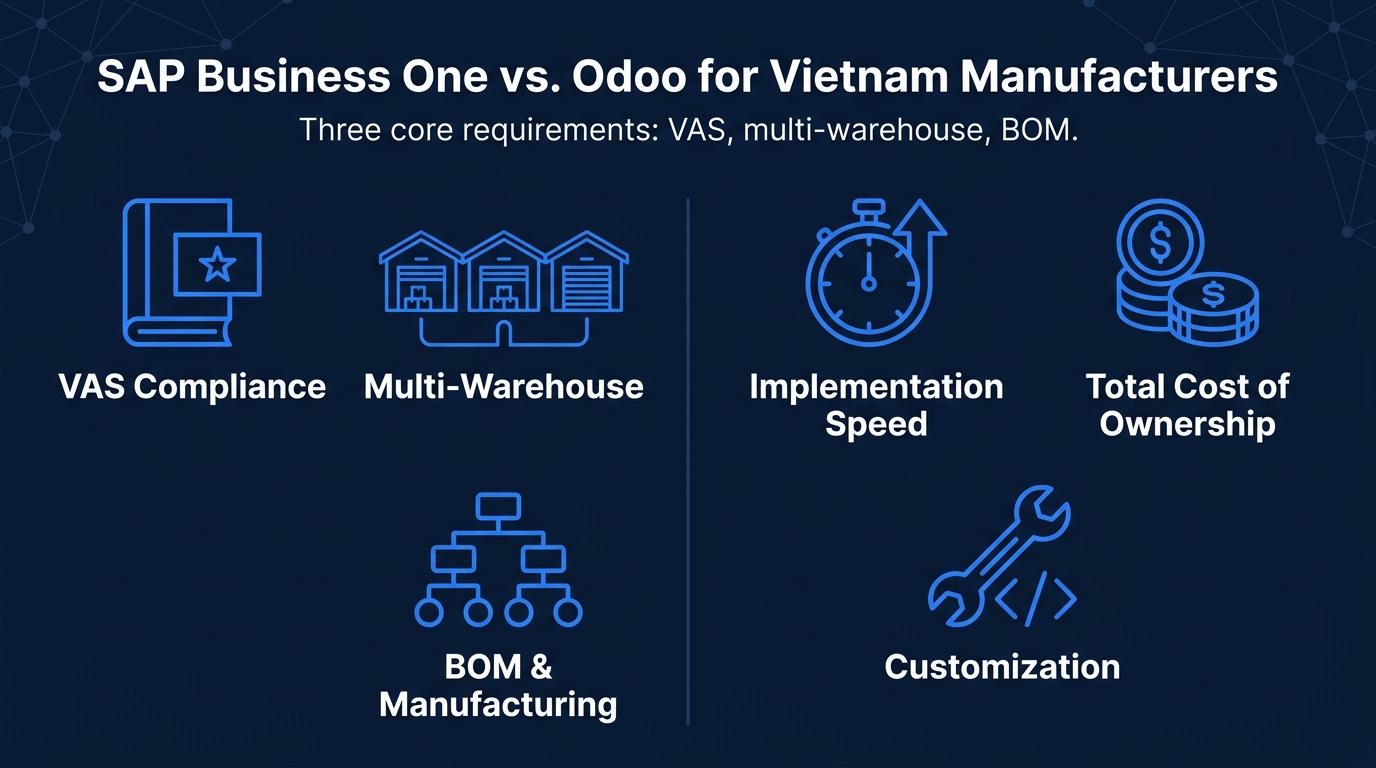
Vietnamese manufacturers evaluating ERP platforms in 2026 face a genuine fork in the road. SAP Business One and Odoo are both viable options, but they are built for different operating realities. For a factory managing multiple warehouse locations, producing goods under Vietnamese Accounting Standards (VAS), and tracking Bills of Materials (BOMs) across finished and semi-finished goods, the "right" answer depends on how each system handles those three requirements out of the box, and what customisation costs to close the gaps.
TL;DR
SAP Business One includes native financial compliance features for regulated environments; Odoo requires VAS-specific localisation work but delivers it at a lower total cost.
Odoo's multi-warehouse and BOM modules are modular and fast to configure; SAP Business One's equivalents follow a stricter configuration path and produce audit-ready output for regulated environments.
Implementation timelines and total cost of ownership differ: Odoo typically deploys in 3-6 months, while SAP Business One requires 6-12 months for comparable scope, and for Vietnamese SMEs, that gap often determines which system is viable.
VAS compliance is non-negotiable in Vietnam, and neither platform ships a fully pre-configured Vietnamese chart of accounts without partner involvement.
Choosing the wrong platform for your BOM complexity or warehouse footprint creates technical debt that compounds over years, not months.
About the Author: 724SOFTWARE is a Top 5 Odoo service partner in Vietnam with direct delivery experience across SAP Business One implementations for Vietnamese manufacturers, including VIETTELIMEX, TocoToco (Taco Service and Trading), and Oakwood Residence, each with specific VAS, multi-warehouse, or manufacturing module requirements.
Why Do VAS Requirements Make ERP Selection Harder in Vietnam?
Vietnamese Accounting Standards are not simply IFRS with a different label. VAS governs specific account structures, journal entry formats, depreciation methods, and statutory reporting-all of which differ from international defaults. Both SAP Business One and Odoo ship with international chart-of-account templates, meaning a Vietnamese manufacturer cannot go live on either platform without localisation work.
Key VAS-specific requirements that affect ERP selection:
Account coding structure: Vietnam uses a regulated account numbering system (e.g. Account 154 for work-in-progress, Account 632 for cost of goods sold) that must be mapped accurately.
Circular 200 compliance: The Ministry of Finance's Circular 200 governs the chart of accounts, and any deviation creates audit risk.
E-invoice integration: Vietnamese manufacturers must connect their ERP to an approved e-invoice provider (such as VNPT or MISA).
VAT output/input declaration reports: These must match the format accepted by the General Department of Taxation.
SAP Business One handles VAS through localised add-ons and partner-built templates. Several certified partners maintain Vietnam-specific country versions, which simplify chart-of-accounts setup but create dependency on that partner's roadmap.
Odoo handles VAS through community and partner-built localisation modules. The quality and completeness of these modules varies by partner. A capable Odoo partner can deliver a fully VAS-compliant deployment, but the onus is on the implementation team.
Practical verdict: Neither platform delivers VAS compliance without a qualified local partner. The differentiator is how much the platform's architecture fights you during localisation, and SAP Business One's rigid financial structure can be both an asset (audit trail) and a constraint (customisation cost).
How Do the Two Platforms Handle Multi-Warehouse Operations?
Building on the compliance question, warehouse complexity adds a second layer of decision criteria that Vietnamese manufacturers often underestimate at the selection stage.
Capability | SAP Business One | Odoo
|
|---|---|---|
Multiple warehouse locations | Native support | Native support |
Bin/rack-level location tracking | Requires add-on | Available in Inventory module |
Inter-warehouse transfer with accounting entry | Native | Native |
Real-time stock valuation per warehouse | Native | Native |
Barcode/WMS integration | Via add-on or third party | Built-in or via third party |
Landed cost allocation per warehouse | Native | Available with configuration |
For manufacturers with 3 to 10 warehouse locations across Vietnam, Odoo's modular inventory system deploys in 3-6 months at a lower implementation cost. SAP Business One's warehouse module generates clean audit trails and supports multi-location tracking, but adding bin-level tracking or WMS integration typically requires a certified add-on, which adds licence cost and integration complexity.
One pattern that appears repeatedly in Vietnamese manufacturing deployments: companies start with 2 warehouses at go-live and grow to 5 or 6 within 18 months. Odoo's architecture handles that growth without a structural change to the core configuration. SAP Business One can accommodate it but often requires additional licences or add-on modules.
Which Platform Handles BOM and Manufacturing Complexity Better?
A related but distinct question is how each system models the production process, particularly for manufacturers working with multi-level BOMs, semi-finished goods, and batch/lot traceability.
SAP Business One Manufacturing:
Production Orders drive BOM consumption and finished-goods receipt.
Multi-level BOMs are supported but require careful setup for phantom assemblies.
Batch and serial number traceability is built in natively.
MRP (Material Requirements Planning) is included, covering planned vs. actual material consumption.
Routing and work centre management is limited in the standard module; more advanced production scheduling typically requires an add-on.
Odoo Manufacturing:
Manufacturing Orders tie directly to BOMs and work centres.
Multi-level BOMs with semi-finished goods (what Odoo calls "subassemblies") are natively supported and visually clear.
Lot/serial number traceability across the full production chain is available.
The "Shop Floor" module (available from Odoo 16/17 onward) adds tablet-based operator interfaces for real-time production tracking.
MRP is functional but does not match SAP Business One's depth for high-complexity planning scenarios.
For Vietnamese food, beverage, or FMCG manufacturers (a common profile in Ho Chi Minh City and the Mekong Delta), lot-based COGS calculation is critical. Odoo supports COGS by Lot/Batch, which is directly relevant to VAS-compliant cost accounting, and 724SOFTWARE's deployment for Baby Corporation Vietnam (FrutoNyanya) demonstrates this in practice.
For discrete manufacturers with complex routings, work-centre capacity planning, and multi-plant scheduling, SAP Business One's production module, supported by an MRP add-on, delivers the depth and maturity needed for those scenarios
What Does Total Cost of Ownership Look Like Over Three Years?
Stepping back from the technical detail, a separate concern is what each platform actually costs when you account for licences, implementation, localisation, and ongoing support.
Cost Component | SAP Business One | Odoo
|
|---|---|---|
Licence model | Per-user named licence | Per-user (Enterprise) or free (Community) |
Implementation timeline | Typically 6-12 months for a mid-sized manufacturer | Typically 3-6 months for comparable scope |
VAS localisation cost | Partner-dependent; moderate to high | Partner-dependent; low to moderate |
Customisation flexibility | Limited without ABAP/SDK knowledge | High; Python-based, large developer pool |
Ongoing upgrade cost | Significant; version upgrades require testing cycles | Lower with SaaS; Community carries upgrade risk |
For Vietnamese manufacturers with annual revenue between USD 2 million and USD 15 million, Odoo's lower total cost of ownership over a three-year horizon reflects deployment speed (3-6 months vs. 6-12 months), lower licence fees, and reduced localisation complexity.
SAP Business One makes economic sense when the compliance depth, audit trail rigour, and MRP maturity justify the premium, typically for manufacturers with regulatory exposure or complex multi-entity financial consolidation requirements.
Frequently Asked Questions
Does SAP Business One support Vietnamese e-invoicing natively?
No. E-invoice integration with Vietnamese providers (VNPT, MISA, etc.) requires a partner-built connector regardless of which platform you choose.
Can Odoo produce VAS-compliant financial statements?
Yes, with proper localisation. A qualified Odoo partner can configure the Vietnamese chart of accounts, VAT reports, and Circular 200-compliant journals. The quality depends on the partner.
Which platform is faster to go live for a manufacturer with 5 warehouses and a 3-level BOM?
Odoo typically reaches go-live in 3 to 6 months for that profile; SAP Business One typically takes 6 to 12 months for comparable scope.
Is batch/lot traceability available in both systems?
Yes. Both SAP Business One and Odoo support lot and serial number traceability natively.
Which system is easier to customise for Vietnamese-specific workflows?
Odoo's Python-based architecture and large developer community make it easier and less expensive to customise for local requirements.
Does SAP Business One scale better for multi-entity manufacturers?
SAP Business One has native support for intercompany transactions and financial consolidation across legal entities, which is relevant for manufacturers with multiple subsidiaries.
Can a Vietnamese manufacturer switch from one platform to the other mid-growth?
Technically yes, but the costs are substantial. Data migration, system reconfiguration, and staff retraining require significant time and budget. Selecting the right platform for your 3-to-5-year roadmap is a better approach than planning for a switch.
About 724SOFTWARE
724SOFTWARE is a Vietnam-based technology company and a Top 5 Odoo service partner in Vietnam, with direct implementation experience across both Odoo ERP and SAP Business One for Vietnamese manufacturers, retailers, and F&B enterprises.
The team of 200+ professionals (58% senior-level) has delivered ERP projects across 10+ countries, with specific expertise in VAS-compliant financial configuration, multi-warehouse inventory architecture, and manufacturing module setup. Certified under ISO 9001, ISO 27001:2022, SOC 2 Type II, and GDPR, 724SOFTWARE works as a long-term technology partner from initial assessment through to ongoing operational support.
Selecting between SAP Business One and Odoo is not a generic ERP decision for a Vietnamese manufacturer. It is a decision about which platform's architecture fits your BOM depth, warehouse footprint, and compliance obligations over the next 3 to 5 years. If you want a structured assessment of which platform fits your specific operation, including a VAS compliance checklist and multi-warehouse configuration review, reach out to the team at 724SOFTWARE.