

If you're evaluating a Vietnam software team for the first time, the headline rates look attractive. But the more practical question is: what does a monthly retainer actually deliver at each seniority level, and how do you map that to real output? A junior developer billed at $1,500/month and a senior architect billed at $4,500/month are not interchangeable, and understanding the difference is what separates a good hiring decision from an expensive mismatch.
TL;DR
Vietnam software engineer salary benchmarks in 2026 sit well below Singapore and US equivalents, but rates vary significantly by seniority, specialisation, and team model.
A monthly retainer buys more than raw hours: it includes onboarding, communication overhead, tooling, and management capacity that fixed-price models often obscure.
Senior engineers (5+ years) command materially higher rates but typically reduce total project cost by compressing timelines and avoiding expensive rework.
Retainer pricing is most predictable when scoped by role, not by deliverable.
The real cost advantage of Vietnam delivery is the senior-to-rate ratio: you get senior-level expertise at mid-market pricing compared to Singapore or US onshore hiring.
About the Author: 724SOFTWARE is a Vietnam-based technology partner with 200+ engineers (58% senior-level) delivering software across 10+ countries. The team has direct experience structuring dedicated retainer engagements for clients across Singapore, Australia, and the US.
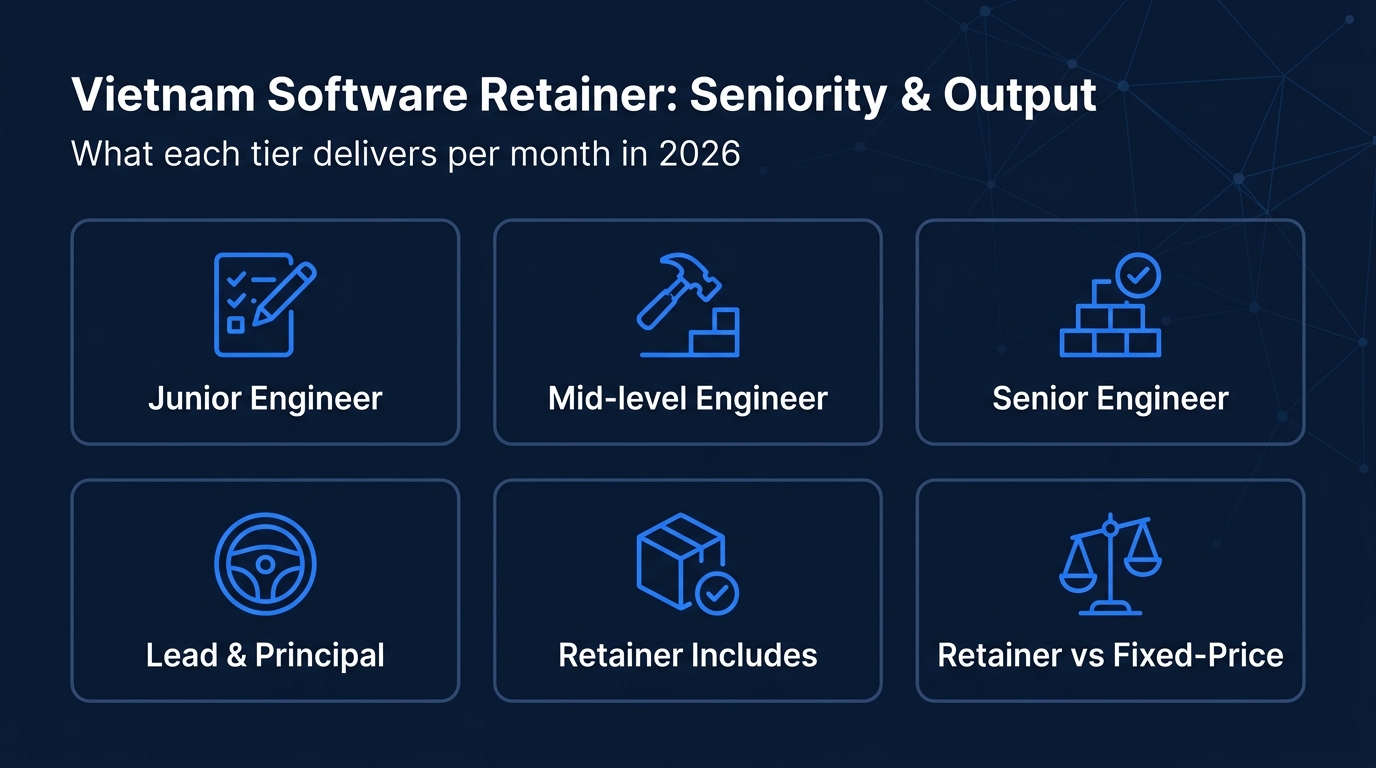
What Does the Vietnam Software Engineer Market Actually Look Like in 2026?
Vietnam's software engineering market has matured considerably. The talent pool now produces engineers with strong experience in cloud-native development, AI integration, and regulated-industry compliance (Fintech, Healthcare, ERP), delivering both depth and technical breadth across specializations. This maturity is reflected in the rates.
Vietnam software engineer salary ranges (monthly, retainer-model basis) for 2026 break down roughly as follows:
Seniority Level | Experience | Typical Monthly Retainer Rate (USD)
|
|---|---|---|
Junior | 0-2 years | $800 - $1,500 |
Mid-level | 2-5 years | $1,500 - $2,800 |
Senior | 5-8 years | $2,800 - $4,500 |
Lead / Principal | 8+ years | $4,500 - $7,000+ |
Specialist (AI, Security, Fintech) | Varies | $4,000 - $8,000+ |
Compare this to day-rate equivalents from other markets: Vietnam senior developers run roughly €200/day equivalent, versus €800-1,200/day in Germany or comparable rates in Singapore and the US. Senior-level expertise at a significant cost advantage compared to onshore alternatives is where the strategic value is demonstrated.
What Does a Monthly Retainer Fee Actually Include?
A retainer is not a block of hours sold in bulk. It is a recurring engagement model that bundles capacity, availability, and process integration into a predictable monthly cost.
For a Vietnam software team on a dedicated retainer, the monthly fee typically covers:
Allocated engineering capacity at the agreed seniority level (usually 160-176 working hours/month per engineer)
Team onboarding and handover into your existing workflow, sprint cadence, and tooling
Communication overhead: stand-ups, sprint reviews, async documentation
Management layer: a team lead or PM who coordinates delivery and escalates blockers
Tooling and infrastructure access aligned to your stack
What it does NOT automatically include (and what you should scope separately):
- Hardware or software licence costs
- Security audits or penetration testing (these are separate service lines)
- Training for new proprietary tools you introduce mid-engagement
Understanding this distinction matters because retainer pricing calculated from pure team cost uses a formula: retainer price equals team cost divided by one minus the desired margin. That margin covers the overhead items above. A rate that looks suspiciously low often means those items are unbundled and billed separately later.
How Does Seniority Affect What You Actually Get Per Month?
This is where most retainer decisions go wrong. Buyers often optimise for the lowest per-engineer rate, then discover their junior-heavy team is blocked waiting for architectural decisions nobody on the team is qualified to make.
Here is a practical guide to what each seniority tier actually delivers month-to-month:
Junior Engineer ($800-$1,500/month)
- Executes well-defined tickets with clear acceptance criteria
- Requires active code review and mentorship (plan for 15-20% of a senior's time)
- Best suited to: UI component work, test case execution, data entry automation, low-complexity API integrations
- Risk: high rework rate without supervision
Mid-level Engineer ($1,500-$2,800/month)
- Works independently on moderately complex features
- Handles debugging, refactoring, and third-party integrations with minimal guidance
- Best suited to: feature development, API work, mobile/web screens with business logic, CI/CD pipeline maintenance
- Risk: may struggle with system design trade-offs on ambiguous requirements
Senior Engineer ($2,800-$4,500/month)
- Owns delivery end-to-end: design, implementation, review, and documentation
- Mentors juniors and mid-levels, reducing supervisory burden on your internal team
- Best suited to: architecture decisions, performance-critical modules, security-sensitive integrations, leading a sub-team
- The compounding value: one senior engineer preventing one sprint of rework typically pays for themselves that month
Lead / Principal ($4,500-$7,000+/month)
- Sets technical direction, defines coding standards, manages cross-team dependencies
- Owns the technical roadmap for a product area
- Best suited to: new product builds, platform migrations, regulated environments (Fintech, Healthcare) where architectural decisions carry compliance risk
The practical implication: a team of three mid-level engineers and one senior, billing roughly $8,500-$12,000/month combined, will consistently outperform a team of five juniors at the same total budget.
How Does Retainer Pricing Compare to Fixed-Price for Ongoing Software Work?
Stepping back from rate-level detail, a separate and common question is whether a retainer model makes more financial sense than fixed-price contracts for ongoing software delivery.
The comparison comes down to scope certainty:
Factor | Retainer | Fixed-Price
|
|---|---|---|
Scope changes mid-engagement | Absorbed naturally | Triggers contract renegotiation |
Budget predictability | High (fixed monthly cost) | High at start, variable with change orders |
Velocity over time | Increases as team learns your codebase | Resets with each new contract |
Risk of hidden costs | Low (transparent hours-based billing) | Higher (contingency padding is common) |
Best for | Ongoing product development and operations | One-off, fully-scoped builds |
For companies operating a live digital product, the retainer model almost always wins on total cost of ownership. The team accumulates context, reducing onboarding cost over time, and the billing is based on actual working hours rather than a fixed scope that may no longer reflect reality.
Frequently Asked Questions
What is a realistic monthly budget for a small dedicated Vietnam software team in 2026?
A team of one senior engineer, two mid-level engineers, and one QA engineer typically runs $7,500-$12,000/month depending on specialisation and stack.
Is the Vietnam software engineer salary gap closing compared to other regions?
Rates have risen steadily, particularly at the senior level. The gap to Singapore and US onshore hiring remains significant at the senior tier, making Vietnam delivery most cost-efficient for senior-heavy teams.
What seniority mix is recommended for a product-stage SaaS company?
A common ratio: 40% senior, 40% mid-level, 20% QA/junior. This balances autonomy with cost and reduces the supervisory overhead that pure-junior teams require.
Does a retainer include management and project coordination?
It depends on the engagement model. A well-structured dedicated team retainer should include a team lead or PM layer. Always confirm this is included rather than billed separately.
How quickly can a dedicated Vietnam software team be assembled and operational?
Pre-vetted teams can typically ramp up in 2-4 weeks, depending on the technical specialisation required.
What are the main hidden costs to watch for in a Vietnam software retainer?
Licence costs, security testing, hardware for on-site requirements, and any training specific to proprietary internal tools are common items that sit outside standard retainer scope.
How do I evaluate whether I'm getting the right seniority for the rate quoted?
Ask for CV-level detail, conduct a technical interview, and request references from a comparable engagement. The rate alone is not a reliable seniority signal.
About 724SOFTWARE
724SOFTWARE is a Vietnam-based technology partner with 200+ professionals, 58% of whom are senior-level engineers, delivering software across Fintech, Digital Healthcare, Edtech, and Enterprise ERP for clients in Singapore, Australia, the US, and the UK. The company operates under ISO 9001, ISO 27001:2022, SOC 2 Type II, and GDPR compliance standards, with a 95% client retention rate built on transparent billing, pre-vetted dedicated teams, and a guaranteed incident response time under 10 minutes. As an official partner with Claude (Anthropic) and Cursor, 724SOFTWARE integrates generative AI tooling into its engineering workflows to accelerate delivery by 30%.
If you're mapping out a Vietnam software team engagement for 2026, the rate table is only the starting point. The structure of the retainer, the seniority mix, and what is actually included in the monthly fee determine whether the engagement delivers value. To explore what a dedicated team engagement looks like for your specific requirements, visit 724SOFTWARE.