

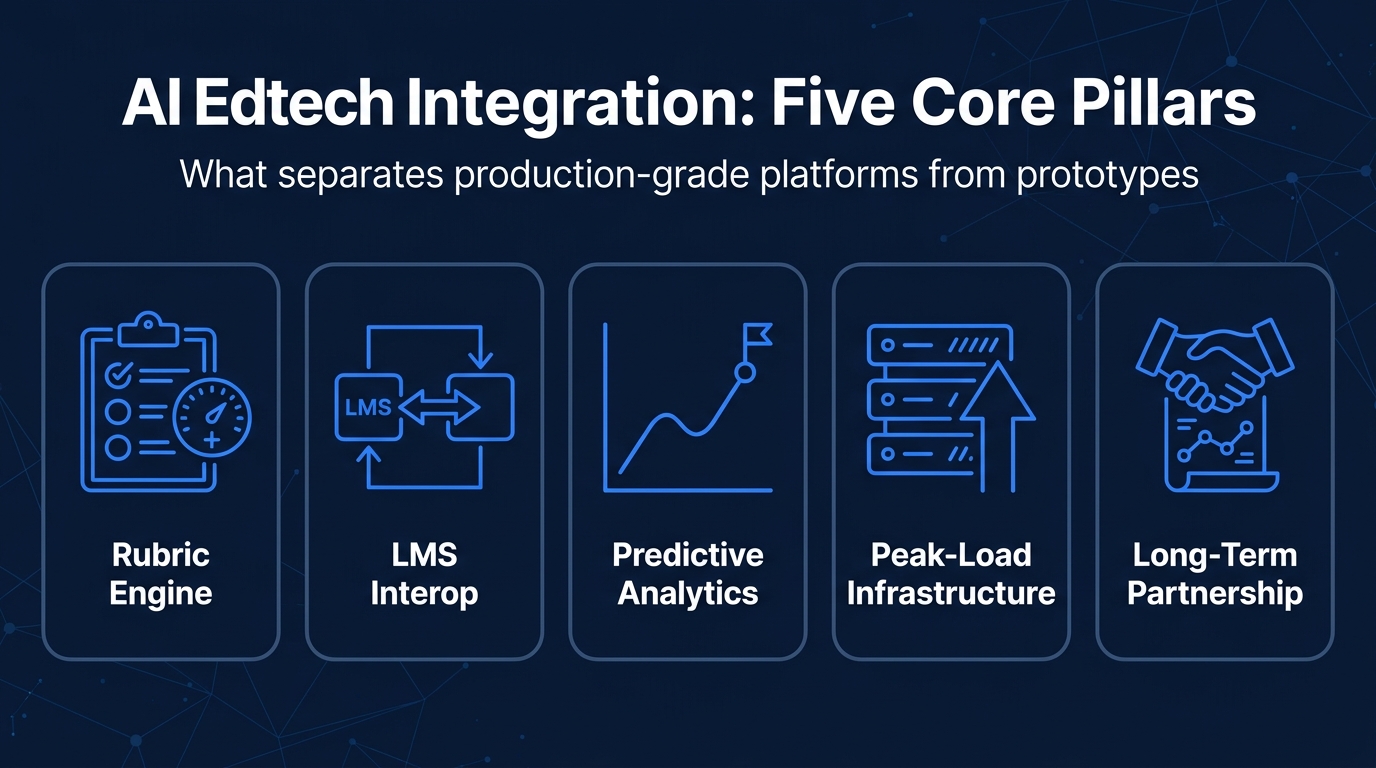
Most edtech companies underestimate what AI integration actually demands from a technology partner. It is not just about plugging in an API. Building a production-grade ai-powered learning platform requires rubric logic, LMS interoperability, bias controls, and infrastructure that holds under exam-day traffic spikes. The Novalearn AI Mentor project, delivered by 724SOFTWARE across Hong Kong, Malaysia, China, Singapore, and Vietnam, illustrates exactly what separates an integration partner with proven edtech delivery from one that just ships a prototype.
TL;DR
AI grading systems need customizable rubric engines and bias-mitigation tuning, not generic LLM output piped directly to students.
Canvas LMS integration and Moodle AI integration require LTI-ready architecture from day one, not rework added later.
Predictive learning analytics only generates value when the underlying data pipeline is clean and the dashboard is actionable, not decorative.
Infrastructure must be designed to handle peak exam loads without degradation.
A long-term engineering partner with edtech domain experience reduces rework and accelerates time-to-value compared to assembling ad hoc contractors.
About the Author: 724SOFTWARE is a Vietnam-based technology company with direct delivery experience in edtech AI, including the Novalearn AI Mentor platform. The team has built AI grading systems, LTI integrations, and predictive analytics dashboards across multiple Southeast Asian and East Asian markets.
What does an AI grading system actually need to work in a real classroom?
An AI grading system is not a wrapper around a language model. It is a structured workflow that converts a student submission into feedback aligned to a specific subject, rubric, and institutional standard, consistently and at scale.
On the Novalearn engagement, the grading engine was built using FastAPI and LangGraph with the following core requirements:
Customizable rubrics: Teachers configure criteria per assignment. The engine applies those criteria consistently across every submission, removing the scoring drift that occurs when human graders work under time pressure.
Subject alignment: A literature rubric scores differently from a STEM rubric. The system needed to distinguish between open-ended analytical responses and answers with verifiable correct outputs.
Bias-mitigation tuning: LLMs carry demographic and stylistic biases. Without deliberate tuning, an AI grading system can systematically disadvantage students who write in a second language or use non-dominant rhetorical structures. This is not a theoretical concern.
Peak load resilience: Grading engines face the same traffic pattern as ticketing systems: near-zero load most of the time, then sudden spikes during midterms and finals. The Novalearn system was engineered to scale under those exam and assignment peak loads without degrading response times.
The practical lesson for edtech product leaders: if a prospective AI integration partner cannot explain rubric customization, bias controls, and load behavior in the same conversation, they are probably thinking about the demo, not production.
Why do Canvas LMS integration and Moodle AI integration require LTI architecture from the start?
Building on the grading requirements above, the harder downstream problem is interoperability. An ai-powered learning platform that cannot connect to the LMS an institution already uses will not get adopted, regardless of how good its AI is.
LTI (Learning Tools Interoperability) is the protocol standard that allows external tools to embed inside Canvas, Moodle, Google Classroom, and similar platforms.
The Novalearn platform was built LTI-ready from the start, which meant:
AI content generation (lesson plans, quizzes, assignments) could surface directly inside a teacher's existing Canvas or Moodle workflow.
Student submissions flowed from the LMS into the grading engine and back without requiring teachers to manage a separate interface.
Grade passback worked automatically, writing scores into the LMS gradebook rather than generating a report that someone had to manually transfer.
The alternative, building LTI compliance into a platform after the core architecture is complete, typically requires significant rework to the authentication layer, data model, and API surface. Edtech teams that discover this six months into a build face both delay and budget overrun.
Integration approach | Time to LMS compatibility | Rework risk
|
|---|---|---|
LTI-ready from architecture phase | Low | Minimal |
LTI added after core build | High | Significant |
Custom API per institution | Very high | Very high |
For product leaders evaluating Canvas LMS integration or Moodle AI integration, the right question to ask an AI integration partner early is: "Show us your LTI implementation approach, not just your AI demo."
What makes predictive learning analytics useful rather than decorative?
Predictive learning analytics is the practice of using a student's historical performance data, engagement patterns, and assessment results to forecast outcomes and trigger timely interventions. The distinction between analytics that is useful and analytics that is decorative comes down to two factors: data quality and intervention design.
The Novalearn platform included a centralized analytics dashboard connected to the grading engine's output. The design choices that made it actionable rather than decorative:
Aggregated at the right level: Teachers saw class-level trends and individual flags, not raw model outputs.
Tied to an action: A risk flag prompted a suggested intervention, not just a colored indicator.
Clean data inputs: The grading engine's structured rubric outputs fed the analytics layer directly, avoiding the messy inconsistency that plagues systems where human graders enter free-text scores.
Research into AI in edtech consistently shows that analytics tools fail adoption when they add information without reducing workload. The Novalearn approach inverted that: the analytics layer reduced the time a teacher spent identifying struggling students, rather than increasing the reporting burden.
What infrastructure decisions determine whether an AI-powered learning platform survives exam season?
Most edtech AI deployments are designed for average load. This is the wrong design target. The Novalearn system used FastAPI with Uvicorn as the async server layer, Alembic for database migrations, and SQLAlchemy for the ORM. These are not incidental choices: they reflect a stack selected for concurrency and maintainability under production pressure.
Key infrastructure considerations for any ai-powered learning platform:
Async-first API layer: Synchronous request handling collapses under concurrent grading submissions. Uvicorn + FastAPI handles this correctly.
LLM routing with LiteLLM: The platform used LiteLLM to abstract across model providers, which allows fallback to an alternative model if a primary provider has a latency spike during peak usage.
Database migration discipline: Alembic-managed migrations mean schema changes deploy cleanly without manual intervention or downtime.
Edtech teams that skip these decisions in early sprints typically rediscover them during their first high-stakes assessment period.
Frequently Asked Questions
What is the difference between an AI grading system and automated scoring?
Automated scoring typically refers to rule-based or statistical models applied to structured inputs. An AI grading system uses a language model to evaluate open-ended responses against a rubric, producing qualitative feedback rather than just a numeric score.
How long does it take to build LTI-ready Canvas LMS integration?
Timeline depends on scope, but a properly scoped LTI integration built from the architecture phase typically adds less to a project than rework does. Adding LTI into an existing platform can require weeks of rework.
Is predictive learning analytics accurate enough to act on?
It depends on the underlying data. With clean, rubric-structured grading outputs and sufficient historical data per student, predictive models can identify at-risk students meaningfully earlier than a teacher reviewing grades manually.
What AI literacy do teachers need to use these platforms?
Platforms designed well require minimal AI literacy from end users. The teacher configures rubrics in familiar language; the AI applies them. The goal is to reduce teacher workload, not introduce a new technical skill requirement.
How do you prevent AI grading bias from affecting student outcomes?
Bias mitigation requires deliberate tuning of the model's outputs, testing across demographic subgroups in the student population, and ongoing monitoring rather than a one-time fix.
About 724SOFTWARE
724SOFTWARE is a Vietnam-based software engineering company with 200+ professionals, 58% of whom are senior-level experts, and delivery experience across 10+ countries. As an official partner with Claude (Anthropic) and Cursor, the company integrates generative AI tools including Claude, Cursor, and Gemini into production software workflows, accelerating delivery by ~30%. Certified to ISO 9001, ISO 27001:2022, SOC 2 Type II, and GDPR compliant, 724SOFTWARE works as a long-term technology partner for edtech, fintech, and enterprise SaaS teams that need engineering depth, not just execution capacity.
If you are building or scaling an ai-powered learning platform and need a partner with hands-on experience in AI grading systems, LTI-ready LMS integration, and predictive learning analytics, visit 724SOFTWARE to start the conversation.