

"Long-term technology partner" appears in nearly every offshore software proposal. In practice, the phrase means almost nothing unless the contract behind it specifies measurable delivery commitments, escalation paths, and accountability structures. A genuine partnership differs from a vendor relationship not in its marketing language, but in how the engagement is structured from day one: dedicated teams, defined SLAs, transparent billing, and governance that survives personnel changes and scope shifts.
TL;DR
"Long-term technology partner" is only meaningful when backed by specific contract terms: SLAs with real numbers, defined escalation paths, and transparent billing.
Dedicated team models with named engineers and embedded workflows signal partnership intent more reliably than project-based arrangements.
Incident response commitments (such as a sub-10-minute response window) and 24/7 support structures are measurable proxies for operational reliability.
Security certifications (ISO 27001:2022, SOC 2 Type II) and compliance frameworks are non-negotiable for regulated industries.
Scaling flexibility, measured in weeks and headcount ranges, not vague promises, distinguishes a real capacity partner from a transactional supplier.
About the Author: This article is written by the 724SOFTWARE team, a Vietnam-based offshore delivery partner with 200+ engineers, a 95% client retention rate, and active engagements across Fintech, Healthcare, and Enterprise ERP in 10+ countries.
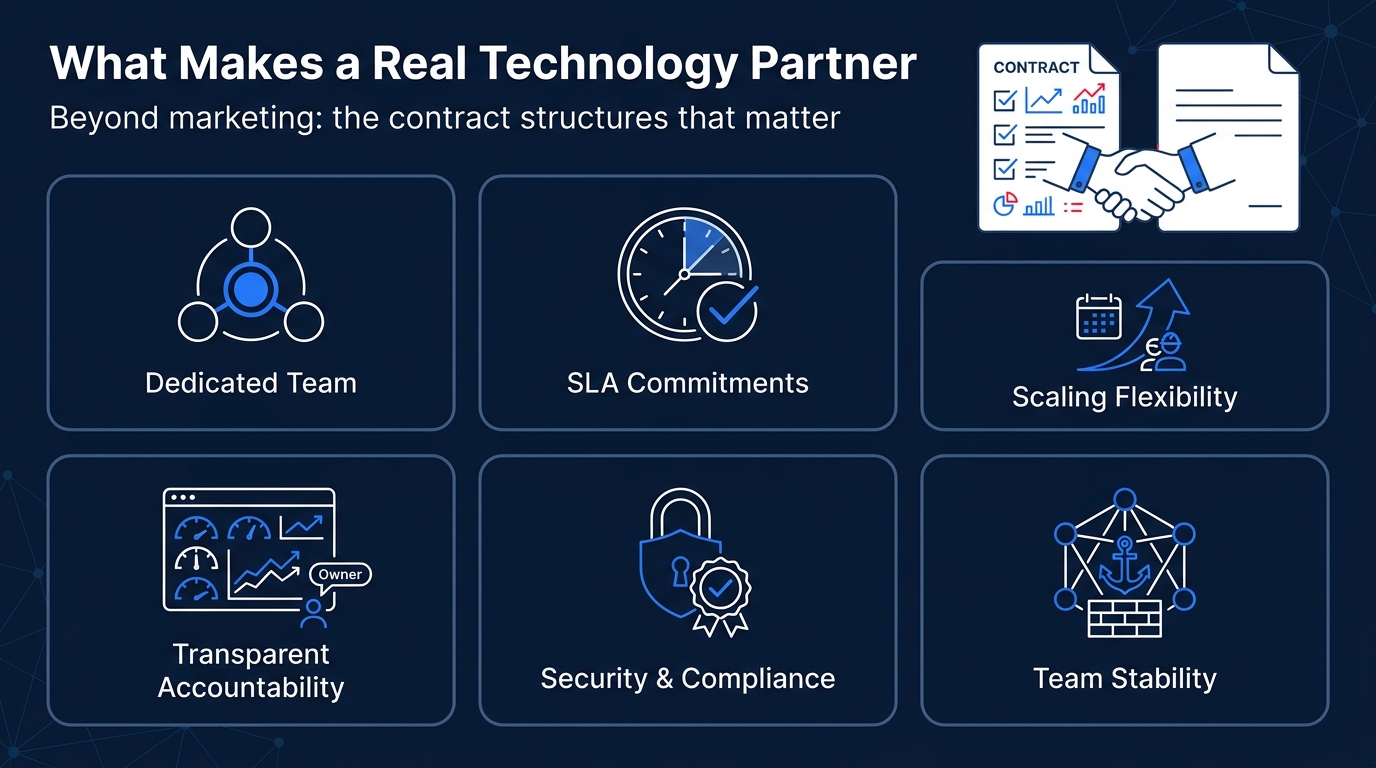
What does "long-term technology partner" actually mean in practice?
The phrase describes a structural relationship, not a sentiment. In a genuine offshore partnership, the vendor operates as an extension of the client's internal team, with shared delivery accountability rather than a hand-off-and-invoice model.
Concrete indicators that distinguish a partnership from a vendor arrangement:
Named, dedicated engineers embedded in the client's sprint cycles, communication channels, and knowledge base
Governance cadences with weekly team syncs, quarterly roadmap reviews, and named escalation contacts on both sides
Continuity mechanisms covering handover protocols, documentation standards, and knowledge transfer procedures when engineers rotate
Shared risk: the partner absorbs ramp costs, onboarding overhead, and attrition risk rather than passing them to the client per incident
Without these structural elements, "long-term partner" is positioning copy, not a delivery commitment.
What SLA commitments should an offshore partnership contract include?
An SLA (Service Level Agreement) in a software delivery context covers three distinct areas, and a contract that only addresses one is incomplete.
SLA Category | What it covers | Measurable example
|
|---|---|---|
Incident response | How fast the team acknowledges a production issue | Response within 10 minutes, 24/7 |
Availability | Support and delivery coverage across timezones | Follow-the-Sun model, 24/7 coverage |
Delivery throughput | Sprint velocity, defect rates, release cadence | Agreed story points per sprint, defect escape rate |
The incident response SLA is the most operationally critical and the most frequently underspecified. Phrases like "rapid response" or "priority support" have no legal or operational weight. The contract should name a specific window, such as under 10 minutes for P1 incidents, alongside a documented escalation matrix that identifies who is contacted, in what order, and through which channel.
A Follow-the-Sun delivery model, where the offshore team's working hours are structured to overlap with the client's timezone, reduces the practical gap between a 24/7 SLA and what the client actually experiences day to day.
How should delivery accountability be structured in an offshore contract?
Accountability fails when it is informal. The strongest offshore contracts build accountability into process design, not goodwill.
Four structural accountability mechanisms to require:
1. Transparent billing tied to actual working hours. Clients should be able to review time logs, not just invoices. Billing based on actual hours worked, with direct visibility into team activity, removes the ambiguity that erodes trust in long-term engagements.
2. Direct team health monitoring. The client should have access to delivery dashboards or reports covering utilization, sprint completion rates, and code quality metrics, rather than relying solely on the partner's own reporting.
3. Named ownership. Every engagement should have a dedicated delivery manager or tech lead on the partner side who is accountable for outcomes, not just a rotating support queue.
4. Defined ramp and ramp-down terms. A contract that cannot answer "how quickly can we scale the team, and what does it cost to reduce it?" is not a partnership contract. Pre-vetted engineers who can be onboarded in 2 to 4 weeks represent a practical commitment to flexibility.
What security and compliance standards should a long-term offshore partner hold?
Stepping back from the operational mechanics, a separate and equally important concern is whether the partner can be trusted with the data and systems they will operate over a multi-year engagement.
For clients in regulated industries, this is not a due-diligence checkbox. It is a material business risk.
Minimum compliance expectations for a long-term offshore partner:
ISO 9001: quality management processes for consistent delivery
ISO 27001:2022: information security management, updated to the current standard
SOC 2 Type II: independently audited security controls over a defined period (not a self-assessed questionnaire)
GDPR compliance: mandatory for any engagement involving EU personal data
The specific version of ISO 27001 matters. The 2022 revision introduced updated control categories for cloud security and threat intelligence that the 2013 version does not address. Partners still citing ISO 27001:2013 without a transition timeline are operating against an outdated framework.
How does team stability affect the quality of a long-term engagement?
Building on the accountability structures above, the harder question is whether the team working on the engagement today will still be there in 18 months.
Attrition is the most underestimated risk in offshore delivery. Knowledge walks out when engineers change, and re-onboarding is expensive in both time and quality. A partner with a demonstrably low attrition rate and a strong engineering culture reduces this risk structurally, not just contractually.
Indicators of team stability worth requesting before signing:
Average tenure of engineers on existing client accounts
Client retention rate (a 95% retention rate, for example, is a proxy for team continuity as much as client satisfaction)
Percentage of senior engineers on the team (a 58% senior-level composition means more institutional knowledge retained per person)
Attrition policy and replacement SLA if a key engineer does leave
Frequently Asked Questions
Q: Is a dedicated team model always better than a project-based model for long-term engagements?
For ongoing product development and support, yes. Project-based models optimise for delivery of a defined scope. Dedicated teams optimise for continuous improvement, institutional knowledge, and responsiveness, which are the attributes that make a partnership valuable over time.
Q: What does "Follow-the-Sun" actually mean in an offshore SLA?
It means the partner structures team coverage so that at least one group of engineers is active during the client's business hours, regardless of timezone. For a Singapore or US client working with a Vietnam-based team, this typically means overlapping shifts or an on-call rotation that ensures no gap in response coverage.
Q: How quickly should a genuine partner be able to scale a team?
A partner with pre-vetted engineers can scale from 1 to 50+ engineers in 2 to 4 weeks. If the answer is "it depends" without a specific range, the bench is likely not pre-qualified.
Q: What is the difference between ISO 27001:2022 and SOC 2 Type II?
ISO 27001:2022 is an international standard for building an information security management system. SOC 2 Type II is an independent audit verifying that specific security controls were operating effectively over a defined period, typically 6 to 12 months. Both are valuable; SOC 2 Type II provides stronger evidence of operational execution because it requires third-party verification.
Q: How can I monitor delivery quality without being embedded in the team?
Require transparent billing based on actual hours, access to delivery dashboards (velocity, defect rates, uptime), and a defined monthly review cadence with your dedicated delivery manager. Visibility into metrics rather than narrative reports is the clearest indicator of a partner's confidence in their own performance.
About 724SOFTWARE
724SOFTWARE is a Vietnam-based technology partner providing dedicated engineering teams, custom software development, and managed IT services for startups, SaaS companies, and enterprises across Singapore, Australia, the US, and the UK. With 200+ professionals including 58% senior-level experts, ISO 9001, ISO 27001:2022, SOC 2 Type II, and GDPR certifications, and a 95% client retention rate across 10+ countries, 724SOFTWARE operates as a long-term delivery partner in Fintech, Digital Healthcare, Edtech, and Enterprise ERP. As an official partner with Claude (Anthropic) and Cursor, the team integrates practical AI tooling into the software lifecycle to accelerate delivery without compromising quality.
If you are evaluating offshore partners and want to understand exactly what delivery commitments, SLAs, and accountability structures would look like in practice, the team at 724SOFTWARE is ready to walk through it with you. Visit https://724software.com.vn to get in touch.