

Hiring your first engineer is a milestone. Realizing that one person can no longer carry your product forward is a different kind of milestone entirely. The transition from a single engineer to a structured development team is one of the most operationally complex moments in a startup's life, and most founders walk into it underprepared. The good news: the decision of where and how to build that team matters as much as when, and a Vietnam software team has become a proven answer for startups scaling out of Singapore, Australia, and the US who need senior engineering capacity without the cost structure of onshore hiring.
TL;DR
One engineer is a ceiling, not a foundation. Knowing when you have hit that ceiling is the first skill.
The transition requires deliberate role sequencing, not just adding headcount.
A Vietnam software team offers senior-level engineers at a cost structure that preserves runway without sacrificing delivery quality.
Pre-vetted, dedicated teams can be ramped from 1 to 50+ engineers in 2-4 weeks, a window that matches post-Series A urgency .
Structure, process, and communication protocols matter more than team size when making this transition work.
About the Author: 724SOFTWARE is a Vietnam-based technology partner with 200+ professionals, 58% of whom are senior-level engineers, and a 95% client retention rate across clients in Singapore, Australia, the US, the UK, and wider APAC. The company has helped startups and SaaS companies structure their first offshore engineering teams across Fintech, Edtech, Healthcare, and Enterprise software.
What Are the Real Signs That You Have Outgrown One Engineer?
The honest signal is not headcount, it is throughput. When a single engineer is simultaneously shipping features, reviewing their own pull requests, managing infrastructure, responding to production incidents, and attending product discovery sessions, the bottleneck is structural, not motivational.
Watch for these specific warning signs:
Release cycles are slowing despite the roadmap shrinking.
Technical debt decisions are being deferred because there is no bandwidth to address them.
The engineer has become a single point of failure for deployment, architecture knowledge, or incident response.
Product and engineering conversations have collapsed into one person's judgment with no peer review.
Investor or customer commitments are at risk because delivery capacity cannot match promises
The transition is not triggered by a headcount number. It is triggered by structural fragility.
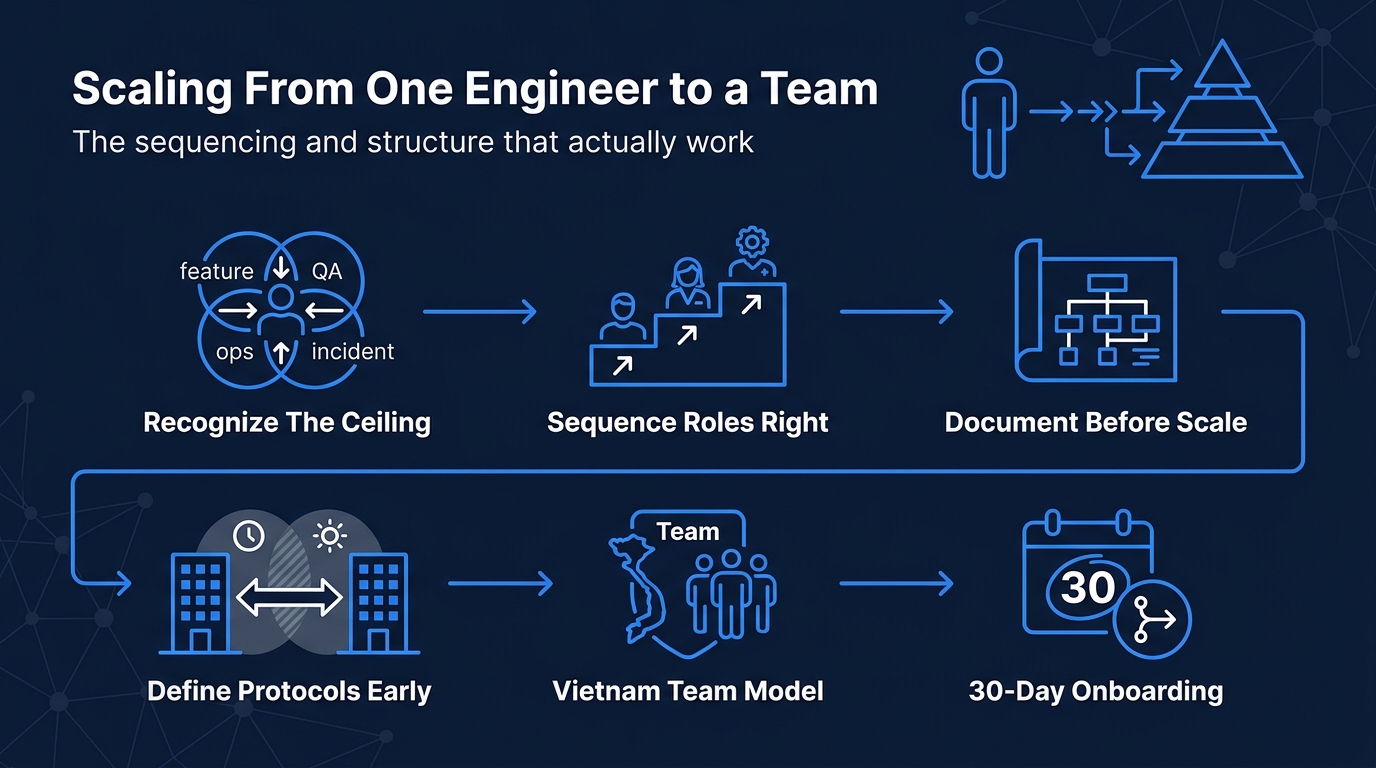
Why Does Role Sequencing Matter More Than Simply Hiring More Engineers?
Building on the fragility problem above, the instinct is to hire two or three more generalist engineers. In most cases, this is the wrong first move.
When scaling after early traction, the sequence of roles determines whether you gain leverage or just distribute the same bottlenecks across more people.
A more deliberate sequence looks like this:
Hire Order | Role | Why This, Not Another
|
|---|---|---|
1st addition | Senior engineer in your core stack | Provides peer review, lifts the ceiling on architecture decisions |
2nd addition | QA engineer or SDET | Stops you shipping broken code faster as velocity increases |
3rd addition | DevOps / Platform engineer | Removes infrastructure as a handbrake on developer output |
4th+ | Specialist or second full-stack | Fills domain gaps once the delivery foundation is stable |
Skipping QA or DevOps to add more feature developers is one of the most common and costly sequencing errors. You end up with more people producing more defects with no mechanism to catch or deploy them reliably.
What Makes a Vietnam Development Team a Practical Choice for This Transition?
Stepping back from the sequencing detail, a separate but equally important question is where to build this team. Vietnam has emerged as a serious engineering location for international startups, not because of price alone, but because of the combination of talent depth, timezone compatibility with APAC and partial overlap with Europe, and documented operational maturity through ISO 9001 and ISO 27001:2022 certifications across leading providers.
Key reasons this works for startups in transition:
Talent availability at senior level. Vietnam's engineering workforce has grown substantially, with experienced developers across full-stack, mobile, cloud, and data engineering roles.
Cost structure without quality tradeoff. Engaging a Vietnam software team costs significantly less than equivalent onshore hiring in Singapore, the US, or Australia, without requiring you to accept junior-only profiles or high attrition.
Fast ramp time. Pre-vetted dedicated teams can be assembled and integrated into your workflow in 2-4 weeks , which matches the urgency of post-funding hiring pressure.
English-fluent collaboration. Vietnam IT companies with ISO 27001:2022 and SOC 2 Type II certifications operate in English as a default working language, with some, like 724SOFTWARE, also supporting Mandarin, Korean, and Japanese for APAC-headquartered clients.
The important distinction for startups is between a Vietnam software team structured as a dedicated extension of your product organization versus ad hoc freelance contractors. The latter creates coordination overhead and knowledge fragmentation that negates most of the cost benefit.
How Should You Structure the Transition Operationally?
A related but distinct question is how the handoff actually works in practice when you move from one engineer to a structured team. The founding engineer holds implicit knowledge: architecture decisions, why certain shortcuts were taken, which integrations are fragile, and where the undocumented edge cases live.
Before adding headcount, do this groundwork:
Document the critical path. Have your existing engineer produce a system map, deployment runbook, and a list of known technical debt items. This is non-negotiable.
Define team communication protocols upfront. Async-first or sync-heavy? Daily standups or written status updates? Resolving this before the team grows avoids confusion as new engineers join.
Choose a clear point of contact on both sides. A team lead or senior engineer on the offshore side who owns communication with your internal stakeholders prevents the "lost in translation" problem.
Set a 30-day onboarding target. New engineers joining a structured Vietnam software team should be committing to production within 30 days. If that is not happening, the onboarding process, not the engineers, is the problem.
Agree on incident response standards before the first incident. If you are working with a partner that operates a follow-the-sun model with a guaranteed response time under 10 minutes, write that into the operating agreement from day one.
Frequently Asked Questions
How many engineers do most startups need at the Series A transition point?
There is no universal number, but the sequencing logic in source suggests starting with 2-3 carefully chosen roles (senior engineer, QA, DevOps) rather than a large cohort. Quality of the first additions matters more than total headcount.
Can a Vietnam development team work effectively with a Singapore or US-based founding team?
Yes, with deliberate process design. Timezone overlap between Vietnam and Singapore is near-complete. With the US, async workflows and clear documentation practices close most of the gap.
What is the difference between a dedicated team and a freelancer arrangement?
A dedicated team is embedded in your workflow, operates under your processes, and builds institutional knowledge over time. Freelancers deliver tasks and move on. For a startup building a product, the former is the right model.
How quickly can a structured Vietnam software team actually be onboarded?
With a provider that maintains a bench of pre-vetted engineers, the realistic window is 2-4 weeks from contract to first active sprint.
What security and compliance standards should I require from an offshore engineering partner?
At minimum, ISO 27001:2022 for information security management and SOC 2 Type II for operational controls. If you are in Fintech or Healthcare, GDPR compliance is also relevant depending on your user base.
What is the most common mistake founders make during this transition?
Hiring for speed rather than sequencing. Adding three generalist engineers when you needed one senior engineer and a QA lead is a common and expensive error.
Should the founding engineer lead the new team?
Not automatically. A technically strong founding engineer is not always the right team lead. Assess honestly whether they have the process and communication skills the role requires before assigning it.
About 724SOFTWARE
724SOFTWARE is a Vietnam-based technology partner providing dedicated engineering teams, custom software development, and managed IT services to startups, SaaS companies, and enterprises across Singapore, Australia, the US, the UK, and wider APAC. With 200+ professionals, 58% at senior level, and a 95% client retention rate, the company works with clients as a long-term partner in building and operating digital products. 724SOFTWARE holds ISO 9001, ISO 27001:2022, SOC 2 Type II, and GDPR compliance certifications, and is an official partner with Claude (Anthropic) and Cursor, integrating generative AI into the software delivery lifecycle to accelerate output by approximately 30%.
Ready to move from a solo hire to a team that can actually carry your product forward? Visit 724SOFTWARE to talk through what a structured Vietnam development team looks like for your stage and stack.